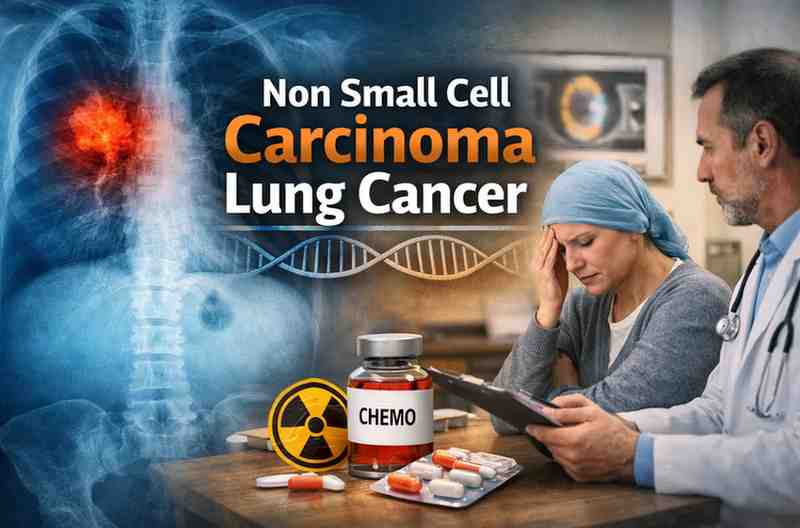
Honestly… the first time someone close to me heard the words Non Small Cell Carcinoma Lung Cancer, the reaction wasn’t dramatic.
It was quieter than that.
A long pause.
A blank stare.
Then the same question I’ve heard dozens of times since.
“What does that even mean?”
Because the phrase sounds clinical. Almost distant.
But what I’ve seen — again and again — is that once people start unpacking what Non Small Cell Carcinoma Lung Cancer really involves, the confusion quickly turns into something else:
Fear.
Decision fatigue.
Information overload.
Families start Googling at 2AM.
Patients bounce between hope and dread depending on the article they read.
And strangely… many people feel like they’re the only ones struggling to make sense of it.
They’re not.
From what I’ve seen watching patients, caregivers, and even doctors navigate this, the real challenge isn’t just the cancer itself.
It’s understanding what actually matters next.
Not theory.
Real decisions.
Real timelines.
Real expectations.
So let’s talk about what this disease actually looks like in the real world — the parts that medical pages often gloss over.
What Non Small Cell Carcinoma Lung Cancer Actually Means
Most people assume lung cancer is one single disease.
It’s not.
There are two major types doctors talk about:
• Small Cell Lung Cancer (SCLC)
• Non Small Cell Lung Cancer (NSCLC)
And here’s the important part:
Non Small Cell Carcinoma Lung Cancer accounts for about 85% of all lung cancer cases.
So when doctors say NSCLC, they’re talking about the majority of lung cancer diagnoses.
But even that category is still a mix of different cancers.
The three main subtypes doctors usually identify are:
1. Adenocarcinoma
This is the one I’ve seen most frequently.
It often appears in:
• Non-smokers
• Former smokers
• Younger patients than people expect
It tends to grow slower than some other types.
Which sounds reassuring… but it can also mean symptoms stay subtle for a long time.
2. Squamous Cell Carcinoma
This one historically shows up more often in long-term smokers.
It usually forms in the central parts of the lungs near the airways.
Symptoms sometimes appear earlier because of that location.
3. Large Cell Carcinoma
Less common.
But often more aggressive.
Doctors sometimes struggle to classify it clearly at first, which can make early treatment decisions a bit complicated.
One thing that surprised me after watching multiple diagnoses unfold:
Most patients never hear these subtype explanations during the first appointment.
That first visit is usually packed with shock, scans, and next steps.
Understanding comes later.
Sometimes weeks later.
Why So Many Cases Get Diagnosed Late
This part honestly frustrates a lot of people →.
And I get why.
Because the early symptoms of Non Small Cell Carcinoma Lung Cancer can look like everyday health issues.
Things people ignore for months.
Or longer.
The patterns I’ve seen again and again include:
• A cough that never quite goes away
• Shortness of breath that slowly worsens
• Chest discomfort that feels like muscle strain
• Fatigue that people blame on stress or aging
• Repeated “bronchitis” diagnoses
One man I watched go through this cycle kept getting antibiotics for almost six months.
He thought it was recurring infection.
It wasn’t.
This is one of the most common early misreads I’ve seen.
Not negligence.
Just how subtle early symptoms can be.
The Moment Everything Changes: Diagnosis
The diagnosis stage is chaotic.
That’s the honest word.
Most patients I’ve seen go through a similar whirlwind:
-
CT scan
-
Biopsy
-
PET scan
-
Genetic testing
-
Staging
And every step raises new questions.
From what I’ve seen, the biggest emotional shift happens when staging gets discussed.
Because stage determines almost everything about treatment options.
Doctors classify NSCLC into stages:
• Stage 1 — localized tumor
• Stage 2 — local spread
• Stage 3 — regional lymph node involvement
• Stage 4 — metastasis to other organs
And this is where people often panic.
But something I’ve noticed repeatedly:
Even Stage 4 lung cancer doesn’t mean the same thing today that it meant 10–15 years ago.
Treatments have changed more than many people realize.
Treatment Paths: What I’ve Seen Work (and Where Reality Hits)
Most people expect one simple treatment path.
But NSCLC treatment is actually more like a branching tree.
Doctors usually consider:
• Stage
• Tumor location
• Genetic mutations
• Patient health
• Spread to other organs
And those factors decide what comes next.
Surgery (When the Cancer Is Found Early)
For Stage 1 or some Stage 2 cancers, surgery is often the first line of treatment.
Doctors may remove:
• A small lung segment
• A lobe of the lung
• Rarely an entire lung
From what I’ve seen, recovery surprises people.
Most expect breathing to be permanently worse.
But many patients adapt better than expected.
The lungs are incredibly resilient.
Still — the emotional adjustment can take longer than the physical one.
Radiation Therapy
Radiation is often used when surgery isn’t possible.
Either because of:
• Tumor location
• Patient health
• Advanced stage
Some modern radiation techniques are surprisingly precise.
One oncologist once described it like “sniping cancer cells.”
But patients still feel fatigue from it.
That part rarely gets mentioned enough.
Chemotherapy
Chemotherapy is still widely used.
But one pattern I’ve noticed:
People expect chemotherapy to be the worst part.
Sometimes it is.
But increasingly, it’s not the only option anymore.
Targeted Therapy (This Is Where Things Changed)
Honestly, this is the area that surprises patients the most.
Modern lung cancer treatment often includes genetic testing of the tumor.
Doctors look for mutations like:
• EGFR
• ALK
• ROS1
• KRAS
• BRAF
If a mutation exists, patients may receive targeted therapy drugs.
And I’ve seen people go from severe symptoms to normal daily life within weeks.
Not everyone qualifies.
But when they do, the response can be dramatic.
Immunotherapy
This treatment basically helps the immune system recognize and attack cancer cells.
Some patients respond incredibly well.
Others… not so much.
That unpredictability is something doctors are still studying.
The Mistakes I See Families Make Early
Almost everyone I’ve watched go through this makes a few predictable mistakes.
Not because they’re careless.
Because the situation is overwhelming.
The big ones:
Trying to Understand Everything Immediately
People want answers the same week as diagnosis.
But honestly… treatment plans often evolve over several appointments.
Rushing understanding just creates more anxiety.
Ignoring Genetic Testing
Some patients don’t realize how critical tumor mutation testing can be.
It often determines the entire treatment path.
Trusting the First Treatment Plan Without Question
This is controversial, but I’ll say it anyway.
Second opinions matter.
Especially for cancer.
Most oncologists expect them.
And good ones encourage them.
How Long Treatment Usually Takes (Realistic Timeline)
One question comes up constantly:
“How long does this treatment take?”
From what I’ve seen, it varies a lot.
But typical patterns look like:
Diagnosis phase: 2–4 weeks
Initial treatment plan: 1–2 months
Ongoing treatment cycles:
• Chemotherapy → 3–6 months cycles
• Targeted therapy → long-term medication
• Immunotherapy → often every few weeks
Some patients live with stable disease for years.
That used to be rare.
It’s becoming more common now.
Common Questions People Ask (Quick Answers)
Is Non Small Cell Carcinoma Lung Cancer curable?
Sometimes.
If detected early and surgically removed, many patients achieve long-term remission.
Later stages focus more on control and life extension.
Can non-smokers get it?
Yes.
And it happens more often than people think.
Adenocarcinoma especially appears in non-smokers.
How fast does it spread?
It depends on subtype and genetics.
Some tumors grow slowly.
Others progress quickly.
That’s why doctors monitor closely with scans.
Is treatment always chemotherapy?
No.
Targeted therapy and immunotherapy have changed treatment dramatically.
Many patients now avoid traditional chemotherapy entirely.
Objections I Hear All the Time
“Treatment sounds worse than the cancer.”
I’ve heard this from many patients.
And yes — some treatments are rough.
But newer therapies are often far more tolerable than people expect.
“I’m too old for treatment.”
Age alone usually doesn’t disqualify someone.
Doctors care more about overall health and organ function.
“Nothing works for lung cancer anyway.”
This belief is outdated.
Survival rates have improved significantly in the last decade because of targeted drugs and immunotherapy.
The Reality Check Most People Need
I’ve watched enough cases unfold to know something important:
There’s no universal lung cancer story.
Some patients respond incredibly well to treatment.
Others face tougher roads.
And that unpredictability can be emotionally exhausting.
But one pattern keeps showing up.
Patients who stay engaged in decisions…
Ask questions…
And build strong care teams…
Tend to navigate the journey with more clarity and less regret.
Not necessarily easier.
Just clearer.
Practical Takeaways I Wish People Heard Earlier
If someone you love is facing Non Small Cell Carcinoma Lung Cancer, a few things consistently help:
1. Don’t skip mutation testing
It can completely change treatment options.
2. Consider a major cancer center consultation
Even if treatment happens locally.
3. Focus on the next step, not the entire road
Trying to mentally map years ahead usually overwhelms people.
4. Protect emotional energy
Cancer discussions quickly become all-consuming.
Patients need normal moments too.
5. Accept uncertainty
This is probably the hardest one.
But lung cancer treatment today is evolving fast.
Which means outcomes are less predictable — sometimes in good ways.
I’ve watched people walk into diagnosis appointments convinced their life was essentially over.
And months later they’re adjusting to a completely different reality.
Managing treatment.
Planning trips again.
Returning to work.
So no… Non Small Cell Carcinoma Lung Cancer isn’t a simple battle.
And it definitely isn’t something anyone would choose.
But I’ve seen enough unexpected recoveries, stabilizations, and small victories to know something that doesn’t show up in statistics very well.
Sometimes progress in medicine moves quietly.
Until suddenly it’s the reason someone gets years they didn’t expect.
And those years… end up mattering more than anyone imagined.