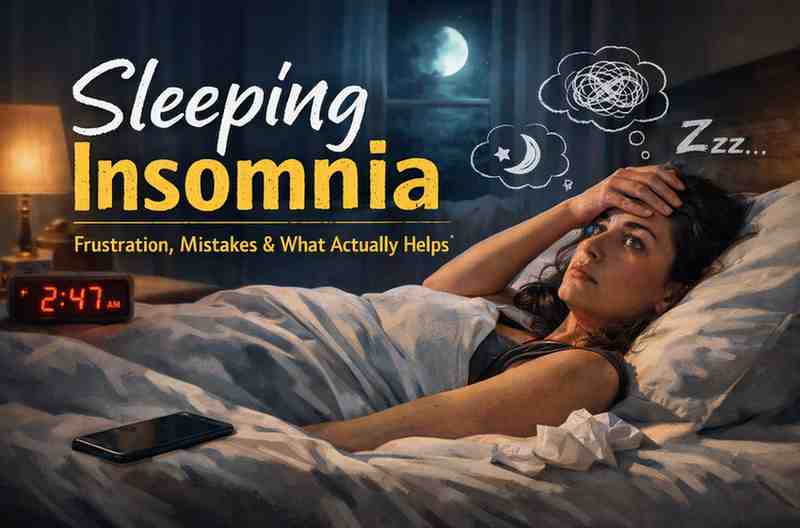
Honestly, most people I’ve watched wrestle with sleeping insomnia hit a wall in the first two weeks. They go to bed hopeful. Then they lie there, eyes closed, mind loud. After a few nights, the hope thins out. By night six or seven, they start wondering if something is broken in them.
I’ve sat with friends on couches at 2 a.m. I’ve read long messages from coworkers who were sure they’d “tried everything.” I’ve helped people test routines, ditch routines, try again. From what I’ve seen →, the pain isn’t just the lack of sleep. It’s the quiet spiral: Why is this so easy for everyone else? Why can’t I do the one thing my body is supposed to do?
Sleeping insomnia isn’t one neat problem. It’s a messy loop of habits, fear, timing, and the stories people tell themselves after a few bad nights. That’s where most folks get stuck.
Why people try to “fix” sleeping insomnia (and what they usually misunderstand)
From what I’ve seen →, people don’t start chasing sleep hacks because they love optimization. They start because life feels harder when you’re tired.
-
Parents who can’t fall asleep after finally getting the house quiet.
-
Night-shift folks whose bodies never fully flip back.
-
High performers who can sleep on weekends but panic on weeknights.
-
People who had one rough month and now live in fear of the bed →.
What most people misunderstand at first:
-
They think sleep is a switch. Off/On. It’s not. It’s a slow drift.
-
They chase tools instead of patterns. Blue-light glasses, supplements, apps. Sometimes helpful. Often not the core issue.
-
They try to force calm. That backfires. The body reads “force” as pressure.
This honestly surprised me after watching so many people try it: the more someone tries to sleep, the worse the insomnia loop gets. Not always. But often.
The patterns that show up again and again
I’m not diagnosing anyone. I’m just naming what I’ve watched play out across a lot of real lives.
1) The bed becomes a stress trigger
Almost everyone I’ve seen struggle with this does this one thing wrong:
They use the bed as a planning desk, a doom-scrolling station, a mini office. Then they expect their nervous system to suddenly relax there.
What happens:
-
Bed = place of stress + thinking
-
Night comes
-
Body remembers
-
Sleep gets harder
2) “Revenge bedtime” is real
People stay up late → to reclaim control. One more episode. One more scroll.
Then morning hits. The cycle tightens.
This is emotional, not logical.
People know it costs them sleep.
They still do it because it feels like freedom.
3) Weekend sleep whiplash
Sleep in two hours on Saturday.
Stay up late.
Sunday night becomes a fight.
Monday feels brutal.
From what I’ve seen, this single habit keeps a lot of people → stuck for months.
4) The panic spiral
A few bad nights → fear of another bad night → hyper-awareness in bed → worse sleep.
This is where insomnia starts to feel personal.
People don’t just want sleep.
They want proof they’re okay.
5) Copy-paste routines that don’t fit real life
“Just meditate for 20 minutes, no screens, drink tea, journal, read, stretch.”
Looks good on paper.
Most people I’ve worked with mess this up at first because their nights aren’t calm enough to fit a perfect routine.
What works better is messy consistency, not perfection.
What consistently works (and what repeatedly fails)
No miracle stuff here. Just patterns I’ve seen help more often than not.
What tends to work
1) Reducing pressure around sleep
People sleep better when they stop grading each night.
Simple shifts I’ve seen help:
-
“I’m resting my body.” (not “I must sleep now”)
-
Lying down with the goal of being comfortable, not unconscious
-
Accepting that some nights will be lighter
That shift alone has helped people sleep more.
2) Anchoring mornings before fixing nights
This surprised me after watching so many people try to fix nights first.
What works better:
-
Same wake time (even after a bad night)
-
Morning light in the eyes
-
Some movement, even a short walk
Night routines help.
Morning anchors stabilize the system.
3) Narrow, realistic routines
Not 10 steps.
2–3 repeatable actions.
From what I’ve seen:
-
Same wind-down cue each night (shower, dim lights)
-
Phone parked away from the bed
-
One low-stimulation activity (paper book, soft music)
People stick to small routines.
They abandon big ones.
4) Untangling “awake in bed” from “failure”
This is subtle.
But powerful.
When people stop treating wakefulness as a threat, sleep often follows more easily later.
5) Tracking patterns, not nights
One bad night means nothing.
Three weeks of trends mean something.
People who zoom out emotionally tend to stabilize faster.
What repeatedly fails
-
Forcing sleep with willpower
-
Switching methods every two nights
-
Doom-Googling at 1 a.m.
-
Comparing to people who “sleep anywhere”
-
Expecting linear progress
Most folks quit right before things start to loosen.
How long does it take (for most people)?
Direct answer, based on what I’ve seen:
-
First 3–7 days: Frustration usually spikes. People think it’s not working.
-
Weeks 2–3: Small wins show up. Falling asleep a bit faster. Less panic.
-
Weeks 4–6: Patterns stabilize. Not perfect. But less scary.
-
After 2–3 months: Many people stop thinking about sleep all day.
Not everyone follows this timeline.
Some people take longer.
Some notice changes sooner.
What slows results:
-
Inconsistent wake times
-
Late caffeine
-
Expecting fast fixes
-
Treating every bad night as a reset
“Is this worth it?” (the honest version)
Worth it for:
-
People who are tired of chasing hacks
-
Folks willing to tolerate some discomfort at first
-
Anyone ready to change mornings, not just nights
Probably not worth it for:
-
People who want instant results
-
Anyone who needs perfect sleep right now for a major life event
-
Folks who aren’t ready to let go of late-night scrolling yet
This isn’t glamorous.
It’s boring.
And it works more often than flashy stuff.
Common mistakes I keep seeing
-
Trying five new sleep tips in one week
-
Sleeping in after a bad night
-
Drinking caffeine later than you think
-
Turning the bed into a thinking zone
-
Lying awake and blaming yourself
Almost everyone I’ve seen struggle with this does at least two of these at first.
It’s normal.
Just don’t camp there.
Short FAQ (for quick answers)
Does sleeping insomnia mean something is wrong with me?
From what I’ve seen, no. It usually means your system learned some unhelpful patterns. Patterns can be unlearned.
Should I stay in bed if I can’t sleep?
Depends. Many people do better stepping out briefly when frustration → spikes, then returning once calmer.
Do supplements help?
Sometimes. But they don’t fix the loop by themselves. I’ve seen people → use them as a crutch and still feel stuck.
Is it okay to nap?
Short naps can help some people. Long or late naps often make nights harder.
Objections I hear a lot (and the grounded responses)
“I’ve tried all of this already.”
Most people have tried versions of it. Few have stuck with a simple plan long enough to see patterns change.
“My insomnia is different.”
Parts of it might be. But the fear-pressure-loop shows up in almost everyone I’ve watched.
“I don’t have time for routines.”
You don’t need a ritual. You need two repeatable cues your body can recognize.
“I need my phone to relax.”
Totally get it. Just know it often teaches your nervous system to stay alert. That’s the tradeoff.
Reality check (what can go wrong)
Let’s be honest about limits.
-
Some people have underlying medical or mental health stuff that needs professional support. This approach alone may not be enough.
-
Progress isn’t linear. A good week doesn’t guarantee the next week.
-
You might feel worse before you feel better. Less sleep pressure can feel scary at first.
-
Life events can knock progress sideways. Travel, stress, illness. It happens.
This isn’t magic.
It’s pattern work.
Practical takeaways (no hype, just usable)
What to do
-
Fix wake time first
-
Create one calm cue before bed
-
Park the phone away from the pillow
-
Track trends, not single nights
-
Treat rest as success, even without sleep
What to avoid
-
Sleeping in to “make up” for nights
-
Overhauling your routine every week
-
Reading scary sleep forums at night
-
Judging yourself for being awake
What to expect emotionally
-
Frustration early
-
Doubt around week two
-
Small relief before big change
-
Fewer panic spirals over time
What patience actually looks like
-
Repeating boring things
-
Letting go of perfect nights
-
Trusting patterns over feelings
-
Showing up for mornings even when tired
Some nights will still be messy.
That’s normal.
From what I’ve seen, the real shift happens → when people stop treating sleeping insomnia like a personal failure and start seeing it as a loop they can slowly loosen.
So no — this isn’t magic.
But I’ve watched enough people finally stop feeling trapped once they approached it this way. Sometimes that quiet relief is the real win.