Honestly, I used to hate people who said they only needed five hours of sleep. Not in a dramatic way. Just… quiet resentment. I’d be wrecked on seven, dragging myself through mornings like a zombie with coffee breath, and then I’d hear, “Yeah, I’m good on five.” Cool story, superhuman.
Not gonna lie… it messed with my head.
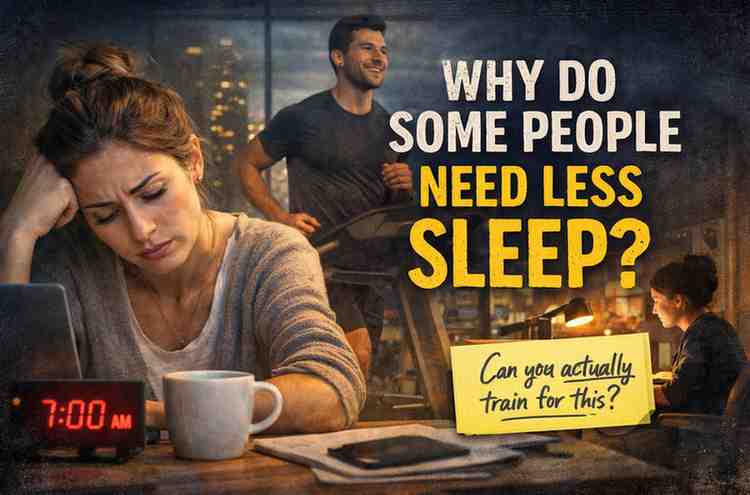
I kept asking why do some people need less sleep and whether I was broken for not being one of them. I tried to become one of them. That part? Yeah, I messed this up at first. Multiple times. I chased the idea of needing less sleep because it sounded efficient. Powerful. Like I could squeeze more life out of the same 24 hours.
What I learned instead was uncomfortable, humbling, and weirdly relieving.
This isn’t a neat guide. It’s what I learned by failing at sleep hacks, watching friends burn out, and slowly accepting my own limits.
The first lie I bought into: “Some people just need less sleep, so I should train myself”
I started with the obvious stuff.
Alarms earlier.
Late-night screens off (okay, mostly).
Caffeine “strategically.”
Those viral routines that swear you can rewire your body in two weeks.
Here’s what happened:
-
Week 1: adrenaline + novelty. I felt sharp.
-
Week 2: cranky, wired-tired.
-
Week 3: brain fog. I snapped at people I like.
-
Week 4: I couldn’t remember simple words. Not even joking.
I kept thinking I was “almost there.” That my body would catch up.
It didn’t.
What surprised me?
I wasn’t just tired. I was worse at being myself. Less patient. Less creative. More anxious. I felt smaller inside. That’s when I realized: trying to need less sleep isn’t the same as being someone who actually needs less sleep.
There’s a difference between forcing deprivation and naturally functioning well on less. I learned that the hard way →.
So… why do some people need less sleep (and why most of us don’t)
From what I’ve seen, there are a few buckets. None of them are sexy life hacks.
1. The genetic unicorns (rare, and not you… probably)
There are people who are wired differently. Their brains recover faster during sleep. They cycle through sleep stages more efficiently.
They wake up clear-headed on 5–6 hours and stay emotionally stable all day.
Here’s the uncomfortable part:
You can’t train into this group.
I tried to convince myself I was one of them because I had “good days” on short sleep. But good days don’t count. Consistent functioning does.
If you’re:
-
moody
-
foggy
-
craving sugar
-
zoning out
-
making dumb mistakes
…you’re not a short sleeper. You’re just running on fumes.
2. The “I’m fine” people who actually aren’t fine
This one hit close to home.
Some folks genuinely believe they need less sleep because they’ve normalized feeling off.
They’ll say:
-
“I’ve always been like this.”
-
“Coffee fixes it.”
-
“I sleep when I’m dead.”
But watch them closely:
-
micro-mistakes
-
emotional hair-trigger
-
weird memory gaps
-
constant low-grade stress
From what I’ve seen, at least, they’re surviving. Not thriving.
I was this person for a while. I called it “discipline.”
It was actually denial.
3. Life stage illusions (stress can fake energy)
There were periods where I slept less and felt wired in a good way.
New job.
Big goal.
Fresh relationship.
That wasn’t because I needed less sleep.
That was cortisol and novelty doing the heavy lifting.
When the excitement faded, the sleep debt showed up like a bill I forgot to pay. Headaches. Anxiety. Random sadness. My body always collected.
4. People with ultra-tight routines (boring, but it works)
Some people seem like they need less sleep, but what they really have is:
-
strict sleep windows
-
consistent wake times
-
low alcohol
-
predictable meals
-
movement most days
-
light exposure in the morning
They’re not sleeping less because they’re superhuman.
They’re sleeping better in less time.
This honestly surprised me.
When I cleaned up my routine (not perfectly, but better), I didn’t suddenly thrive on five hours. But I stopped needing nine.
That’s a different thing.
What I misunderstood about “needing less sleep”
I thought the goal was to reduce hours.
The real goal is to increase quality.
I chased numbers.
I should’ve chased how I felt at 2 PM on a normal day.
Here’s what didn’t work for me:
-
Forcing early alarms without consistent bedtimes
-
“Powering through” tiredness
-
Late caffeine to mask sleep debt
-
Weekend sleep binges to “reset”
-
Blue light filters as an excuse to stay on screens
What actually helped (slowly, annoyingly):
-
Same wake time, even on weekends
-
Morning sunlight (boring advice, annoying how well it works)
-
No caffeine after early afternoon
-
A stupidly simple wind-down routine
-
Not eating heavy food late
None of this made me a five-hour sleeper.
It made me a functional seven-hour sleeper. Big difference.
The part no one tells you: sleeping less has a personality cost
This one caught me off guard.
When I cut sleep, I didn’t just lose energy.
I lost:
-
humor
-
empathy
-
curiosity
-
emotional range
I became more rigid. More reactive.
From what I’ve seen, at least, people who “need less sleep” tend to be naturally steady. When I tried to imitate their sleep patterns, I became a worse version of myself.
That was my line in the sand.
If a habit gives you more hours but makes you harder to live with?
Not worth it. For me, anyway.
Mini stories I wish I’d listened to earlier
The startup friend
Slept 4–5 hours for two years. Built something cool. Also developed panic attacks. He’s sleeping 8 hours now and says he wishes he’d protected his sleep earlier. He didn’t “need less sleep.” He paid for less sleep later.
The gym rat who bragged about 5 hours
Looked unstoppable. Then he plateaued hard. Injuries. Mood swings. He finally admitted he felt “wired and empty.” Sleep fixed → half of it.
The one actual short sleeper I know
She sleeps 5.5 hours. Wakes up bright. No coffee. No crashes.
She doesn’t try to convince anyone else to copy her. That’s how I knew it was real.
Common mistakes that made everything worse
I hit most of these. Maybe you’re hitting one right now.
-
Confusing tolerance with need
You can tolerate short sleep for a while. That doesn’t mean you need less. -
Using caffeine as a sleep substitute
This just delays the crash. It doesn’t remove it. -
Assuming productivity = success
Being busy while slowly hollowing out isn’t winning. -
Ignoring emotional signals
Irritability is data. Numbness is data. Don’t ignore them. -
Thinking discipline beats biology
This one stung. Willpower doesn’t outmuscle physiology forever.
FAQ-style quick answers (for the stuff people actually ask)
Do some people really need less sleep?
Yeah. A small percentage. They function well, consistently, without crashes or mood issues.
How can I tell if I’m one of them?
If you feel sharp, emotionally steady, and energized most days on 5–6 hours for months… maybe. If you’re cranky, foggy, or reliant on caffeine? Probably not.
Can I train myself to need less sleep?
You can improve sleep quality. You can’t change your genetic sleep need.
How long does it take to see benefits from better sleep habits?
For me, a couple weeks to feel small changes. A couple months for it to feel stable.
Is sleeping less worth trying?
Only if your sleep quality is already solid and you’re curious. Not if you’re already exhausted.
Objections I had (and what changed my mind)
“I don’t have time to sleep more.”
I said this a lot. Then I looked at my screen time. Oof.
“I feel fine on five hours.”
Cool. How do you feel at 3 PM? How’s your patience? Your memory? Be honest.
“I’ll sleep more when life calms down.”
Life doesn’t calm down on its own. You either protect sleep or trade it for something else.
“Other people do it, so I should be able to.”
Comparison almost wrecked my health. Different bodies. Different costs.
Reality check (the unglamorous part)
This isn’t for everyone.
Trying to sleep less is a bad idea if you:
-
have anxiety issues that worsen with fatigue
-
struggle with mood regulation
-
are in intense physical training
-
are recovering from burnout
-
are already underslept
-
rely on precision or safety in your work
Results can be slow.
You might clean up your routine and still need 7–8 hours.
That’s not failure. That’s information.
What can go wrong:
-
you feel wired but hollow
-
you mistake stress hormones for energy
-
your relationships take small hits
-
your immune system gets weird
-
you normalize being half-present
Not dramatic. Just… quietly costly.
Experience-driven patterns I noticed over time
From what I’ve seen, at least:
-
People who truly need less sleep don’t brag about it.
-
People chasing less sleep are usually chasing control.
-
Better sleep quality shrinks sleep needs a little, not a lot.
-
The cost of sleep debt shows up emotionally before physically.
-
“One bad night” doesn’t matter. Chronic short sleep does.
I didn’t expect that at all:
When I stopped trying to optimize sleep hours and focused on protecting sleep quality, my days felt longer anyway. My brain worked faster. Decisions took less effort. Time felt less slippery.
That was the win.
Practical takeaways (no hype, just what I’d tell a friend)
What to do:
-
Lock in a consistent wake time
-
Get morning light on your face
-
Cut caffeine earlier than you think you need to
-
Build a boring wind-down ritual
-
Track how you feel at midday, not just in the morning
What to avoid:
-
Competing with “short sleepers”
-
Forcing early alarms without sleep quality
-
Using stimulants to pretend you’re fine
-
Treating sleep like wasted time
What to expect emotionally:
-
initial frustration
-
some FOMO
-
weird relief when you stop fighting your body
-
better moods before better productivity
What patience looks like:
-
weeks, not days
-
small improvements
-
fewer crashes
-
more even energy
No guarantees.
No miracle claims.
Just… less friction with yourself.
One last honest thought
I went into this wanting to be the person who needed less sleep.
What I became instead was someone who stopped fighting their biology.
So yeah—why do some people need less sleep?
Because they’re wired that way, or because their routines are tight, or because stress is masking the bill for now.
But most of us?
We don’t need less sleep.
We need better sleep.
And we need permission to stop pretending we’re built like someone else.
So no—this isn’t magic.
But for me? It stopped feeling like a personal failure.
And that tiny shift made the whole thing lighter.