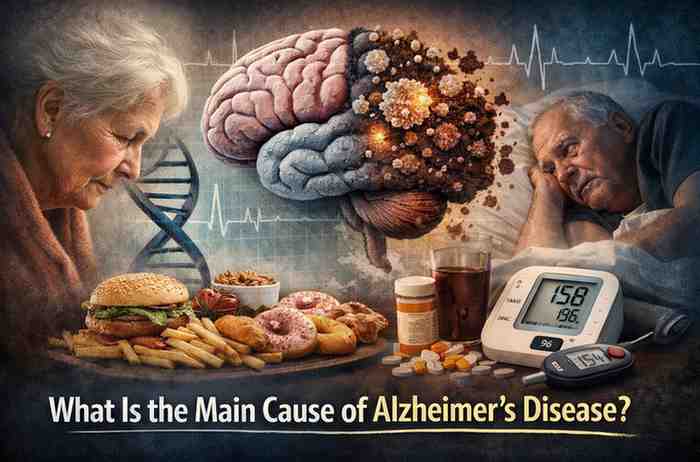
I’ve sat in too many living rooms where someone whispers, “We just want to know what caused this.”
Usually it’s a daughter. Sometimes a husband who still sets two coffee mugs out by habit. And almost every time, they’re asking the same thing in different words:
What is the main cause of Alzheimer’s disease?
They want one clear reason. One mistake. One thing they could have fixed earlier.
From what I’ve seen → across families, neurologist visits, caregiver support groups, and long after the diagnosis settles in — the hardest part isn’t just the memory loss.
It’s the uncertainty.
And here’s the uncomfortable truth most people → aren’t prepared for:
There isn’t one single cause.
But there is a pattern.
And once you see it, things start making more sense.
The Short Answer (For the People Who Just Need It Straight)
The main biological driver of Alzheimer’s disease is the buildup of amyloid-beta plaques and tau tangles in the brain, which slowly damage and kill brain cells.
But that’s not the full story.
Those buildups don’t happen randomly. They’re influenced by:
-
Genetics (especially the APOE-e4 gene variant)
-
Age (the biggest risk factor)
-
Vascular health
-
Metabolic health
-
Chronic inflammation
-
Sleep quality
-
Lifestyle patterns over decades
It’s rarely just one thing.
It’s accumulation.
And honestly, that surprises a lot of people.
What Families Usually Think the Cause Is (And Why That’s Incomplete)
Most people I’ve worked with fall into one of these camps at first:
-
“It runs in our family. It’s purely genetic.”
-
“It’s just old age.”
-
“It was stress.”
-
“It was sugar.”
-
“It was that surgery.”
-
“It was the statins.”
They’re looking for a clean villain.
From what I’ve seen, genetics matters. Aging matters. But neither acts alone.
And this is where it gets nuanced.
Age Is the Biggest Risk Factor — But Not the Root Cause
Let’s be clear.
The strongest risk factor for Alzheimer’s in the United States is age.
Most cases happen after 65.
Risk doubles roughly every five years after that.
But aging itself doesn’t “cause” Alzheimer’s.
What aging does:
-
Reduces the brain’s ability to clear amyloid protein
-
Weakens blood-brain barrier integrity
-
Increases inflammation
-
Slows repair mechanisms
-
Compounds decades of vascular wear
Think of aging as the soil.
The disease grows in it — but the seeds were planted earlier.
That distinction matters.
The Biological Core: Amyloid and Tau (Why They Matter)
If we strip it down biologically, Alzheimer’s disease is associated with two main protein abnormalities:
1. Amyloid-Beta Plaques
Sticky protein fragments that clump between brain cells.
These:
-
Disrupt cell communication
-
Trigger immune responses
-
Promote inflammation
-
Interfere with synapses
2. Tau Tangles
Twisted fibers inside neurons.
Tau normally stabilizes cell structure.
When it misfolds, it collapses transport systems inside neurons.
Cells die.
Memory fades.
Judgment shifts.
Personality changes.
That’s the biological layer.
But here’s what most people miss:
Amyloid buildup can begin 15–20 years before symptoms.
Which means Alzheimer’s isn’t a sudden event.
It’s a slow process.
And that’s where lifestyle intersects.
The Genetic Piece (And What It Actually Means)
Families get very tense around genetics.
Especially when someone hears about the APOE-e4 gene.
Let’s ground this.
If someone carries one copy of APOE-e4:
Their risk increases.
Two copies:
Higher risk still.
But I’ve seen families panic after 23andMe results as if it’s destiny.
It isn’t.
Plenty of APOE-e4 carriers never develop Alzheimer’s.
Plenty without it do.
Genetics loads the gun.
Environment pulls the trigger.
And sometimes — it doesn’t.
That uncertainty is hard.
But it’s real.
What Consistently Shows Up in Real-World Cases
Across patterns I’ve seen, certain themes repeat over and over:
1. Long-Term Vascular Issues
High blood pressure.
High cholesterol.
Poor circulation.
Type 2 diabetes.
Brain health and heart health are deeply linked.
Most people underestimate this.
They treat memory as separate from cardiovascular health.
It’s not.
Reduced blood flow means reduced oxygen and nutrient delivery to brain tissue.
Over decades?
Damage accumulates.
2. Metabolic Dysfunction
Insulin resistance shows up in so many cases.
Some researchers even call Alzheimer’s “Type 3 diabetes.”
That term is debated, but the pattern isn’t.
Chronic high blood sugar →:
-
Promotes inflammation
-
Increases amyloid production
-
Damages blood vessels
Almost everyone I’ve seen struggle with cognitive decline also had years of metabolic imbalance.
Not always.
But often enough to notice.
3. Sleep Deprivation (This One Surprised Me)
Honestly, I didn’t expect sleep to show up this consistently.
During deep sleep, the brain clears amyloid through the glymphatic system.
Chronic poor sleep = impaired clearance.
Many caregivers later realize:
“He barely slept for years.”
Shift work.
Untreated sleep apnea.
Insomnia.
Late-night habits.
It seems small.
Until it compounds.
4. Chronic Inflammation
Long-term inflammatory states:
-
Obesity
-
Autoimmune conditions
-
Poor diet
-
Smoking
-
Air pollution exposure
Inflammation accelerates neurodegeneration.
And most people don’t feel inflammation happening.
That’s part of the problem.
What People Commonly Get Wrong Early On
From what I’ve seen, these mistakes happen repeatedly:
-
Assuming memory slips are just “normal aging” for too long
-
Ignoring hearing loss (yes, it’s linked to cognitive decline)
-
Avoiding cardiovascular care
-
Thinking supplements alone will fix risk
-
Waiting until symptoms appear to act
By the time symptoms show, brain changes have been developing for years.
That realization hits families hard.
“Is There One Main Cause Though?”
If someone forced me to narrow it down?
The closest thing to a “main cause” is:
Accumulated brain damage from protein buildup driven by age, genetics, and long-term vascular/metabolic stress.
It’s cumulative.
Layered.
Multifactorial.
That word sounds clinical, but what it really means is:
No single villain.
Just compounding risk.
How Long Does It Take to Develop?
Most Alzheimer’s pathology builds silently for 10–20 years.
Symptoms usually appear gradually:
-
Short-term memory slips
-
Repeating questions
-
Losing items
-
Subtle personality shifts
-
Difficulty planning
Families often look back and say:
“Now that I think about it, this started years ago.”
That’s common.
FAQ (Direct Answers for Search Clarity)
What is the main cause of Alzheimer’s disease?
The primary biological cause is the buildup of amyloid plaques and tau tangles in the brain, influenced by age, genetics, and long-term health factors.
Is Alzheimer’s mostly genetic?
Most cases are not purely genetic. Family history increases risk, but lifestyle and health conditions also play major roles.
Can stress alone cause Alzheimer’s?
No direct evidence shows stress alone causes it, but chronic stress may contribute indirectly through inflammation and vascular effects.
Can you prevent Alzheimer’s?
There’s no guaranteed prevention, but managing blood pressure, blood sugar, sleep, exercise, and cognitive engagement may lower risk.
Objections I Hear a Lot
“My grandmother was perfectly healthy and still got it.”
Yes. That happens.
No risk factor model explains 100% of cases.
Sometimes genetics and aging alone are enough.
That’s frustrating.
But it doesn’t invalidate patterns.
“If it’s protein buildup, why can’t we just remove it?”
Several drugs target amyloid.
Some show modest slowing in early stages.
But removing plaques doesn’t fully reverse damage.
Because once neurons die, they don’t regenerate easily.
That’s why timing matters.
“Is it worth trying lifestyle changes after diagnosis?”
This depends on stage.
In early cognitive impairment?
Yes, often helpful.
In advanced stages?
Changes may slow progression but won’t reverse it.
Expectations need to be realistic.
Reality Check (Who This Is Not For)
If someone is looking for:
-
A miracle cure
-
A single food to eliminate risk
-
A guaranteed prevention plan
-
A quick fix supplement
This conversation will frustrate them.
Alzheimer’s is complex.
It unfolds over decades.
No shortcut overrides biology entirely.
Practical Takeaways (Grounded, Not Dramatic)
If you’re worried about risk, this is what I usually suggest focusing on:
1. Protect Vascular Health
-
Control blood pressure
-
Monitor cholesterol
-
Stay physically active
-
Avoid smoking
2. Stabilize Blood Sugar
-
Address insulin resistance
-
Reduce ultra-processed foods
-
Maintain healthy weight
3. Prioritize Sleep
-
Treat sleep apnea
-
Aim for consistent deep sleep
-
Reduce late-night blue light exposure
4. Stay Mentally & Socially Engaged
Isolation accelerates decline.
Social withdrawal is both symptom and accelerator.
What Patience Looks Like
This is slow work.
Risk reduction isn’t visible in weeks.
It’s decades-long maintenance.
And that’s hard to sell emotionally.
People want certainty.
This offers probability shifts.
Still — I’ve watched families feel empowered once they understood the pattern.
Even if it didn’t change everything.
Understanding replaces helplessness.
And sometimes that matters more than control.
I won’t pretend there’s a clean answer.
There isn’t one main cause in the simple sense people hope for.
But there is a clearer picture than most get told at first.
Alzheimer’s disease tends to emerge from protein buildup driven by aging, genetics, and years of vascular and metabolic strain. Not overnight. Not randomly.
So no — this isn’t magic.
But I’ve watched enough people feel less lost once they stopped searching for a single villain and started looking at the full landscape.
Sometimes that shift alone is the real relief.