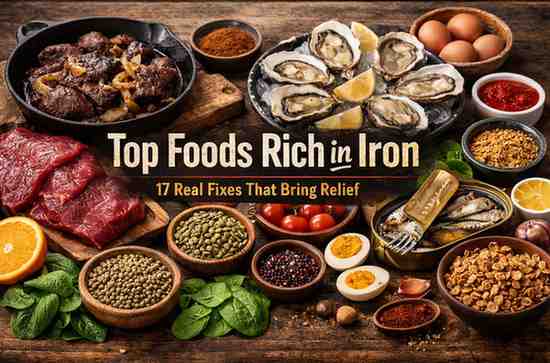
Most people don’t start searching for Top Foods Rich in Iron because they’re casually curious.
They start because they’re exhausted.
I’ve watched it happen over and over. A friend says she’s “just tired lately.” A client can’t focus by 3 p.m. Someone’s workouts suddenly feel twice as hard. They assume it’s stress. Or sleep. Or aging. They tweak coffee intake. They download a productivity app.
Then the labs come back.
Low iron.
And here’s what surprised me after watching so many people try to fix it: almost everyone thinks it’ll be solved in two weeks with spinach and good intentions.
It usually isn’t.
From what I’ve seen, raising iron through food absolutely works — but only when people stop guessing and start understanding what actually makes iron absorb… and what quietly blocks it.
Let’s talk about what I’ve observed across real kitchens, real grocery carts, and real blood test results.
No hype. Just patterns.
Why So Many People End Up Low on Iron (Even When They “Eat Healthy”)
This part honestly frustrates people the most.
Because they’re not eating junk.
They’re eating salads. Oatmeal. Smoothies. Almond butter. Whole grains. Lentils.
And still — iron is low.
Here’s what I’ve repeatedly seen:
-
Plant-based eaters assuming “spinach is enough”
-
Women with heavy periods underestimating losses
-
Athletes not adjusting intake for training load
-
Coffee drinkers unknowingly blocking absorption
-
People pairing iron foods with the wrong things
Iron intake isn’t just about quantity.
It’s about type and absorption timing.
There are two forms:
-
Heme iron (from animal foods) – absorbed efficiently
-
Non-heme iron (from plants) – absorbed less predictably
Most people I’ve worked with mess this up at first. They focus only on milligrams. But absorption is where the real story is.
The Top Foods Rich in Iron (Ranked by What Actually Moves the Needle)
Below are the foods I’ve consistently seen make measurable differences when people include them correctly.
Not theoretically.
Not Instagram-healthy.
Actually effective.
1. Beef Liver (The Heavy Hitter Most People Avoid)
This one sparks strong reactions.
But I can’t ignore the pattern.
A few ounces of beef liver provide more absorbable iron than most full “healthy” meal plans combined.
From what I’ve seen:
-
1–2 servings per week can significantly support low ferritin levels →
-
People who tolerate the taste see faster improvements
-
Pairing with vitamin C helps even more
That said — not everyone can stomach it. Texture is a deal-breaker for many.
If someone refuses liver, I don’t push it. But I do tell them the truth: it’s one of the most efficient options.
2. Oysters (Quietly Powerful)
Oysters don’t show up often in “iron lists,” but when people include them?
Results improve.
They’re rich in heme iron and zinc — which supports overall recovery.
The hesitation is usually:
-
Cost
-
Accessibility
-
Taste preference
But nutritionally, they’re strong.
3. Lean Red Meat (The Consistent Fix)
This is the one I see work again and again.
3–4 servings per week of lean red meat:
-
Supports steady iron intake
-
Absorbs reliably
-
Easier compliance than liver
Most people who shift from “mostly chicken” to including red meat notice energy changes within 4–8 weeks.
Not overnight.
But steady.
4. Dark Turkey Meat
Often overlooked.
Dark meat contains more iron than white breast meat.
It’s not as dense as beef, but for people easing into higher heme intake, it’s a practical step.
5. Sardines
Affordable. Shelf-stable. Nutrient-dense.
People who actually eat them weekly tend to maintain iron better than those relying on plant sources alone.
The barrier?
Texture.
Still — they’re effective.
Best Plant-Based Iron Foods (When Done Correctly)
This is where I see the most trial-and-error.
Plant iron absolutely matters. But it needs strategy.
6. Lentils
Strong source of non-heme iron.
But here’s what people miss:
-
Pair with vitamin C (bell peppers, lemon)
-
Avoid coffee or tea within an hour
-
Soaking improves tolerance for some
When combined correctly, lentils work well.
Alone? Slower progress.
7. Spinach (Overestimated, But Still Useful)
Spinach looks impressive on paper.
In reality?
Oxalates reduce absorption.
I didn’t expect this to be such a common issue, but people relying heavily on spinach often see minimal lab change.
It’s supportive — not a primary fix.
8. Pumpkin Seeds
Easy snack upgrade.
Good addition — but rarely enough alone for deficiency.
9. Fortified Cereals
This one surprises people.
Some fortified cereals contain very high iron levels.
But absorption varies.
And sugar content can be high.
Helpful tool. Not a magic fix.
Common Mistakes That Slow Iron Recovery
Almost everyone I’ve seen struggle with this does one of these:
-
Drinking coffee with iron-rich meals
-
Pairing iron with calcium-heavy foods
-
Relying only on spinach
-
Under-eating overall calories
-
Expecting results in two weeks
Iron repletion takes time.
Usually:
-
4–6 weeks to notice energy changes
-
8–12 weeks for labs to reflect meaningful improvement
-
Longer if levels are severely low
And that timeline assumes consistency.
How Long Does It Take for Iron Levels to Improve?
Short answer:
It depends on:
-
Severity of deficiency
-
Menstrual losses
-
Diet consistency
-
Gut absorption
-
Whether supplements are used
From what I’ve seen in real cases:
-
Mild low ferritin improves with diet changes alone
-
Moderate deficiency often needs food + supplements
-
Severe anemia requires medical supervision
Food helps. But sometimes food alone isn’t enough.
That’s just reality.
Is It Worth Trying to Fix Iron Through Food First?
For many people — yes.
Especially if:
-
Levels are borderline low
-
You prefer natural adjustments
-
You tolerate red meat or seafood
It may not be enough if:
-
You have heavy ongoing losses
-
You have digestive absorption issues
-
Your ferritin is extremely low
I’m always honest about that.
Who This Approach Is Not For
Let’s be clear.
Food-first may not work quickly if:
-
You’re pregnant with diagnosed anemia
-
You have gastrointestinal bleeding
-
You have diagnosed malabsorption disorders
-
Your hemoglobin is critically low
In those cases, food supports recovery — but isn’t the primary intervention.
Quick FAQ (Straight Answers)
What food is highest in iron?
Beef liver is among the highest natural sources.
Are plant sources enough?
Sometimes — but absorption strategy matters.
Can you feel better in a week?
Rare. Most improvements take 4+ weeks.
Does cooking in cast iron help?
Yes, slightly. I’ve seen modest improvements with regular use.
Objections I Hear All the Time
“I don’t like red meat.”
Then we build around seafood and careful plant pairing.
“I eat spinach daily — why am I still low?”
Because spinach isn’t efficiently absorbed alone.
“I’m scared of eating too much red meat.”
Moderate inclusion isn’t extreme. Context matters.
The Reality Check No One Likes
Iron deficiency doesn’t correct itself casually.
It requires:
-
Intentional food choices
-
Consistency
-
Patience
-
Sometimes labs every few months
There’s usually a phase where people feel discouraged because nothing changes fast.
That phase is normal.
Practical Takeaways (What Actually Works)
If I were guiding someone starting today:
-
Include heme iron 3–4 times per week.
-
Pair plant iron with vitamin C.
-
Separate coffee/tea from iron meals.
-
Recheck labs in 8–12 weeks.
-
Expect gradual improvement, not a sudden burst.
Emotionally?
Expect:
-
Frustration early
-
Doubt around week 3
-
Subtle improvement before dramatic change
Small wins matter.
Better afternoon focus.
Less breathlessness.
Warmer hands.
Those signals usually show up before labs shift.
No — this isn’t magic.
But I’ve watched enough people stop blaming themselves once they understood what was actually happening.
Iron recovery isn’t about eating “healthier.”
It’s about eating strategically.
And once that clicks, things usually start moving.
Slowly.
Then steadily.
Sometimes that shift alone is the real relief.