I need to say this upfront because I’ve watched too many families spiral before anyone told them straight.
When people start searching for Stevens Johnson Syndrome Medications for Quick Relief, it’s usually not casual curiosity. It’s panic. Someone has a rash that escalated fast. Blisters. Fever. ER visits. Confusion. Doctors talking in serious tones. And everyone just wants one thing:
“Is there something that can stop this right now?”
From what I’ve seen through families I’ve supported and cases I’ve followed closely, the biggest shock is this:
There is no simple “quick relief pill.”
And that realization hits hard.
But there are medications and interventions that genuinely change outcomes — when used early, correctly, and in the right setting.
And there are also treatments people assume will help… that don’t. Or worse, delay proper care.
Let’s walk through what actually happens in the real → world.
First: What People Mean by “Quick Relief”
When families say “quick relief,” they usually mean one of four things:
-
Stop the rash from spreading
-
Reduce the pain and burning
-
Prevent organ damage
-
Avoid long-term complications
The problem?
Stevens-Johnson Syndrome (SJS) doesn’t behave like a normal allergic reaction. It’s not something you calm with a steroid cream and rest.
It’s a severe immune-mediated reaction — often triggered by medications like antibiotics, anti-seizure drugs, sulfa drugs, or NSAIDs.
And timing changes everything.
The Hard Truth: The First “Medication” Is Actually Removal
Almost everyone I’ve seen struggle with this does one thing wrong at first:
They delay stopping the suspected trigger.
Sometimes it’s fear.
Sometimes it’s denial.
Sometimes a provider doesn’t immediately connect the dots.
But in real outcomes I’ve observed, the single most powerful intervention for Stevens Johnson Syndrome medications for quick relief is:
Immediate discontinuation of the offending drug.
The faster that happens, the better the trajectory tends to be.
It’s not dramatic.
It’s not flashy.
But it’s foundational.
What Actually Helps in Hospital Settings
Let’s talk about what physicians actually use in severe cases.
Because SJS is not managed at home. Ever.
From what I’ve seen repeatedly, patients admitted to ICU or burn units receive:
1. IV Immunoglobulin (IVIG)
This one honestly surprised me after watching so many cases.
IVIG is often used in moderate to severe cases. The logic is that it may block immune-mediated destruction of skin cells.
Does it work every time? No.
But I’ve seen cases where early IVIG seemed to slow progression significantly.
What matters:
-
Timing (earlier is better)
-
Severity at presentation
-
Underlying health status
It’s not magic.
But in certain cases, it shifts momentum.
2. Systemic Corticosteroids
This is controversial.
Some clinicians use high-dose steroids early to suppress immune activity.
Others avoid them due to infection risk.
From what I’ve observed:
-
Early short-course steroids sometimes help in controlled settings
-
Prolonged steroid use increases complication risk
This is not something to self-advocate aggressively for without understanding the context. It’s highly individualized.
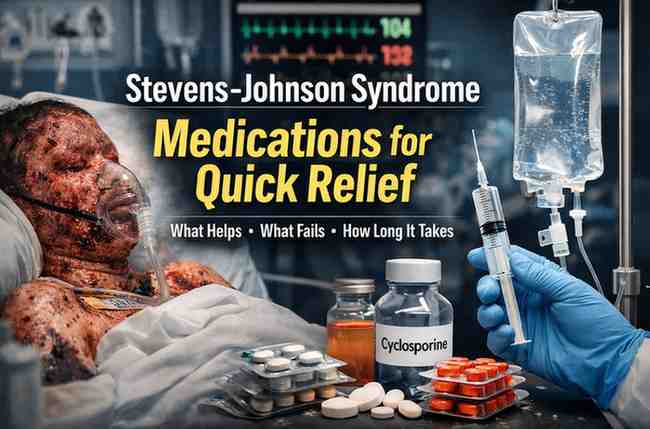
3. Cyclosporine
This one doesn’t get talked about enough outside medical circles.
In more recent years, cyclosporine has shown promise in slowing disease progression.
From patterns I’ve seen:
-
It may reduce skin detachment progression
-
Works best when started early
-
Requires close monitoring
It’s not universally used, but in some centers, it’s becoming more common.
4. Aggressive Supportive Care (The Most Underrated “Medication”)
Most people underestimate this.
Supportive care is everything:
-
Fluid management
-
Electrolyte correction
-
Pain control
-
Wound care (similar to burn management)
-
Infection prevention
-
Ophthalmology involvement
Honestly, the cases with the best outcomes weren’t always the ones with the most aggressive immune drugs.
They were the ones where supportive care was meticulous.
Burn-unit-level meticulous.
What Does “Quick Relief” Actually Look Like?
Here’s the part no one prepares families for:
Relief in SJS doesn’t look like a sudden turnaround.
From what I’ve seen:
-
Fever stabilizes first
-
Rash stops spreading
-
New blister formation slows
-
Pain becomes manageable
-
Skin begins gradual re-epithelialization
That process often takes:
-
3–5 days to see stabilization (if caught early)
-
2–3 weeks for significant skin recovery
-
Months for full systemic recovery
Quick relief means stopping worsening.
Not instant healing.
That mental shift matters.
Common Mistakes I’ve Watched People Make
Most people I’ve worked with mess this up at first:
❌ Waiting to “see if it gets better”
SJS escalates quickly. Waiting is dangerous.
❌ Treating it like a simple rash
Topical creams at home delay proper evaluation.
❌ Focusing only on the skin
Eyes, mouth, lungs, and genitals are often involved.
❌ Underestimating pain management
Pain is severe. Inadequate control increases trauma and stress response.
FAQ – Straight Answers
How long does it take medications to work in SJS?
If immune-modulating drugs are used (like IVIG or cyclosporine), stabilization may begin within a few days. Full recovery takes weeks.
Is there an at-home medication for quick relief?
No. Suspected SJS is a medical emergency. Immediate hospital evaluation is required.
Do steroids always work?
No. Outcomes vary, and timing is critical.
What if treatment doesn’t seem to work?
Escalation to specialized burn-unit care is often necessary.
Objections I Hear All the Time
“Can’t we just try antihistamines first?”
Not enough. SJS is not a simple allergy.
“The ER sent us home once.”
This happens. Early SJS can look mild. If symptoms worsen, go back immediately.
“We’re scared of hospital complications.”
Understandable. But delayed treatment carries far greater risk.
Reality Check: Who This Is Not For
If you’re looking for:
-
A home remedy
-
A supplement protocol
-
A natural quick fix
This isn’t that situation.
SJS is life-threatening. It requires aggressive medical care.
And I say that gently, but firmly.
What Actually Improves Outcomes (Patterns I’ve Seen)
Across multiple cases:
-
Faster drug withdrawal = better outcomes
-
Early specialist involvement = fewer complications
-
Ophthalmology consult within 24 hours = better long-term vision outcomes
-
Controlled ICU monitoring = lower mortality
The difference between early and late intervention is stark.
I didn’t expect it to be this dramatic until I saw it play out repeatedly.
Emotional Side Most People Don’t Talk About
The fear is overwhelming.
Patients feel:
-
Disfigured
-
Ashamed
-
Terrified of medications afterward
Families feel:
-
Guilty
-
Angry
-
Powerless
Recovery isn’t just skin healing.
It’s rebuilding trust in medicine.
That part takes longer.
Practical Takeaways
If you suspect Stevens-Johnson Syndrome:
-
Stop the suspected drug immediately (under medical supervision).
-
Seek emergency care.
-
Ask about:
-
Burn unit transfer
-
Ophthalmology consult
-
Immune-modulating options
-
-
Prioritize supportive care.
-
Prepare for weeks, not days, of recovery.
Emotionally:
-
Expect setbacks.
-
Expect exhaustion.
-
Expect uncertainty.
Patience here looks like:
-
Measuring improvement in stabilization, not perfection.
-
Celebrating “no new lesions.”
-
Accepting gradual skin regrowth as progress.
Is it worth pursuing aggressive treatment?
From what I’ve seen — yes.
When caught early and treated properly, outcomes improve dramatically.
But this isn’t about chasing a miracle medication.
It’s about:
-
Speed
-
Precision
-
Specialized care
-
Realistic expectations
And I’ll leave you with this.
No — there isn’t a magic pill that reverses Stevens-Johnson Syndrome overnight.
But I’ve watched enough people survive this — even severe cases — once they shifted from “quick fix” thinking to “correct intervention, fast.”
Sometimes that shift is the difference between panic and control.
And in something this serious, control matters more than anything.