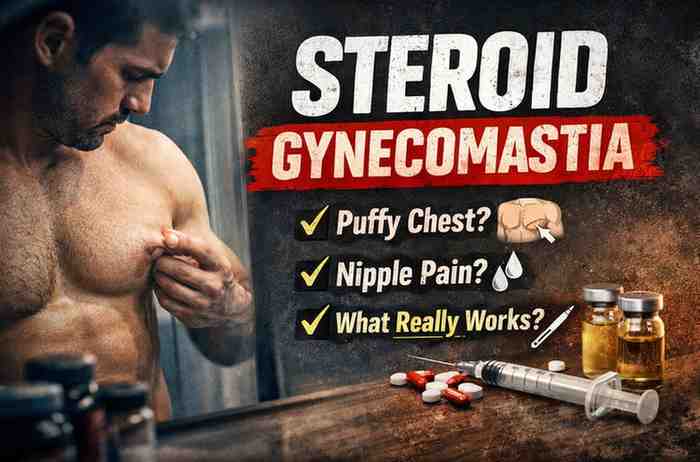
Honestly, most of the guys I’ve watched deal → with steroid gynecomastia don’t even notice it at first.
It starts as a weird sensitivity. A little puffiness. Maybe a dull ache behind the nipple. They brush it off. Water retention. Bad lighting. “It’ll go away after cycle.”
Then two weeks later they’re standing in front of the mirror, poking at their chest, trying to convince themselves it’s just fat.
And that’s usually when the frustration → sets in.
Because steroid gynecomastia doesn’t feel fair. You’re training hard →. Eating clean. Dialed in. And suddenly your chest looks softer than it did before you started.
From what I’ve seen across dozens of real cases — → gym friends, clients, guys who messaged in panic — this is one of the most emotionally destabilizing side effects of anabolic steroid use. Not because it’s dangerous at first. But because it hits ego. Identity. Control.
Let’s unpack what actually happens. What people get wrong. What works. What doesn’t. And when you need to stop experimenting and make a real decision.
First: What Steroid Gynecomastia Actually Is (Without the Clinical Lecture)
Steroid gynecomastia is the development of glandular breast tissue in men triggered by hormonal imbalance — usually excess estrogen relative to testosterone.
It’s not just chest fat.
That’s the first mistake almost everyone makes.
Real gynecomastia feels:
-
Rubbery or firm under the nipple
-
Tender or sensitive
-
Centered directly behind the areola
-
Sometimes slightly painful when pressed
Fat, on the other hand, is soft. Diffuse. Spread out.
I’ve seen guys diet aggressively thinking it’s fat. They lose 12 pounds. Their abs pop more.
The lump? Still there.
That’s usually the moment reality hits.
Why It Happens (In Real-World Terms)
When someone runs anabolic steroids — especially aromatizing compounds like testosterone — part of that testosterone converts into estrogen through aromatase.
More testosterone → more conversion → more estrogen.
If estrogen climbs too high relative to androgens, breast tissue can start to grow.
And here’s the pattern I keep seeing →:
-
Guys underestimate how fast estrogen can spike
-
They skip bloodwork
-
They “eyeball” their AI dose
-
Or worse — they don’t run one at all
Then they react only after symptoms start.
By then, you’re playing defense.
This honestly surprised me after watching so many people try → to out-train hormonal imbalance. You can’t bench press your way out of estrogen dominance.
The Early Warning Signs Most People Ignore
Almost everyone I’ve seen struggle with this does this one thing wrong:
They wait.
They assume soreness is temporary.
The early phase usually looks like:
-
Nipple sensitivity
-
Itchiness
-
Slight swelling
-
Emotional irritability
-
Increased water retention
If caught early, intervention can actually work well.
If ignored for months?
That tissue can become fibrotic. And once it’s fibrotic, medication becomes far less effective.
That’s the fork in the road.
What Actually Works (From What I’ve Seen Repeatedly)
Let’s break this down clearly.
1. Early Intervention with SERMs
Selective Estrogen Receptor Modulators like tamoxifen (Nolvadex) are commonly used.
From what I’ve observed:
-
Works best in early stages (first few weeks)
-
Reduces tenderness quickly
-
Can shrink developing tissue
-
Doesn’t “melt” fully established gland
Most people I’ve → worked with mess this up at first by:
-
Waiting too long
-
Underdosing
-
Stopping too early
Patience matters here. It’s usually a 4–6 week commitment minimum.
2. Proper Estrogen Management During Cycle
Aromatase inhibitors (like anastrozole) reduce estrogen production.
But here’s the nuance:
Too much AI → crashed estrogen → joint pain, mood crashes, libido issues.
I’ve seen more emotional breakdowns from crashed estrogen than from mild elevation.
This is where bloodwork matters. Not guessing. Not bro-science dosing.
Cause → effect → outcome.
High E2 → tissue growth risk.
Crushed E2 → systemic misery.
Balance wins.
3. Surgery (When It’s Truly Established)
If the gland is solid and months old, surgery becomes the definitive solution.
And this is where denial gets expensive.
Guys will spend:
-
Months cycling SERMs
-
Trying supplements
-
Running weird protocols
When the tissue is already permanent.
In the U.S., surgical costs typically range from $3,000 to $8,000 depending on surgeon and location.
Recovery is usually:
-
1–2 weeks downtime
-
Compression garment for several weeks
-
Full healing in 2–3 months
From what I’ve seen, the emotional relief after surgery is massive. Not because it’s cosmetic. But because the mental loop finally stops.
What Repeatedly Fails
I didn’t expect → this to be such a common issue, but here’s what consistently doesn’t work:
-
“Natural estrogen blockers”
-
Crushing calories hoping it’s fat
-
Ignoring bloodwork
-
Adding more steroids to “balance it out”
-
Panic stacking multiple drugs at once
Almost everyone who spirals does so because they react emotionally instead of strategically.
More drugs is not a strategy.
It’s panic.
How Long Does It Take to Reverse Steroid Gynecomastia?
Short answer:
Early stage: 4–8 weeks can show real improvement.
Established gland: Often does not fully reverse without surgery.
This depends on:
-
How long it’s been present
-
How aggressive the hormone imbalance was
-
Individual sensitivity
Some guys respond fast. Others barely at all.
And that uncertainty drives people crazy.
Is It Worth Trying to Reverse It Naturally?
If you’re in the first few weeks of symptoms?
Yes. Absolutely.
If it’s been there for 8–12 months and feels firm?
Manage expectations.
This is where decision support becomes real:
-
Mild puffiness + recent onset → worth medical intervention
-
Hard lump + long duration → consult a surgeon
I’ve watched guys delay surgery for two years trying to “beat it.”
The stress cost more than the procedure.
Who Should Avoid Self-Treating This
Let me be blunt.
You should not self-manage this if:
-
You have no access to bloodwork
-
You’re stacking multiple compounds
-
You don’t understand estrogen ranges
-
You’re prone to anxiety-driven dosing changes
Hormones are not forgiving.
And in the U.S., telehealth hormone clinics make supervised care far more accessible now than it was five years ago.
Guessing is outdated.
Common Mistakes That Slow Results
-
Starting treatment too late
-
Stopping once pain goes away
-
Not addressing root cause (ongoing cycle)
-
Crashing estrogen entirely
-
Refusing to admit surgery may be needed
The biggest one?
Ego.
I say that gently. But it’s true.
Objections I Hear All the Time
“It’s just water retention.”
Maybe. But tenderness is usually your clue it’s not.
“I’ll cut and it’ll go away.”
Cutting removes fat. Not gland.
“I don’t want to take more drugs.”
Understandable. But unmanaged estrogen can create a bigger problem.
“Surgery feels extreme.”
Sometimes. But so does living in hoodies for three summers.
Quick FAQ (Straight Answers)
Can steroid gynecomastia go away on its own?
Sometimes in very early stages. Rare once tissue matures.
Does PCT prevent it?
Not reliably if estrogen was high during cycle.
Is it dangerous?
Usually not life-threatening. But it can impact mental health → heavily.
Will lowering body fat fix it?
Only if it’s fat, not glandular tissue.
Reality Check Section
This isn’t magic.
There’s no guaranteed reversal timeline.
Some people respond beautifully to early SERM therapy.
Others don’t.
Some need surgery.
Some never develop it despite reckless cycles.
Hormonal sensitivity is individual.
And yes — this is one of the real risks → of anabolic steroid use. Anyone pretending otherwise hasn’t watched enough people → go through it.
Practical Takeaways
If you suspect early steroid gynecomastia:
-
Get bloodwork immediately.
-
Stop guessing your estrogen levels →.
-
Consider supervised SERM therapy early.
-
Don’t crash estrogen aggressively.
-
Set a timeline for reevaluation (4–6 weeks).
If it’s long-standing:
-
Consult a board-certified plastic surgeon.
-
Ask about gland excision, not just liposuction.
-
Understand total cost upfront.
Emotionally?
Expect frustration.
Expect mirror-checking.
Expect second-guessing.
Patience in practice looks like:
-
Not adjusting dosage every 3 days →
-
Not doom-searching forums nightly
-
Not assuming worst-case outcomes immediately
Small wins → matter.
Reduced tenderness. Slight shrinkage. Stabilization.
That’s progress.
Most of the guys I’ve seen finally feel relief → not when the tissue disappears.
But when they stop feeling confused.
When there’s a plan.
When they understand what stage they’re actually in.
So no — steroid gynecomastia isn’t a death sentence for your physique.
But it is a wake-up call.
Sometimes the real win → isn’t reversing it perfectly.
It’s learning to handle your hormones with more respect than you did before.
And from what I’ve seen… that shift alone changes everything.