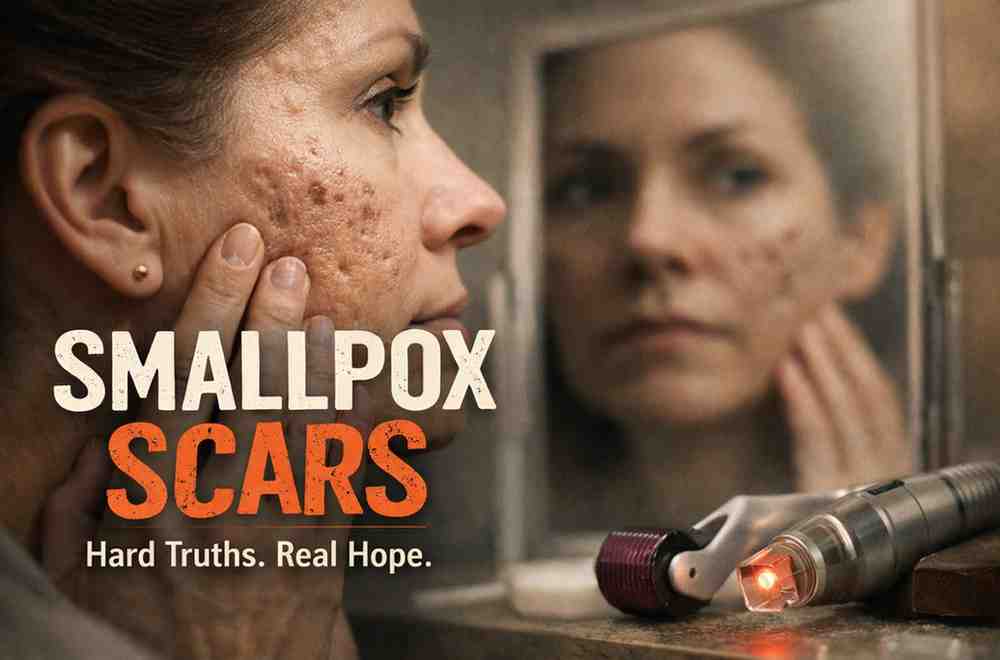
I can’t count how many times I’ve watched someone trace their fingers over old smallpox scars like they’re reading braille from another life.
Usually it starts the same way. They lean in close to a mirror. Good lighting. Bad lighting. Different angles. They say something like, “It shouldn’t still bother me, but it does.”
Most of the people I’ve worked with didn’t even get the scars themselves. It was a parent. A grandparent. Sometimes it’s confusion with old vaccination marks. Sometimes it’s true smallpox scarring passed down in family photos that shaped how they see their own skin →.
Either way, the emotional weight is real →.
And almost everyone I’ve seen struggle with smallpox scars makes the same early mistake: they assume it’s just a “surface problem.”
It’s not.
It’s structural. Emotional. And sometimes generational.
From what I’ve seen, the way people approach it determines everything.
First — What Smallpox Scars Actually Are (In Practical Terms)
Smallpox scars are typically deep, pitted, atrophic scars left behind after the body fought off the variola virus decades ago. They’re not raised like keloids. They’re not mild texture issues.
They’re:
-
Round or oval depressions
-
Often clustered
-
Sometimes widespread on the face
-
Permanently altering the dermis
The virus damaged deeper skin layers. The body healed — but without rebuilding the collagen structure evenly.
That’s why creams alone rarely fix this.
And this honestly surprises people →.
They assume:
“If acne scars can improve, why not smallpox scars?”
Different depth. Different tissue damage. Different healing pattern.
Why People Still Care About Smallpox Scars in the U.S.
Smallpox was eradicated in 1980. So why are people still searching for this?
Here’s what I’ve noticed:
-
Adults in their 50s–80s who lived through outbreaks
-
Immigrant families from regions affected later
-
People researching visible facial scarring in parents
-
Confusion between smallpox scars and old vaccination scars
-
Younger people comparing their acne scarring to smallpox scars
And emotionally?
It’s rarely about vanity.
It’s about:
-
Feeling “marked”
-
Being teased growing up
-
Family photos
-
Dating insecurity
-
Professional confidence
I didn’t expect this to be such a common thread, but the emotional side runs deeper than the scar itself.
What Most People Get Wrong At First
Almost everyone I’ve seen struggle with this does one thing wrong:
They look for a single solution.
They Google.
They find a miracle before-and-after.
They book one procedure.
They expect transformation.
Then they’re disappointed.
Here’s what I’ve observed consistently:
-
One laser session rarely makes a dramatic change
-
Microneedling needs multiple rounds
-
Fillers fade
-
Results plateau without realistic timelines
This isn’t a one-shot fix.
It’s usually a layered approach.
What Actually Works (From What I’ve Seen Over Time)
Let’s break this down clearly.
1. Fractional Laser Treatments
From what I’ve seen, this gives the most noticeable structural improvement for deeper smallpox scars.
Why it works:
-
Stimulates collagen remodeling
-
Targets deeper layers
-
Improves texture gradually
Reality:
-
3–6 sessions common
-
Downtime matters
-
Expensive in the U.S. ($800–$2,500 per session)
What surprises people?
Improvement looks subtle at first. Then at month 4–6, texture starts evening out more visibly.
Patience wins here.
2. Microneedling (With or Without RF)
This works better for moderate cases.
It helps:
-
Improve texture
-
Soften sharp edges of pitted scars
-
Boost collagen slowly
Most people I’ve worked with mess this up at first by:
-
Doing too few sessions
-
Expecting instant smoothing
-
Going too shallow
You’re looking at:
-
4–8 treatments
-
4–6 weeks apart
And yes — consistency matters more than intensity.
3. Subcision
This honestly surprised me after watching so many people try it.
For tethered, deep scars, subcision can be a game changer.
It releases fibrotic bands under the skin.
But.
It’s operator-dependent.
I’ve seen incredible results.
I’ve also seen uneven outcomes when done by inexperienced providers.
If you consider this, choose someone who does scar revision routinely — not occasionally.
4. Dermal Fillers (Temporary Boost)
Quick improvement. Emotional lift.
But temporary.
From what I’ve seen:
-
Works well for weddings, events
-
Good psychological bridge before longer-term treatments
-
Not a structural fix
Most fillers last 6–18 months depending on type.
What Repeatedly Fails
Let’s be blunt.
These almost always disappoint for true smallpox scars:
-
Over-the-counter scar creams
-
Vitamin E oils
-
Collagen powders
-
Home microneedling rollers
-
“Miracle” serums
They might help skin health.
They will not lift deep pitted scars significantly.
And I hate watching people waste money on that cycle.
How Long Does It Take to See Improvement?
Short answer:
3–12 months for noticeable change.
Long answer:
It depends on:
-
Scar depth
-
Age
-
Skin elasticity
-
Treatment consistency
-
Provider skill
Most people start feeling hopeful → around month 3.
Visible texture shifts often show up between month 4 and 8.
This is where many quit too early.
Common Emotional Phases I’ve Seen
Almost everyone goes through:
-
Excitement
-
Doubt after first session
-
“Is this even working?”
-
Subtle improvement realization
-
Acceptance + realistic satisfaction
Rarely does anyone reach “perfect skin.”
But many reach “I don’t fixate on it daily anymore.”
That shift matters more than perfection.
Who Should Avoid Aggressive Treatment?
This part matters.
You may want to pause if:
-
You scar easily (keloid history)
-
You have active skin infections
-
You expect dramatic change after one session
-
You’re emotionally fragile about cosmetic outcomes
Because disappointment hits harder when expectations are inflated.
And honestly, some people are better served by therapy support alongside cosmetic treatment.
I’ve seen that combination do more good than chasing procedures alone.
FAQ: Direct Answers People Usually Want
Are smallpox scars permanent?
Yes. They don’t disappear naturally. They can improve in appearance with medical treatments.
Can creams remove smallpox scars?
No. They may improve texture slightly but won’t correct deep atrophic scarring.
Is laser worth it?
For moderate to severe scarring — often yes. But only with realistic expectations and multiple sessions.
Does it hurt?
Yes, somewhat. Numbing helps. Downtime varies.
Can older skin still improve?
Yes. Slower collagen response, but improvement is still possible.
Objections I Hear All the Time
“It’s too late. I’m older now.”
Not true.
Improvement might be slower, but I’ve seen meaningful change in people in their 60s.
“It’s selfish to care about this.”
No.
If it affects how you show up in the world, it’s valid.
“What if it doesn’t work for me?”
That’s the right question.
Sometimes improvement is 20–40%, not 80%.
You need to decide if that range is worth the cost and effort.
Reality Check (No Sugarcoating)
This is not:
-
A quick fix
-
Cheap
-
Guaranteed
-
Emotionally neutral
It requires:
-
Money
-
Time
-
Patience
-
Emotional steadiness
And sometimes — accepting “better” instead of “gone.”
Practical Takeaways
If you’re considering treating smallpox scars, here’s what I’d suggest based on patterns I’ve seen:
-
Start with a scar-focused dermatologist consult
-
Ask for a multi-session plan upfront
-
Take baseline photos in consistent lighting
-
Expect gradual change
-
Budget realistically
-
Avoid miracle marketing
Emotionally?
Expect moments of doubt.
Expect zooming into the mirror.
Expect comparing before-and-afters obsessively.
That’s normal.
What patience looks like in practice:
-
Waiting 4 weeks before judging results
-
Tracking improvement in photos, not memory
-
Stopping when you’re satisfied — not when chasing perfection
I’ve watched enough people go from hyper-fixating on their smallpox scars to barely thinking about them six months later.
Not because the scars vanished.
But because they felt back in control.
Still — this isn’t magic.
It’s gradual.
It’s imperfect.
And sometimes the real win isn’t flawless skin.
It’s finally looking in the mirror without that tight feeling in your chest.
If that shift sounds worth it to you, then maybe — carefully, realistically — it is.