I can’t tell you how many families I’ve sat with who thought they were dealing with one thing… and slowly realized it was something else.
A wife convinced her husband’s forgetfulness was “just normal aging.” A son frustrated that his dad’s shaking hands must mean dementia is coming fast. A daughter crying in the parking lot because she Googled Similarities and Differences between Parkinsons and Alzheimers Disease and came away more confused than before.
Honestly, most people I’ve watched try to figure this out hit a wall in the first few weeks.
They’re scared. They want certainty. They want someone to say, “It’s this. Here’s what happens next.”
But these two diseases overlap just enough to make everything feel blurry — especially in the beginning.
From what I’ve seen across dozens of families navigating both Parkinson’s and Alzheimer’s here in the U.S., the confusion isn’t just medical.
It’s emotional. It’s practical. It’s about what daily life will look like.
Let’s break this down the way I usually explain it to people when we’re sitting across a kitchen table.
The Core Difference Most People Miss at First
Here’s the simplest way I’ve seen it play out:
-
Parkinson’s usually starts in the body.
-
Alzheimer’s usually starts in the mind.
That sounds overly neat. And it is. But it’s directionally true.
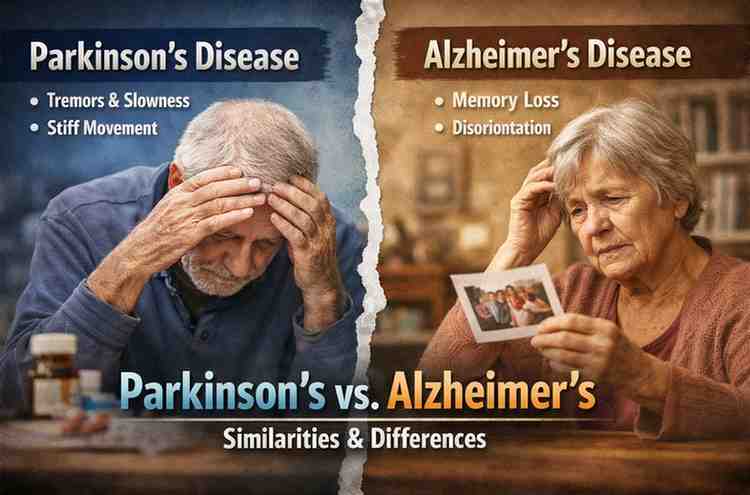
With Parkinson’s, the first things families notice are often:
-
Tremors (especially at rest)
-
Slower movement
-
Stiffness
-
Smaller handwriting
-
Reduced facial expression
Memory might be fine at first.
With Alzheimer’s, what shows up early is different:
-
Repeating questions
-
Losing track of time
-
Misplacing things in strange places
-
Getting lost driving familiar routes
-
Trouble managing finances
The body can look completely normal.
That’s usually the first dividing line.
Still — it’s not that simple. It rarely is.
What Actually Happens in the Brain (Without Getting Clinical)
From what I’ve observed in how doctors explain it to families:
-
Parkinson’s disease primarily affects dopamine-producing neurons in a region called the substantia nigra.
-
Alzheimer’s disease involves widespread brain changes including amyloid plaques and tau tangles.
But what matters more practically is what those changes feel like in daily life →.
Parkinson’s Patterns I Keep Seeing
-
Movement gets slower over time.
-
Facial expressions become flatter.
-
Voice gets softer.
-
Walking becomes shuffling.
-
Later on, thinking may slow — but not always immediately.
Alzheimer’s Patterns I Keep Seeing
-
Memory gaps widen.
-
Executive function (planning, organizing) declines.
-
Personality shifts.
-
Confusion increases gradually.
-
Judgment becomes unpredictable.
I didn’t expect how often families confuse “slowed thinking” in Parkinson’s with “memory loss” in Alzheimer’s.
They aren’t the same.
Slowed processing isn’t necessarily forgetting.
But to a stressed caregiver, it looks identical.
Where the Similarities Create Real Confusion
This honestly surprised me after watching so many people try to understand it.
Later-stage Parkinson’s can include:
-
Dementia
-
Hallucinations
-
Cognitive decline
And some Alzheimer’s patients eventually develop:
-
Gait problems
-
Balance issues
-
Muscle rigidity
So yes — there is overlap.
Common shared features include:
-
Cognitive decline (eventually)
-
Mood changes (depression is huge in both)
-
Sleep disturbances
-
Hallucinations (more common in advanced stages)
-
Increased caregiver burden
Almost everyone I’ve seen struggle with this does one thing wrong:
They assume the first symptom defines the entire trajectory.
It doesn’t.
Why Families Try to “Figure It Out” Themselves First
I’ve watched this pattern repeat over and over in U.S. households.
Before seeing a neurologist, families:
-
Blame stress.
-
Blame aging.
-
Blame medication side effects.
-
Blame each other.
The husband thinks his wife is “not trying.”
The daughter thinks her dad is being stubborn.
The spouse thinks, “He’s just depressed.”
Sometimes they wait months.
Sometimes years.
And by the time they seek help, progression has already happened.
That’s not failure. That’s human.
But it changes outcomes.
How Long Does It Take to See Clear Differences?
This is one of the biggest questions I hear.
For most families I’ve seen:
-
Parkinson’s motor symptoms evolve gradually over years.
-
Alzheimer’s memory symptoms also progress slowly — but steadily.
The key difference?
In Parkinson’s, cognitive decline (if it happens) usually appears later.
In Alzheimer’s, memory decline is central early.
Timeline patterns I’ve observed in real life:
-
Year 1–2 Parkinson’s: noticeable movement issues, intact memory.
-
Year 1–2 Alzheimer’s: noticeable memory issues, intact movement.
-
5+ years Parkinson’s: possible cognitive decline.
-
5+ years Alzheimer’s: more global impairment.
Of course, there are exceptions.
But this general pattern holds more often than not.
Treatment Differences That Matter in Real Life
Here’s where practical reality hits.
Parkinson’s Treatment
Medications like levodopa often improve movement symptoms significantly.
And families are shocked by how dramatic the early response can be.
But…
Over time:
-
Medication effects fluctuate.
-
“On-off” periods develop.
-
Doses increase.
Alzheimer’s Treatment
Medications can slow symptoms slightly.
But I rarely see dramatic reversals.
Families often feel disappointed because improvement isn’t obvious.
That emotional difference matters.
Parkinson’s can give hope through visible response.
Alzheimer’s feels slower, more subtle, more frustrating.
Common Mistakes I’ve Seen Families Make
Let’s just say it plainly.
Most people I’ve worked with mess this up at first.
1. Waiting Too Long for Evaluation
If memory is changing or movement is shifting — get a neurological evaluation.
Earlier clarity helps with:
-
Planning
-
Financial decisions
-
Lifestyle adjustments
-
Support systems
2. Assuming Memory Loss = Alzheimer’s
Parkinson’s dementia exists.
Medication side effects exist.
Depression can mimic cognitive decline.
It’s not automatically Alzheimer’s.
3. Ignoring Emotional Health
Depression is massive in both conditions.
I’ve seen untreated depression worsen everything:
-
Motivation
-
Cognitive performance
-
Relationship strain
Treat mood. It changes trajectory more than people expect.
Short FAQ Section (Direct Answers)
Is Parkinson’s worse than Alzheimer’s?
They’re different. Parkinson’s often impacts mobility first. Alzheimer’s impacts memory first. Long-term burden can be high in both.
Can someone have both?
Yes. Mixed pathology happens, especially in older adults.
Does Parkinson’s always lead to dementia?
No. Some patients never develop significant dementia.
Is Alzheimer’s always memory loss first?
Almost always early on, yes. But presentation can vary.
Objections I Hear All the Time
“But my dad has shaking and memory loss.”
It could be:
-
Parkinson’s with cognitive decline
-
Alzheimer’s with movement issues
-
Another neurodegenerative condition
-
Medication effects
Diagnosis requires clinical evaluation.
Guessing creates anxiety.
“We’re afraid of the diagnosis.”
I understand that.
But uncertainty is heavier than clarity. Every time.
Reality Check (Because Someone Needs to Say It)
Neither condition currently has a cure.
Progression happens.
Caregiving is demanding.
Emotional burnout is common.
Almost everyone I’ve seen underestimate this part.
You need:
-
Support networks
-
Financial planning
-
Respite care options
-
Honest family conversations
This is not a solo journey.
Who This Information Is NOT For
If you’re looking for miracle reversals or biohacks promising total recovery…
This isn’t that.
If symptoms are extremely mild and stable, don’t panic-diagnose.
And if you’re not in the U.S., healthcare pathways and support systems may differ.
Practical Takeaways
If you’re trying to understand the similarities and differences between Parkinsons and Alzheimers Disease because you’re worried about someone you love, here’s what I’d actually do:
-
Document symptoms clearly.
-
Note what appeared first — movement or memory.
-
Schedule a neurologist visit sooner than feels necessary.
-
Treat depression aggressively.
-
Prepare financially earlier than you think you need to.
-
Join caregiver groups. Patterns help normalize fear.
Emotionally?
Expect:
-
Denial
-
Anger
-
Moments of guilt
-
Small relief when there’s clarity
-
Unexpected tenderness
Progress is rarely dramatic.
It’s incremental. Quiet.
Sometimes invisible.
What I’ve learned watching families navigate both conditions is this:
The disease matters.
But so does how early you adapt.
The people who do best aren’t the ones who “stay positive.”
They’re the ones who get informed early. Adjust expectations. Ask for help sooner.
So no — this isn’t simple. And it’s definitely not comforting.
But I’ve watched enough families move from confusion to grounded clarity once they truly understood the similarities and differences between Parkinsons and Alzheimers Disease.
Sometimes that shift alone — from guessing to knowing — is the first real relief.