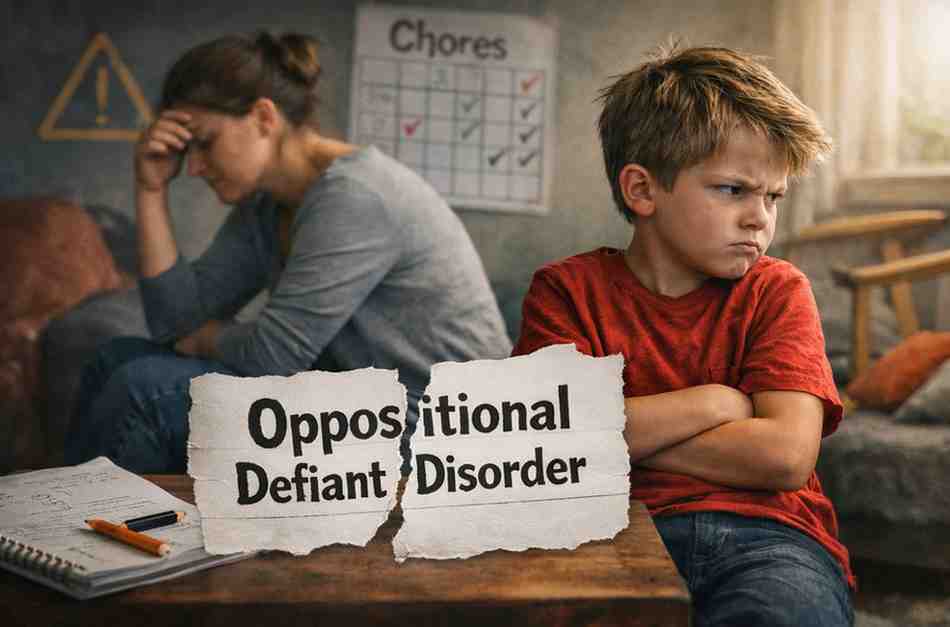
Honestly, most parents I’ve sat with hit a wall in the first few weeks. They come in hopeful, then quietly wonder if they’re the problem when nothing seems to work. The yelling gets louder. The rules get stricter. The pushback gets sharper. Somewhere in that loop, Oppositional Defiant Disorder shows up in their search history—not as a neat label, but as a question: Is this what we’re dealing with? And if so… what now?
From what I’ve seen, people don’t come looking for a definition. They come looking for relief. For a way to stop the daily blowups. For a way to feel less like the villain in their own home. I’ve been close enough to enough families—coaching, observing sessions, helping track what worked and what quietly made things worse—to notice patterns that repeat across kids, across households, across well-meaning plans that looked good on paper and then fell apart in real life.
This is messy. It’s emotional. And it’s learnable. Not in a “follow these three steps and your kid will be fine” way. More in a “here’s what tends to help when nothing else has” way.
What people usually mean when they say “Oppositional Defiant Disorder”
Nobody introduces themselves with, “Hi, I think my child has Oppositional Defiant Disorder.” It shows up as:
-
“He argues about everything.”
-
“She melts down over the smallest requests.”
-
“It feels intentional. Like they’re pushing buttons on purpose.”
-
“We can’t get through a morning without a fight.”
Most people I’ve worked with mess this up at first: they assume it’s just stubbornness. Or bad behavior. Or a phase that discipline will outgrow. Then the discipline ramps up. The kid ramps up. And everyone feels worse.
From what I’ve seen, the kids who get tagged with Oppositional Defiant Disorder aren’t trying to be difficult in the way adults imagine. They’re stuck in a pattern of reacting to perceived control, criticism, or pressure. It’s not that they “can’t follow rules.” It’s that rules, as delivered, hit a nerve.
This honestly surprised me after watching so many people try to “out-structure” the behavior. More structure often made things louder, not calmer.
Patterns that repeat across families
Across dozens of households, I kept seeing the same loops:
-
Control battles escalate fast. The more tightly adults held the line, the more intensely the child pushed back.
-
Tone mattered more than content. The exact same request, delivered with tension, sparked defiance. Delivered neutrally, sometimes landed fine.
-
Kids were calmer with outsiders. Teachers, coaches, therapists often saw a different version of the child. Parents felt gaslit by this.
-
Everyone was exhausted. Parents were tired of being “on.” Kids were tired of feeling misunderstood.
Almost everyone I’ve seen struggle with this does this one thing wrong: they treat every moment as a teaching moment. When you’re in a constant corrective posture, kids who already feel controlled dig in harder.
Why people try to “fix” this fast (and why that backfires)
The urge to fix Oppositional Defiant Disorder quickly makes sense. The behavior is loud. Public. Embarrassing sometimes. It can affect school, siblings, even how parents see themselves.
Here’s what people usually try first:
-
More consequences
-
Stricter routines
-
Longer lectures
-
“If you don’t, then…” bargains
What I’ve observed: this creates short-term compliance at best, long-term resentment at worst.
I didn’t expect this to be such a common issue, but almost every family tried a version of “we’ll be more consistent and tougher.” Consistency matters, yes. But toughness without relationship repair just hardens the standoff.
What consistently works better (even though it feels counterintuitive at first):
-
Reducing power struggles
-
Making fewer, clearer demands
-
Picking battles with surgical precision
-
Repairing the relationship before fixing behavior
Still. This part is frustrating. It feels like letting go of control when what you want is more control. Parents worry they’re being too soft. That fear is real. And it’s not totally wrong. The balance is delicate.
The stuff that looks good on paper but fails in real life
Most guides say things like “set firm boundaries” and “be consistent.” Those aren’t wrong. They’re just incomplete.
Here’s what I’ve seen fail over and over:
-
Overloading with rules
-
Too many expectations = more chances to fail = more fights.
-
-
Public corrections
-
Kids with defiant patterns often escalate when corrected in front of others.
-
-
Long explanations in the heat of the moment
-
When emotions are high, reasoning doesn’t land. It feels like pressure.
-
-
Threats you can’t follow through on
-
Once a consequence isn’t enforced, credibility drops. The kid learns the boundary is flexible.
-
Most people I’ve worked with mess this up at first because they’re trying to be thorough. They want to explain. To be fair. To teach values. But in the moment, less is more.
What tends to work better (from real-world trial and error)
No miracle tools here. Just patterns that, across multiple families, led to fewer explosions over time.
1. Fewer demands, clearer demands
When everything is a rule, nothing is. The families who saw change:
-
Cut expectations down to 2–3 non-negotiables
-
Let smaller stuff go (messy rooms, mismatched clothes, harmless quirks)
-
Stated expectations once, calmly
This took pressure off everyone. Kids stopped feeling constantly managed.
2. Neutral tone beats perfect words
Tone carries more weight than content. I’ve watched the same sentence land or explode based on tone alone.
What helped:
-
Flat, boring delivery
-
No sarcasm
-
No emotional charge
-
Brief statements
It feels robotic at first. Then it becomes peaceful.
3. Repair after conflict (even when you’re “right”)
This one is hard for adults. After a blowup, many parents want to “stand firm.” What worked better:
-
Short repair moments
-
Acknowledging the emotion without endorsing the behavior
-
Resetting the relationship
Example patterns I’ve seen work:
-
“That got intense. I don’t like how we spoke to each other. Want to reset?”
-
“I still need you to do the thing. But I get that you were frustrated.”
Not a long apology. Not a lecture. Just repair.
4. Structure that feels predictable, not controlling
Kids with oppositional patterns do better with predictability. Not micromanagement.
Helpful structures I’ve seen:
-
Visual schedules
-
Clear routines
-
Advance warnings before transitions
-
Choices within limits (“Homework now or in 10 minutes?”)
This reduces the feeling of being ambushed by demands.
How long does it take (for most people)?
This is where expectations break.
From what I’ve seen:
-
First 2–4 weeks: Things often get worse. Kids test new boundaries. Parents doubt themselves.
-
1–3 months: Some reduction in intensity. Fewer daily explosions. Still messy.
-
3–6 months: Patterns start shifting. Not perfect behavior. More manageable conflict.
-
Long-term: The household tone changes. The kid isn’t “fixed,” but the cycle is different.
If someone promises fast results with Oppositional Defiant Disorder, I’d be cautious. Change is slow because patterns are deeply wired.
Common mistakes that slow everything down
Almost everyone I’ve seen struggle with this does at least one of these:
-
Trying five strategies at once
-
Quitting a plan right before it starts working
-
Expecting the child to change before the adult changes
-
Taking defiance personally
-
Comparing their kid to “normal” kids
This honestly surprised me after watching so many people try it: comparison is poison here. Every child with oppositional patterns looks different. Progress isn’t linear. Some days feel like setbacks. They’re not always.
Is this worth trying if you’re already exhausted?
Short answer: it depends on what you’re expecting.
This approach—slower, relationship-first, less control-heavy—doesn’t give instant peace. It gives fewer blowups over time. It gives you your nervous system back. It makes the house quieter, not perfect.
It’s worth trying if:
-
You’re burned out from constant conflict
-
Punishments haven’t changed the pattern
-
You’re open to changing how you respond
It’s probably not for you if:
-
You want fast compliance
-
You need visible obedience right now
-
You don’t have bandwidth to tolerate short-term worsening
That’s not a judgment. It’s a reality check.
Objections I hear all the time (and what actually happens)
“If I ease up, won’t they walk all over me?”
From what I’ve seen, easing up on power struggles doesn’t mean removing boundaries. It means choosing fewer battles and enforcing them calmly. Kids often push less when they feel less controlled.
“This feels like rewarding bad behavior.”
Repairing connection isn’t rewarding defiance. It’s separating the relationship from the behavior. That separation reduces the need to act out for attention or control.
“We’ve tried being calm. It didn’t work.”
Most people I’ve worked with tried calm for a day or two. Then gave up. This takes weeks of consistency to shift patterns.
Reality check: what can go wrong
This isn’t a magic fix. Here’s what I’ve seen go sideways:
-
One caregiver changes, the other stays harsh → mixed signals
-
Expectations aren’t aligned with the child’s capacity
-
Parents burn out and revert to old patterns
-
The child has additional needs (ADHD, trauma, anxiety) that aren’t addressed
Sometimes Oppositional Defiant Disorder sits on top of other struggles. Ignoring that slows everything down.
Short FAQ (for the stuff people Google at 2 a.m.)
Is Oppositional Defiant Disorder just bad parenting?
No. From what I’ve seen, some of the most thoughtful parents struggle with this. Parenting style can influence patterns, but it’s not the sole cause.
Do kids grow out of Oppositional Defiant Disorder?
Some patterns soften with age. Others shift shape. What changes most is how adults respond—and that changes outcomes.
Does therapy help?
When therapy includes parents and focuses on patterns (not just labeling the child), I’ve seen better results.
Will stricter discipline fix this?
Short-term compliance, long-term power struggles. That’s the usual pattern I’ve observed.
Practical takeaways (the stuff that actually moves the needle)
What to do
-
Pick 2–3 non-negotiables
-
Use calm, short statements
-
Repair after conflict
-
Build predictability
-
Track patterns instead of single incidents
What to avoid
-
Power struggles over everything
-
Public shaming
-
Long lectures in heated moments
-
Threats you can’t enforce
What to expect emotionally
-
Doubt
-
Frustration
-
Small wins that don’t feel impressive at first
-
Occasional backslides
What patience looks like in practice
-
Sticking with one approach for weeks
-
Measuring progress in fewer explosions, not perfect behavior
-
Letting go of being “right” in favor of being effective
No guarantees here. Just patterns I’ve seen repeat when families stop trying to win and start trying to stabilize.
There’s a moment I keep thinking about—watching a parent lower their voice after weeks of yelling, watching a kid pause instead of explode, both of them surprised by the quiet. No fireworks. No miracle. Just a small break in the cycle.
So no—this isn’t magic. But I’ve watched enough people finally stop feeling stuck once they approached Opppositional Defiant Disorder this way. Sometimes that shift alone is the real win.