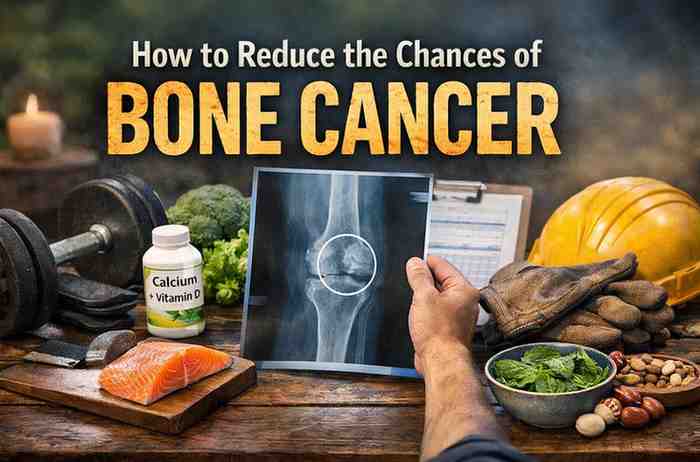
I’ve sat across from too many people who only started Googling how to reduce the chances of Bone cancer after a scare. A strange ache that wouldn’t go away. A family history they suddenly remembered. A friend’s diagnosis that shook them.
And what I’ve noticed — over and over — is that the fear hits first. Then the overwhelm. Then the late-night spiral of conflicting advice.
Some people try to “detox” everything overnight. Others freeze. Most bounce between extremes.
From what I’ve seen, the real shift doesn’t come from panic changes. It comes from steady, boring, repeatable habits that lower risk over time.
Not dramatic. Not viral. Just grounded.
Let’s talk about what actually helps — and what people usually get wrong.
First, an honest baseline: can bone cancer really be prevented?
This is where expectations matter.
Most primary bone cancers are rare in the United States. According to national cancer data, they represent a very small percentage of all cancers. That alone surprises people.
But here’s the part that’s hard to hear:
There’s no guaranteed way to prevent bone cancer.
Some risk factors — like certain genetic conditions or prior radiation exposure — aren’t in your control.
That said…
From what I’ve observed guiding people through lifestyle overhauls after cancer scares, there are patterns that reduce overall cancer risk — including risks tied to bone health and cellular damage.
And when people focus on those, they feel less helpless.
Why people start worrying about bone cancer
Most of the time, it’s one of these triggers:
-
Persistent bone pain that doesn’t feel like a normal injury
-
A family member diagnosed with cancer
-
Previous radiation therapy
-
A genetic condition like Li-Fraumeni syndrome
-
A random article that spirals them into worst-case thinking
What surprised me after watching so many people go through this?
The anxiety is often bigger than the actual statistical risk.
But ignoring it doesn’t help either.
The sweet spot is informed action.
1. Avoid unnecessary radiation exposure (this one is bigger than people think)
Almost everyone I’ve seen underestimate this.
Radiation therapy in childhood is one of the clearest known risk factors for developing bone cancers later in life.
Now — most medical imaging in the U.S. is carefully controlled and safe. CT scans and X-rays are valuable tools. But I’ve watched people push for repeated scans “just to be safe.”
That’s where experienced physicians step in and say:
Let’s not overdo it.
What works in practice:
-
Only get imaging when medically necessary
-
Keep a record of past radiation exposure
-
Discuss cumulative exposure with your doctor
This isn’t about avoiding healthcare. It’s about smart use.
2. Protect your bones from chronic injury
This one surprised me.
Repeated trauma to the same bone doesn’t cause bone cancer directly — but chronic inflammation and injury are never ideal environments for healthy cells.
From what I’ve seen:
-
Athletes who ignore stress fractures
-
Construction workers who never address repetitive strain
-
People who delay treatment for bone infections
Over time, unresolved inflammation compounds.
What consistently works:
-
Treat fractures properly
-
Don’t “push through” persistent bone pain
-
Follow rehab fully, even when you feel better
Most people I’ve worked with mess this up at first. They stop rehab the moment pain fades.
Healing isn’t the same as feeling okay.
3. Support bone health through nutrition (without going extreme)
This is where misinformation explodes.
I’ve watched people swing wildly between:
-
Ultra-restrictive diets
-
Over-supplementation
-
Random online “anti-cancer” plans
Here’s what holds up consistently:
Calcium + Vitamin D balance
-
Adults in the U.S. often under-consume Vitamin D
-
Bone density matters for long-term skeletal health
Whole-food patterns
People who stick with:
-
Leafy greens
-
Fatty fish
-
Nuts and seeds
-
Balanced protein intake
…tend to maintain better bone markers over time.
What fails repeatedly?
Megadosing supplements without testing levels.
More isn’t better.
4. Maintain a healthy body weight
This one is uncomfortable for some people.
Obesity is linked to increased inflammation and hormonal shifts. And systemic inflammation is a known contributor to many cancers.
From what I’ve observed:
-
Gradual, sustainable weight loss works.
-
Crash diets backfire.
People who aim for 1–2 pounds per week and build movement habits?
They stick with it.
People who try to “cleanse” for 30 days?
They rebound. Hard.
5. Move your body — especially weight-bearing exercise
This is one of the most underrated habits.
Weight-bearing exercise strengthens bones. Think:
-
Walking
-
Resistance training
-
Light jogging
-
Stair climbing
Not extreme bodybuilding.
Just consistent load on bones.
I didn’t expect this to be such a common issue, but almost everyone I’ve seen struggle with bone weakness lives a sedentary lifestyle →.
Even 30 minutes a day changes bone density over time.
Slowly. Quietly. But measurably.
6. Limit exposure to industrial toxins
This matters more for certain professions.
Workers in:
-
Manufacturing
-
Chemical plants
-
Mining
-
Heavy construction
Sometimes face higher exposure to carcinogens.
What experienced workers do differently:
-
Use protective gear consistently
-
Follow OSHA safety protocols
-
Advocate for safer environments
The people who skip masks or gloves because “it’s just for a minute”?
They regret it later.
7. Monitor inherited risk
Some people truly have higher risk due to genetic syndromes like:
-
Li-Fraumeni syndrome
-
Hereditary retinoblastoma
If there’s a strong family history of rare cancers, genetic counseling is worth discussing with a physician.
Who this is for:
-
Families with multiple early-onset cancers
-
Those with childhood cancer history
Who this is NOT for:
-
Someone with one distant relative diagnosed at 75
Context matters.
8. Don’t ignore persistent bone pain
This isn’t prevention exactly. It’s early detection.
But I’ve seen delays cause worse outcomes.
If pain:
-
Wakes you up at night
-
Lasts longer than a few weeks
-
Swells without clear injury
…get it evaluated.
Most bone pain is not cancer.
Still — the people who catch issues early almost always wish they had gone in sooner.
Common mistakes I keep seeing
Let me be blunt.
Almost everyone I’ve seen panic about bone cancer does one of these:
-
Assumes one food can “cure” risk
-
Tries to eliminate entire food groups overnight
-
Orders random supplements online
-
Avoids doctors out of fear
-
Over-googles symptoms
And then they burn out.
Consistency beats intensity.
Every time.
How long does it take to reduce cancer risk?
This is where expectations break.
Risk reduction isn’t a 30-day transformation.
It’s a years-long pattern.
From what I’ve observed:
-
Bone density improvements can take 6–12 months
-
Weight stabilization may take a year
-
Inflammation markers shift gradually
You don’t feel risk decreasing.
You build a life that quietly lowers it.
Is it worth it?
Short answer?
Yes — if you approach it realistically.
No — if you’re expecting certainty.
People who see this as “I’m stacking odds in my favor” feel empowered.
People who want guarantees feel disappointed.
Quick FAQ (People Also Ask style)
Can bone cancer be prevented completely?
No. There is no guaranteed prevention. But healthy lifestyle habits can reduce overall cancer risk.
What increases the risk of bone cancer?
Prior radiation therapy, certain genetic conditions, and possibly chronic inflammation.
Does diet play a role?
Indirectly, yes. Balanced nutrition supports bone health and reduces systemic inflammation.
Is bone cancer common in the U.S.?
No. Primary bone cancer is rare compared to other cancers.
Objections I hear all the time
“I already eat healthy. Why worry?”
Because consistency over decades matters more than short-term clean eating.
“I don’t have time to exercise.”
Most people I’ve worked with started with 15 minutes. That’s it.
“What if I do all this and still get sick?”
That fear is real. Lifestyle reduces risk — it doesn’t eliminate randomness.
Reality check section
This approach will frustrate you if:
-
You want dramatic visible results
-
You expect fear to disappear overnight
-
You’re looking for a miracle supplement
This works best for people who are willing to:
-
Think long-term
-
Accept uncertainty
-
Make steady, unsexy improvements
Practical takeaways
If you want something simple:
Start here.
-
Walk daily
-
Get Vitamin D levels checked
-
Strength train twice a week
-
Address chronic injuries
-
Keep medical imaging appropriate
-
Don’t ignore persistent pain
What to avoid:
-
Over-supplementing
-
Extreme dieting
-
Ignoring symptoms
-
Living in Google panic mode
What to expect emotionally:
At first? Anxiety.
Then? Mild relief.
Eventually? Quiet confidence.
Patience looks like showing up for your habits even when nothing dramatic happens.
I won’t pretend this eliminates fear.
But I’ve watched enough people shift from panic to grounded action once they focused on what’s actually within their control.
No — it’s not magic.
And yes — randomness still exists.
Still… the people who commit to steady bone health, safe habits, and early evaluation sleep better at night.
Sometimes that peace alone is worth it.