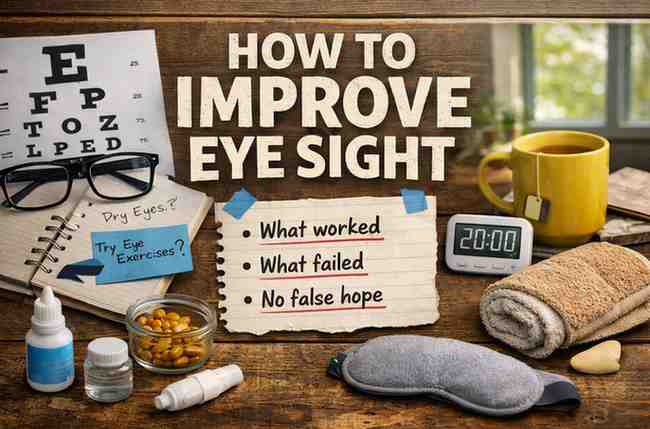
Not gonna lie… I didn’t start trying → to improve my eyesight because I was inspired.
I started because I was tired of squinting at street signs and pretending my eyes were “just dry.” Tired of the headaches. Tired of nudging my glasses up my nose like that was a solution. The first time I typed how to improve eye sight into Google, I was half-hopeful, half-embarrassed. It felt like admitting I’d messed up something basic. Vision is supposed to just… work, right?
It didn’t help that everything I found sounded magical or militant. Do these exercises. Buy this supplement. Stare at the sun (nope). Cut all screens forever (also nope). I wanted something that fit a normal life. I wanted relief without pretending I’d become a monk.
So I tried a lot. Some of it helped. Some of it was a waste of time. A couple things made my eyes worse for a bit because I overdid them. I’m not cured. I still wear glasses for driving at night. But my day-to-day strain is way down. The blur backs off faster when it shows up. And I don’t feel helpless about my eyes anymore. That part mattered more than I expected.
Here’s what that messy learning curve actually looked like.
The stuff that pushed me to try (and what I misunderstood at first)
I thought “bad eyesight” meant broken hardware. Like a cracked screen. Fixed or doomed.
What I didn’t get: a huge chunk of my problem was strain + habits. The way I stared at screens. The way I blinked less when stressed. The way I treated eye pain like background noise. I kept hunting for a silver bullet instead of fixing the daily grind that was grinding my eyes down.
Three misunderstandings that slowed everything:
-
I expected fast results.
I gave up on things after a week because nothing “dramatic” happened. My eyes don’t work on influencer timelines. -
I did too much at once.
Eye yoga, blue light glasses, supplements, posture fixes, hydration, no screens after 8 pm… all at once. Burned out in 10 days. -
I ignored sleep.
Thought eye health was about eyes only. Turns out tired eyes are just tired me.
That framing shift — from “fix my eyes” to “change how I use them” — is what finally moved the needle.
What I tried (and what actually stuck)
I’m going to be blunt here. Some popular stuff didn’t work for me at all. Some worked, but only when I stopped being intense about it.
1) The 20–20–20 rule (annoying, effective)
Every 20 minutes, look at something 20 feet away for 20 seconds.
I rolled my eyes at this. Then I set a timer. Then I forgot to follow it.
When I finally stuck with it for two weeks? The end-of-day burn eased up. The tight “helmet” headache I got from screens showed up less.
What surprised me:
It wasn’t the 20 seconds. It was the permission to stop staring. My eyes needed micro-breaks like my brain does.
Mistake I made: I tried to “optimize” it. 60 seconds every hour. Worse results. Small, frequent breaks beat heroic ones.
2) Blinking on purpose (felt silly, helped dryness a lot)
Screens made me blink like a robot.
I started doing slow, deliberate blinks when my eyes felt scratchy.
-
Close gently.
-
Pause half a second.
-
Open slow.
Two minutes of that when my eyes felt gritty helped more than drops sometimes.
Not always. But enough that I noticed.
What failed: forcing myself to blink constantly all day. I got tense. It backfired.
3) Warm compress at night (the low-effort win)
This one shocked me. I thought it was woo.
A warm compress over closed eyes for 5–10 minutes at night helped with that tired, sand-in-the-eyes feeling the next morning.
From what I’ve seen, at least, it helped my eyelids’ oil glands do their job. Less evaporation. Less dryness. Fewer “I can’t focus on this paragraph” moments.
What I’d do differently:
I microwaved a cloth too hot once. Don’t. Warm, not sauna.
4) Adjusting my screen setup (boring, huge impact)
This was the unsexy fix that worked.
-
Screen a little lower than eye level
-
Brightness matched to the room (no glowing rectangle in the dark)
-
Text size bigger than my ego wanted to admit
I thought posture stuff was for back pain. Nope. My eyes relaxed when my neck and shoulders stopped doing weird things.
Don’t repeat my mistake:
I waited months to fix this because it felt “too small” to matter. It mattered.
5) Going outside for distance vision (this helped more than exercises)
I started taking short walks and intentionally looking far away. Trees. Buildings. Clouds. Not doom-scrolling while walking.
After a few weeks, the “everything is slightly fuzzy after work” feeling eased faster.
Not cured. Just… less sticky.
This honestly surprised me. I expected eye exercises to help more than real-world distance. But my eyes liked variety more than drills.
6) Eye exercises (mixed bag)
I tried:
-
Near-far focusing
-
Figure-eight tracking
-
Palming (covering eyes and relaxing)
Near-far focusing helped a little with stiffness.
Figure-eights made me dizzy at first. I quit that one.
Palming felt good emotionally. Hard to measure physically. Still kept it.
Reality: exercises aren’t magic. They’re like stretching. Helpful if gentle. Harmful if forced.
7) Supplements (mostly a miss for me)
I tried lutein/zeaxanthin for a few months.
Didn’t notice a big difference. Maybe subtle? Hard to tell.
Not saying they’re useless. Just… not my breakthrough.
Food + sleep did more for me than pills.
8) Blue light glasses (meh)
They reduced glare a bit at night.
They didn’t fix strain by themselves.
Helpful tool. Not a solution.
9) Eye exams (humbling, necessary)
I delayed seeing an eye doctor because I wanted to “fix it naturally.”
That was dumb. Getting a proper check ruled out stuff I was low-key anxious about. It also meant my prescription wasn’t outdated. Straining with the wrong prescription is like trying to read with the wrong font size forever.
The routine that finally felt realistic
Nothing fancy. No biohacking circus. Just boring consistency:
Weekdays:
-
20–20–20 rule (I miss some. That’s okay.)
-
Bigger text + better lighting
-
Two short outdoor distance breaks
-
Slow blinks when dry
Nights:
-
Warm compress 5–10 minutes
-
No screens the last 30 minutes (I fail this more than I win)
That’s it.
When I stuck with this for about 4–6 weeks, I noticed:
-
Less end-of-day burning
-
Faster recovery from blur
-
Fewer tension headaches
-
Less panic about my eyes “getting worse”
Not a miracle. But relief. Real relief.
People Also Ask (quick, honest answers)
Can you really improve eyesight naturally?
Sometimes you can improve comfort, reduce strain, and make vision feel clearer. Structural vision issues (like certain refractive errors) usually don’t reverse completely. Relief ≠ cure.
How long does it take to see results?
For strain and dryness, I felt changes in 2–4 weeks. For habits to stick, more like 6–8 weeks. It’s slow. Annoyingly slow.
Do eye exercises work?
They can help with flexibility and comfort if done gently. They won’t replace glasses for most people. Think support, not replacement.
Is it worth trying?
If your main problem is screen strain, dryness, or fatigue—yeah, it’s worth it. If you’re hoping to ditch your prescription overnight… you’re going to be disappointed.
Common mistakes that slowed my progress
-
Going too hard, too fast
Eye strain got worse when I forced long exercise sessions. -
Chasing hacks instead of habits
I wasted time on gimmicks when lighting and breaks were the real fix. -
Ignoring pain signals
Powering through strain just trained me to notice it later. -
Expecting permanent change in a week
My eyes didn’t get tired overnight. They weren’t going to recover overnight.
Objections I had (and what I think now)
“This sounds like placebo.”
Some of it might be. But even placebo that reduces pain is still relief →. Also, changing lighting and breaks isn’t placebo. That’s mechanics.
“I don’t have time for this.”
Neither did I. The routine only stuck when it took under 10 minutes total per day.
“If this worked, doctors would talk about it more.”
They do talk about breaks, posture, dryness, and lighting. It’s just not flashy advice, so it doesn’t trend.
Reality check (important)
This isn’t for everyone.
-
If you have eye disease, sudden vision changes, or pain that won’t quit, this routine is not your solution. Get checked.
-
If you’re expecting to reverse strong prescriptions, you’re setting yourself up for frustration.
-
If you can’t be patient for a month, this will feel pointless.
Also: some days your eyes will still feel awful.
Progress isn’t linear. I had “good weeks” followed by random bad days. That messed with my head more than the strain itself.
Short FAQ (the stuff I kept Googling)
Who should avoid DIY eyesight routines?
People with recent eye surgery, unexplained vision loss, or chronic eye conditions should follow medical guidance first.
Can this make things worse?
Yes, if you overdo exercises or use heat incorrectly. Gentle > intense.
Do you still wear glasses?
Yep. Especially for night driving. And that’s okay.
Practical takeaways (no hype, just what helped me)
What to do
-
Take tiny, frequent visual breaks
-
Fix your screen setup
-
Spend time looking far away
-
Treat dryness early, not when it’s unbearable
-
Sleep like it matters (because it does)
What to avoid
-
Forcing eye exercises
-
Chasing miracle fixes
-
Ignoring prescriptions
-
Staring through discomfort
What to expect emotionally
-
Initial doubt
-
Boredom
-
Small wins that feel too small
-
Random bad days that test your patience
What patience actually looks like
-
Sticking with boring habits for a month
-
Not quitting after one bad week
-
Letting “slightly better” count as progress
No guarantees here.
Just a way to stop feeling powerless about your eyes.
So yeah — how to improve eye sight isn’t a single trick. It’s a bunch of unsexy choices stacked together. Some days I still catch myself squinting at a screen like it owes me money. Then I remember to look up. Breathe. Blink. Step outside for a minute.
No, this isn’t magic.
But for me? It stopped feeling impossible.
And that was enough to keep going.