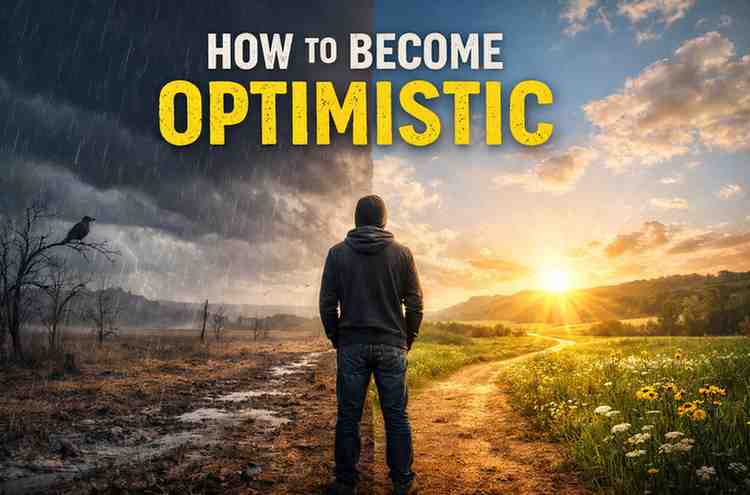
Honestly, most people I’ve watched try to become optimistic hit a wall in the first two weeks.
They start strong. New journal. New podcast. Maybe a quote saved as their phone wallpaper.
Then life does what life does. A bad email. A market dip. An argument. A silent rejection. And suddenly they’re back in that familiar headspace — “See? This is why I don’t do optimism.”
From what I’ve seen up close, the problem isn’t that people can’t learn how to become optimistic.
It’s that they try to install it like an app.
Optimism isn’t an app. It’s a pattern interruption.
And most people try to interrupt the wrong pattern.
I’ve sat across from enough friends, clients, coworkers — and watched enough real emotional cycles — to see this clearly. The ones who eventually shift aren’t the most positive people.
They’re the ones who stop fighting reality and start changing how they interpret it.
That difference is everything.
Why People Want to Become Optimistic (And Why It’s Usually Not What They Think)
Most people don’t wake up thinking, “I want to be more optimistic.”
They wake up thinking:
-
“Why do I always assume the worst?”
-
“Why does my brain go straight to failure?”
-
“Why does everyone else seem calmer about setbacks?”
Optimism, in real life, usually means:
-
Less emotional whiplash
-
Fewer spirals
-
More resilience after bad days
-
Not feeling like you’re behind all the time
I didn’t expect this to be such a common issue, but almost everyone I’ve seen struggle with this does one thing wrong:
They think optimism means denying negative thoughts.
It doesn’t.
It means learning how not to marry them.
That distinction changes the entire process.
What Most People Get Wrong About How to Become Optimistic
Let me call out the big ones.
Because I’ve seen these fail repeatedly.
1. They try to “think positive” on demand
Affirmations shouted over anxiety.
Doesn’t work long-term.
Your brain doesn’t believe statements that contradict evidence it thinks it has. So you get internal resistance.
Instead of: “Everything will work out.”
What actually works better: “I don’t know how this will play out yet.”
It sounds small. It’s not.
Optimism grows from uncertainty tolerance, not forced certainty.
2. They confuse optimism with delusion
Optimism is not:
-
Ignoring risk
-
Overestimating outcomes
-
Betting everything on hope
From what I’ve seen, the most optimistic people are actually very realistic.
They say:
-
“This might fail.”
-
“That could hurt.”
-
“I might be wrong.”
But they also say:
-
“If it fails, I’ll adjust.”
That second sentence is the difference.
3. They expect fast emotional rewiring
This one frustrates people the most.
“How long does it take to become optimistic?”
Short answer:
For most people I’ve observed — 4 to 8 weeks before noticeable shift.
But.
The first 2–3 weeks often feel worse.
Why?
Because you become aware of your default pessimism before it softens.
That awareness phase is uncomfortable.
Most quit there.
The Pattern I Keep Seeing in People Who Successfully Become More Optimistic
After watching this across different personalities — entrepreneurs, students, parents, corporate professionals — I noticed 5 repeated behaviors.
Not personality traits.
Behaviors.
1. They question first reactions
Not suppress.
Question.
When something goes wrong, they pause and ask:
-
“Is this permanent?”
-
“Is this personal?”
-
“Is this catastrophic?”
Almost always, the answer to at least one of those is “No.”
That pause creates space.
Space reduces emotional intensity.
Reduced intensity = clearer thinking.
Clearer thinking = more hopeful outcomes.
2. They shorten prediction windows
This honestly surprised me after watching so many people try it.
Pessimistic minds predict 5 years out.
Optimistic minds focus on the next step.
Instead of:
-
“This failure means I’ll never succeed.”
They think:
-
“What’s the next useful move?”
Optimism grows when timelines shrink.
3. They collect evidence — slowly
Most people wait to feel optimistic before acting.
Successful optimists act first and let the evidence change their mood.
Small wins matter.
-
One task finished.
-
One honest conversation.
-
One avoided spiral.
The brain adapts to proof.
Not motivational speeches.
4. They stop consuming emotional junk
This one is uncomfortable.
But real.
Almost everyone I’ve seen struggle with this does this one thing wrong:
They feed their anxiety.
Constant news. Doom scrolling. Negative social comparisons.
You cannot become optimistic while repeatedly reinforcing threat narratives.
It’s neurological.
Input shapes interpretation.
5. They accept neutral days
This is underrated.
Optimism isn’t high energy happiness.
It’s steady neutrality with upward tilt.
The people who succeed don’t chase excitement.
They stabilize.
Stability makes room for hope.
What Consistently Fails (Even Though It Looks Good on Paper)
Let’s be blunt.
These approaches rarely stick:
-
Overconsumption of motivational content
-
Hyper-gratitude journaling when stressed
-
Toxic positivity circles
-
Forcing constant “good vibes”
Why they fail:
They bypass emotional processing.
If someone is burned out, telling them to “focus on blessings” feels dismissive.
Optimism grows from emotional honesty first.
Then reframing.
Not the other way around.
Quick FAQ (Straight Answers)
Is it worth trying to become optimistic?
From what I’ve seen — yes, if your pessimism is draining energy or damaging relationships.
No, if you think it will remove all stress.
Optimism reduces suffering.
It doesn’t eliminate reality.
How long does it realistically take?
Noticeable shifts: 4–8 weeks
Deep pattern change: 3–6 months
Assuming daily micro-adjustments.
Not perfection.
What if it doesn’t work for me?
Most people who say this:
-
Stopped during the awareness phase
-
Tried to skip discomfort
-
Expected mood before behavior change
Behavior first. Mood second.
Who should avoid this approach?
If you’re in acute depression or trauma recovery, optimism work alone may not be enough.
Professional support matters there.
This isn’t a replacement for therapy.
It’s a cognitive habit shift.
Objections I Hear All the Time
“I’m just realistic.”
Maybe.
But ask yourself:
Is your realism helpful or protective?
There’s a difference.
“I’ve always been this way.”
So had most people I’ve watched change.
Patterns feel permanent until they aren’t.
“What if optimism makes me careless?”
Healthy optimism includes risk awareness.
It just removes emotional paralysis.
The Emotional Reality No One Talks About
Here’s the part people don’t say out loud.
When you start learning how to become optimistic, you grieve your old identity.
If you’ve been “the cautious one” or “the realist” or “the one who doesn’t get disappointed,” optimism feels vulnerable.
Hope is risk.
Disappointment hurts more when you allow hope.
That’s real.
But what I’ve consistently seen is this:
People don’t regret hoping.
They regret chronic fear.
What Patience Actually Looks Like
Not:
-
Waking up positive
-
Loving setbacks
-
Smiling through chaos
It looks like:
-
Catching one spiral per day
-
Choosing one neutral interpretation
-
Not catastrophizing one mistake
That’s it.
Repeated.
Boring.
Effective.
Practical Takeaways (If You Actually Want to Do This)
If I were guiding someone step-by-step, here’s what I’d suggest:
Start Here
-
Notice your first interpretation of events.
-
Replace certainty with possibility.
-
Shrink timelines.
-
Reduce negative input.
-
Track micro-wins weekly.
Not daily.
Weekly gives perspective.
Avoid This
-
All-or-nothing mindset
-
Identity attachment to pessimism
-
Forcing happiness
-
Expecting speed
Expect This Emotionally
-
Resistance
-
Doubt
-
Occasional backslides
-
“This feels fake” moments
Normal.
Very normal.
If You’re Still Unsure
Ask yourself:
Is my current mental pattern helping me build the life I want?
If yes, keep it.
If not, experimenting with optimism isn’t naïve.
It’s strategic.
I won’t pretend this is magic.
I’ve seen people improve their stress tolerance dramatically. I’ve seen relationships soften. I’ve seen risk-taking become healthier.
I’ve also seen people quit too early.
So no — learning how to become optimistic won’t flip a switch overnight.
But I’ve watched enough real people stop feeling chronically stuck once they stopped trying to feel positive and started training their interpretation instead.
Sometimes that quiet shift — the ability to say “maybe this isn’t the end” — is the real win.
And from what I’ve seen, that’s usually enough to change everything.