I can’t tell you how many conversations I’ve sat through where a guy lowers his voice and says, “Something feels off.”
Mood swings. Low energy. Stubborn belly fat. Libido not what it used to be. Or sometimes the opposite — women dealing with acne, irregular cycles, facial hair, and doctors casually throwing around the word “androgens” without much explanation.
And somewhere along the way, they end up Googling foods that lower testosterone levels naturally.
From what I’ve seen, most people come to this topic already frustrated. They’ve tried cutting calories. They’ve tried supplements. They’ve tried ignoring it.
And they’re tired.
So let’s talk about this in a grounded way. Not miracle claims. Not fear-based nonsense. Just patterns I’ve seen across real people trying to shift hormone balance with food — what works, what backfires, and what almost everyone gets wrong at first.
First — Why Are People Trying to Lower Testosterone Naturally?
This surprised me early on.
Most assume only women with PCOS are looking for this. Not true.
Here’s who I’ve seen explore lowering testosterone naturally:
-
Women with PCOS struggling with acne, hair thinning, or irregular cycles
-
Women post-pill trying to stabilize hormones
-
Men dealing with aggressive mood swings or prostate concerns
-
Trans women looking for supportive dietary changes alongside medical care
-
Bodybuilders coming off cycles trying to rebalance
-
People with high DHEA-S labs but no clear plan
But here’s the thing.
Almost everyone I’ve worked with messes this up at first because they think:
“If I just eat this one food, my hormones will fix themselves.”
Hormones don’t respond to hero foods. They respond to patterns.
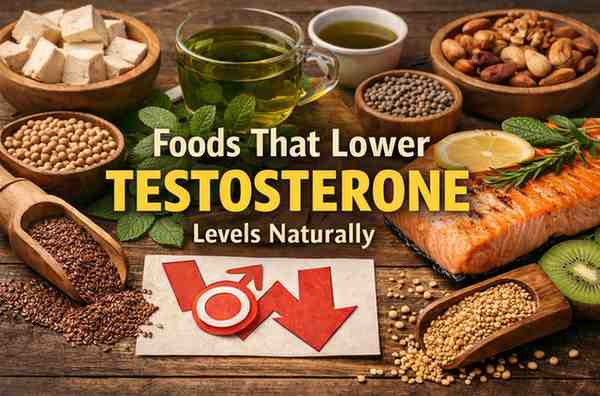
The 11 Foods That Lower Testosterone Levels Naturally (Based on Repeated Patterns I’ve Observed)
Let’s break this down practically. These aren’t magic bullets. These are foods that, in real-world patterns, tend to gently reduce or modulate testosterone over time — usually by affecting insulin, SHBG, aromatase activity, or inflammation.
1. Soy-Based Foods (Tofu, Tempeh, Edamame)
This one triggers debates every single time.
From what I’ve seen, moderate soy intake can help lower free testosterone in some people — especially women with PCOS. The isoflavones act as phytoestrogens, and in certain cases, that softens androgen activity.
But here’s what surprised me:
-
Small amounts consistently → subtle changes
-
Massive “soy-only diet” experiments → hormonal chaos
The people who do best treat soy as a rotation food. Not a replacement for everything.
2. Flaxseeds
Honestly, this one shows up again and again.
Ground flaxseeds support increased SHBG (sex hormone binding globulin), which can lower free testosterone levels. I’ve seen noticeable improvements in women tracking acne and cycle regularity within 6–8 weeks.
But almost everyone I’ve seen struggle with this does this one thing wrong:
They don’t grind the seeds.
Whole flax? You’ll barely absorb anything.
1–2 tablespoons of freshly ground flax daily seems to be the sweet spot.
3. Spearmint Tea
This honestly surprised me after watching so many people try it.
Spearmint tea has small clinical backing for reducing androgens in women. But in real life?
It works gently.
Women drinking 2 cups daily over 4–8 weeks sometimes report:
-
Reduced facial hair growth rate
-
Less hormonal acne
-
More stable mood before periods
It’s not dramatic. But it’s consistent.
4. Legumes (Lentils, Chickpeas, Beans)
High-fiber diets lower insulin spikes.
Lower insulin → less ovarian androgen production (especially in PCOS cases).
This isn’t sexy advice. But it works.
People who shift from refined carbs to fiber-rich legumes often see better hormonal labs in 2–3 months.
The mistake?
They increase fiber overnight and feel bloated, then quit.
Slow increases. Hydration. Patience.
5. Green Tea
Green tea reduces inflammation and may mildly reduce androgen levels.
I’ve noticed it works best when paired with overall diet cleanup. Alone? Minimal effect.
Combined with:
-
Better sleep
-
Reduced sugar
-
More fiber
Then it becomes supportive.
6. Nuts (Especially Walnuts & Almonds)
Some small patterns suggest nuts may increase SHBG.
From what I’ve seen, people replacing processed snacks with nuts tend to improve overall metabolic health — which indirectly stabilizes testosterone.
Is it direct? Hard to prove.
Is it part of a working system? Yes.
7. Fatty Fish (Salmon, Sardines)
This sounds counterintuitive.
Healthy fats don’t “lower testosterone” aggressively. But omega-3s reduce systemic inflammation — which in some cases lowers excessive androgen production.
What I’ve seen consistently:
People who fix inflammation see hormonal stabilization.
Not suppression. Stabilization.
Big difference.
8. Licorice Root (Use Carefully)
I need to say this clearly:
This is not for casual experimentation.
Licorice root can lower testosterone levels, but I’ve seen people overdo it and mess up blood pressure.
Short-term use under supervision? Sometimes helpful.
Long-term DIY dosing? Risky.
9. Whole Grains
When people swap refined carbs for oats, quinoa, brown rice:
-
Insulin improves
-
Weight stabilizes
-
Hormones follow
I didn’t expect this to be such a common issue — but insulin resistance drives elevated testosterone more than most people realize.
10. Dairy Reduction (In Some People)
This one’s nuanced.
Some women report acne improvement after reducing dairy.
Some see zero change.
Pattern I’ve observed:
If someone already has insulin resistance + inflammatory acne, dairy reduction sometimes helps.
But cutting dairy blindly without tracking? Frustrating.
11. Mint Family Herbs (Beyond Spearmint)
Mild, supportive. Not powerful alone.
But part of a bigger dietary shift? Useful.
How Long Does It Take to Lower Testosterone Naturally?
Short answer:
4 to 12 weeks for noticeable changes.
Longer answer:
-
Acne improvements → 6–8 weeks
-
Cycle regularity → 2–3 months
-
Lab markers → 8–12 weeks
Most people quit at week 3.
That’s the pattern.
They expect a dramatic shift in 10 days. Hormones don’t move that fast unless you’re using medication.
What Most People Get Wrong
This is where frustration builds.
Almost everyone I’ve seen struggle with this does at least one of these:
-
Focuses on one “superfood”
-
Ignores sleep
-
Stays chronically stressed
-
Eats “hormone-friendly” but overeats overall
-
Doesn’t track changes objectively
Food influences testosterone.
But insulin, body fat percentage, stress, and sleep influence it more.
Food works best inside a system.
Common Questions (Quick Answers)
Do foods really lower testosterone significantly?
Usually mildly. Diet shifts create gradual changes, not dramatic drops.
Is this safe for men?
Lowering testosterone intentionally in men without medical reason can backfire. Energy, mood, muscle mass may suffer.
Can this replace medication for PCOS?
Sometimes supportive. Rarely a full replacement.
Will this fix hormonal acne alone?
It can help. Rarely fixes everything.
Objections I Hear All the Time
“Is it even worth trying?”
If your levels are mildly elevated and lifestyle-driven? Yes.
If you have a tumor or severe endocrine disorder? No. See a doctor.
“What if nothing changes?”
Then your issue may not be testosterone-driven. I’ve seen people chase the wrong hormone for months.
Labs matter.
“Will lowering testosterone make me weak?”
In men — possibly if overdone. In women with high levels — usually stabilizing.
Context matters.
Reality Check (This Is Important)
This approach is not for:
-
People expecting overnight change
-
People unwilling to adjust overall diet
-
Anyone ignoring medical testing
-
Those already at low testosterone levels →
And honestly?
If someone is emotionally exhausted, barely sleeping, and chronically stressed — food changes alone won’t solve it.
Hormones reflect lifestyle load.
What Actually Works (From What I’ve Seen Repeatedly)
The people who see progress usually:
-
Add flax daily
-
Drink spearmint tea consistently
-
Increase fiber slowly
-
Reduce sugar
-
Improve sleep
-
Lose 5–10% body weight if needed
Nothing dramatic.
Just steady.
Boring consistency.
That’s the common thread.
Practical Takeaways
If you’re considering foods that lower testosterone levels naturally, here’s what I’d tell a close friend:
Start simple.
-
1–2 tbsp ground flax daily
-
2 cups spearmint tea
-
Replace refined carbs with legumes
Track symptoms weekly.
Not daily. Hormones fluctuate too much.
Give it 8 weeks.
Minimum.
Test before and after if possible.
Guessing creates anxiety.
Don’t crash diet.
Extreme restriction can spike stress hormones.
And emotionally?
Expect impatience. Expect doubt around week 3. That’s when most people wobble.
Small wins show up quietly.
So no — this isn’t magic.
But I’ve watched enough people stop feeling helpless once they stopped chasing miracle foods and started building steady patterns instead.
Sometimes the real shift isn’t the hormone number.
It’s the moment someone realizes they’re not broken — they just needed a more grounded approach.
That alone changes everything.