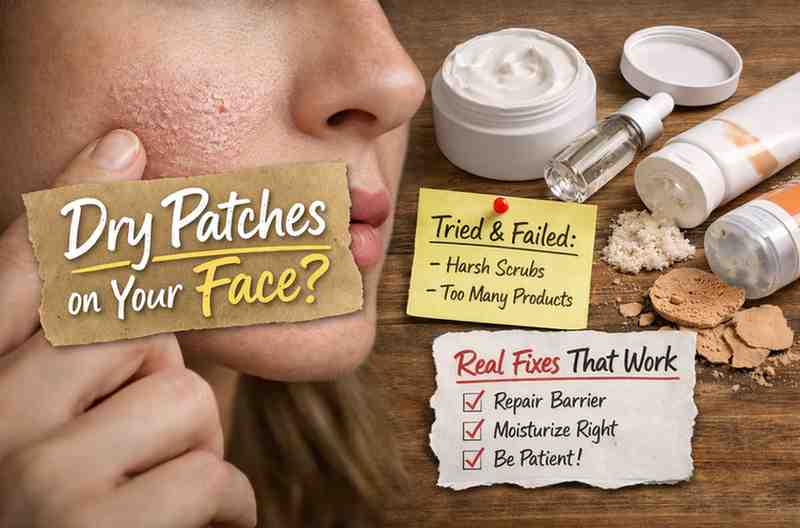
I can’t tell you how many people I’ve watched panic over dry patches on your face like it’s some kind of personal failure.
A friend will text me a close-up selfie. “Why is this happening? I drink water. I moisturize. I’m not even doing anything crazy.”
And yet — there it is. Flaky skin near the nose. A tight, dull patch on the cheek. Rough texture that foundation clings to like Velcro.
Most of the time, the reaction is the same: they start doing more. More products. More exfoliation. More “hydrating” masks. And almost every time, that makes it worse.
From what I’ve seen across dozens of real routines — dry patches aren’t about laziness or bad hygiene. They’re usually about overcorrection, confusion, and a skin barrier that’s quietly overwhelmed.
Let’s break this down in the way I wish someone had explained it to them earlier.
What Dry Patches on Your Face Usually Mean (Beyond “Your Skin Is Dry”)
This is the first misunderstanding.
Dry patches don’t always mean you have dry skin.
I’ve seen people with oily skin get them.
I’ve seen people with acne-prone skin get them.
I’ve seen people who just switched cleansers get them.
What’s usually happening:
-
The skin barrier is compromised.
-
Moisture is escaping faster than it should.
-
Something in the routine is irritating — even if it’s labeled “gentle.”
-
Or the weather shifted and the routine didn’t.
In the U.S., this gets worse during:
-
Winter heating season (indoor air is brutally dry)
-
High-AC environments
-
Sudden climate shifts (travel between states)
Almost everyone I’ve worked with messes this up at first — they treat the symptom (flaking) instead of the cause (barrier damage).
And flaking is often the last stage of irritation, not the first.
The Pattern I Keep Seeing Over and Over
Here’s the cycle I’ve watched repeat:
-
Skin feels tight.
-
Person exfoliates.
-
Skin feels smoother for a day.
-
Flakes return — worse.
-
They exfoliate harder.
-
Patch turns red. Stings.
-
Now it’s not just dry. It’s reactive.
I didn’t expect this to be such a common issue, but almost everyone I’ve seen struggle with dry patches does this one thing wrong:
They try to “scrub away” the dryness.
Dryness isn’t dead skin.
It’s unprotected skin.
That shift alone changes everything.
The 9 Fixes That Actually Help (From What I’ve Observed)
These aren’t trendy. They’re consistent.
1. Stop Exfoliating for 7–10 Days
Yes, even chemical exfoliants.
Most people hate hearing this.
But every single time someone pauses exfoliation, the irritation calms down within a week.
Your skin needs stability, not stimulation.
2. Switch to a Boring Cleanser
I mean truly boring.
No fragrance. No actives. No “brightening.” No foaming if it leaves your skin tight.
If your face feels squeaky clean? That’s not a win.
From what I’ve seen, skin improves fastest when cleansing feels neutral. Not stripped.
3. Use a Moisturizer With Barrier-Support Ingredients
Look for:
-
Ceramides
-
Fatty acids
-
Glycerin
-
Petrolatum (yes, even if TikTok hates it)
People get scared of thicker creams. Especially in humid states like Florida or Texas.
But dry patches need reinforcement.
Thin gel moisturizers almost never fix established patches. They’re maintenance — not repair.
4. Apply Moisturizer to Damp Skin
This sounds minor.
It’s not.
Almost everyone I’ve guided through this forgets this step at first.
Apply within 60 seconds of washing. Skin should still feel slightly damp.
That small habit shift changes absorption dramatically.
5. Seal It at Night (Strategically)
Not full-face slugging unless your skin tolerates it.
Instead:
-
Dab a thin layer of petrolatum just on the patch.
-
Do this 3–4 nights in a row.
This honestly surprised me after watching so many people try it — localized occlusion works better than drowning your entire face.
6. Check for Hidden Irritants
Common culprits I’ve seen:
-
New laundry detergent (pillowcase exposure)
-
Retinol layered too frequently
-
Vitamin C with low pH
-
Acne treatments applied “just near” the patch
-
Hot showers hitting the face
People swear nothing changed. Then we trace it back. Something always did.
7. Don’t Add New Serums “To Help”
When someone adds hyaluronic acid, peptides, and a calming essence all at once — it usually delays recovery.
Barrier repair loves simplicity.
One cleanser. One moisturizer. Sunscreen.
That’s it for 10–14 days.
8. Use Sunscreen Even If It’s Cloudy
This one’s overlooked.
Dry patches get darker and more textured when exposed to UV.
Healing skin + sun = slower recovery.
I’ve watched patches linger for weeks longer in people who skip SPF.
9. Give It Time (Longer Than You Think)
Here’s the realistic timeline from what I’ve seen:
-
Mild irritation: 5–7 days
-
Moderate barrier damage: 2–3 weeks
-
Chronic over-exfoliation: 4+ weeks
People quit at day 6 because it’s not perfect yet.
Skin isn’t instant.
That’s where most frustration builds.
What People Get Wrong About Dry Patches on Your Face
Let me be blunt.
They assume:
-
“If it flakes, it needs exfoliation.”
-
“If it’s dry, it needs more products.”
-
“If it doesn’t improve in a week, it’s not working.”
No.
It needs consistency.
And boredom.
And patience.
That part is hard.
How Long Does It Take to See Improvement?
Short answer:
Most people notice softness return in 5–10 days if they truly stop irritating it.
Visible flaking reduction? Usually 1–2 weeks.
Full texture normalization? Often 3–4 weeks.
If nothing changes after 4 weeks, that’s when I suggest:
-
Evaluating for eczema
-
Checking for seborrheic dermatitis
-
Or consulting a dermatologist
Sometimes it’s not just dryness.
And that’s okay.
When This Approach Might Not Be Enough
Who this may not fully fix:
-
People with diagnosed eczema
-
People using prescription acne treatments
-
Those in extremely dry climates (Colorado winters are brutal)
-
People who refuse to simplify
If someone insists on keeping their exfoliating toner, retinol, AND daily acids?
This won’t work.
I’ve seen that stubbornness delay healing for months.
Common Mistakes That Slow Recovery
Almost everyone I’ve seen struggle with this does at least one of these:
-
Testing new products mid-repair
-
Using hot water
-
Applying moisturizer too thin
-
Skipping sunscreen because “I’m indoors”
-
Picking at flakes
The picking one… that’s emotional. I get it.
But it resets progress every time.
Objections I Hear All the Time
“But I have oily skin. Why would I get dry patches?”
Because oil and hydration aren’t the same thing. Oily skin can still have a damaged barrier.
“Won’t petrolatum clog my pores?”
On intact skin, usually no. On inflamed skin, it often protects better than it harms.
“I tried moisturizer and it didn’t help.”
Which one? How long? Were actives paused?
Most people try repair while still irritating the skin daily.
That’s not repair.
Quick FAQ (Straight Answers)
What causes dry patches on your face suddenly?
Weather shifts, over-exfoliation, new products, retinol misuse, or barrier disruption.
Are dry patches a sign of dehydration?
Sometimes. But more often they signal barrier damage.
Should I exfoliate dry patches?
Not at first. Repair first. Exfoliate only after full recovery.
Can stress cause dry patches?
Indirectly, yes. Stress affects barrier repair and inflammation.
The Emotional Side No One Talks About
This sounds dramatic.
But I’ve watched people feel genuinely embarrassed about visible flakes.
They cancel plans.
They overblend makeup.
They obsess in bathroom mirrors.
The small win moment?
When they text: “It feels normal again.”
Not perfect.
Just normal.
That relief is real →.
Practical Takeaways (If You’re Stuck Right Now)
If you’re dealing with dry patches on your face:
Do this:
-
Pause exfoliation for 10 days.
-
Use a simple cleanser.
-
Apply a thick, barrier-focused moisturizer on damp skin.
-
Spot-seal at night.
-
Wear sunscreen daily.
-
Don’t add new actives.
Avoid this:
-
Scrubs.
-
Over-layering.
-
Constant product switching.
-
Hot water.
-
Impatience.
Expect this emotionally:
-
Doubt around day 4.
-
Mild improvement around day 7.
-
Visible softening by week 2.
-
Temptation to “add something” too soon.
Patience looks boring.
But boring works.
Still — this isn’t magic.
Some cases need dermatologists. Some take longer. Some require prescription help.
But from what I’ve seen, most people don’t have a complicated skin disease.
They have irritated skin that needs less interference.
And once they stop trying to fix it aggressively, it finally calms down.
Sometimes the biggest shift isn’t a new product.
It’s stepping back.
And letting your skin breathe again.