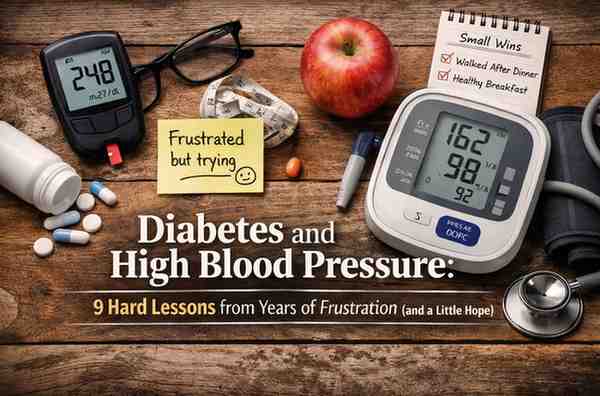
Not gonna lie… I used to treat Diabetes and High Blood Pressure like two separate fires. One pill for sugar. Another for pressure. Different doctors. Different plans. Different days.
It felt organized.
It was also a mess.
I remember staring at my home monitor one night, watching my numbers jump around like they were mocking me. Sugar high. Pressure high. Mood low. I kept thinking, I’m doing what they told me. Why does this still feel out of control?
That’s the part nobody really prepares you for. The stuck feeling. The quiet fear that maybe you’re the problem. The guilt when you slip. The tiny wins that don’t feel big enough to celebrate.
This isn’t a neat success story. It’s more like a journal I never meant to publish. Mistakes, trial-and-error, some things that actually helped, and a few surprises I didn’t expect at all.
The moment it clicked: these two problems are kind of the same fight
I used to manage them like this:
-
Diabetes = food problem
-
High blood pressure = salt + stress problem
Clean boxes. Easy logic.
Except my body didn’t follow my boxes.
What I didn’t get at first:
Both issues feed off the same stuff.
-
Inflammation
-
Insulin resistance
-
Poor sleep
-
Chronic stress
-
Inconsistent routines
So I’d “fix” my sugar for a week… and my pressure would spike.
Then I’d cut salt for blood pressure… and my sugar would swing because I was eating random low-salt junk.
This honestly surprised me. I expected separate solutions. What I actually needed was one boring, unsexy foundation.
What I misunderstood (and paid for)
I thought meds would do most of the work
They helped. They didn’t fix my habits.
I treated medication like a shield.
As long as I took it, I felt entitled to small “cheats.”
Those cheats stacked.
I thought stress was optional
I’d roll my eyes when people said stress affects numbers.
Then I had a week of family drama + poor sleep.
My readings went nuts. No food changes. Just stress.
That was a humbling week.
I thought consistency meant perfection
I’d go hard for 10 days.
Then crash.
Then feel ashamed.
Then quit.
Turns out boring consistency beats intense motivation. Every time.
What actually helped both Diabetes and High Blood Pressure (for me, at least)
Not magic. Just patterns I noticed after messing this up enough times.
1. One simple routine beat five “perfect” plans
I stopped chasing perfect diets.
I picked a repeatable base:
-
Protein + fiber at every main meal
-
Walk after dinner (even 10 minutes)
-
Water before coffee
-
Same breakfast most days
It wasn’t exciting.
But my numbers calmed down faster than when I tried fancy protocols.
2. Walking worked better than I expected
I hated this answer at first. Felt too basic.
But short walks did more than intense workouts I kept skipping.
-
Sugar dropped more steadily
-
Blood pressure didn’t spike as much
-
My mood stabilized (which mattered more than I expected)
3. Sleep fixed things I couldn’t “discipline”
When sleep sucked:
-
I craved sugar
-
My pressure climbed
-
I snapped at people
When sleep improved, everything felt… less uphill.
This part annoyed me.
You can’t “willpower” bad sleep away.
What failed (so you don’t repeat my mistakes)
-
Extreme low-carb without planning → rebound eating
-
Overdoing cardio → burnout + skipped weeks
-
Cutting salt so hard food tasted like sadness → didn’t last
-
Tracking everything → anxiety spiral
-
Ignoring mental health → numbers went up anyway
If your plan makes you miserable, you won’t stick to it. Period.
The part nobody tells you about timelines
How long does it take to see changes?
From what I’ve seen, at least:
-
Blood sugar →: small improvements in 1–3 weeks
-
Blood pressure: more stubborn, 3–8 weeks for noticeable change
-
Energy/mood: inconsistent at first, then steadier
Progress wasn’t a straight line.
Some weeks felt like backward steps.
That didn’t mean it wasn’t working.
Mini FAQ (the stuff people quietly Google at 2 a.m.)
Is it worth trying to manage both at once?
Yeah. It’s frustrating. But splitting them made things harder for me.
Can lifestyle changes replace meds?
Sometimes. Often not right away. Don’t rush this. I didn’t.
What if my numbers don’t improve?
That doesn’t mean you failed. Sometimes meds need adjusting. Sometimes sleep or stress is the real issue.
Is diet alone enough?
For me? No. Diet + movement + sleep worked together. Alone, each one stalled.
Common mistakes that slowed my progress
-
Going all-in for a week, then quitting
-
Comparing my progress to someone else’s
-
Ignoring small improvements
-
Thinking one bad reading meant total failure
-
Trying to “earn” junk food with workouts
Honestly, consistency beats intensity. I learned that the hard way.
Objections I had (and still kind of have)
“This is too slow.”
Yeah. It is.
But slow beats stuck.
“I don’t have time for walks.”
I didn’t either. I found 10 minutes after dinner. That was enough to start.
“My situation is different.”
True. Everyone’s is.
But patterns repeat. Stress, sleep, food quality, movement… they matter for most people dealing with Diabetes and High Blood Pressure.
“I’ll start when life calms down.”
Life didn’t calm down.
I started anyway.
Reality check (because sugarcoating helps no one)
This isn’t for you if:
-
You want a 7-day reset that fixes everything
-
You’re looking for a miracle food
-
You hate routines
-
You’re not ready to look at sleep and stress honestly
Results can be slow.
Setbacks happen.
Some weeks feel pointless.
Also, numbers can improve and you still feel tired.
That part messed with my head. Progress doesn’t always feel like progress.
Practical takeaways (the boring, useful stuff)
What to do:
-
Pick 1–2 habits you can repeat daily
-
Walk after your biggest meal
-
Eat protein + fiber first
-
Protect your sleep like it’s medicine
-
Track trends, not single readings
What to avoid:
-
Extreme plans you can’t repeat
-
Guilt spirals after slip-ups
-
Comparing your timeline to anyone else’s
What to expect emotionally:
-
Frustration
-
Random hope
-
Doubt
-
Small wins that feel too small
-
Occasional “oh… this is working” moments
What patience looks like:
-
Doing the boring thing again
-
Not quitting after one bad week
-
Adjusting instead of restarting
No guarantees.
No hype.
Just momentum you build quietly.
I won’t pretend this fixed everything.
There are days I still mess it up. Days I skip walks. Days I eat like I’m mad at myself.
But managing Diabetes and High Blood Pressure stopped feeling like two enemies fighting me at once.
It became one long, imperfect process I’m learning to work with instead of against.
So no — this isn’t magic.
But for me? It stopped feeling impossible.
And that was enough to keep going.