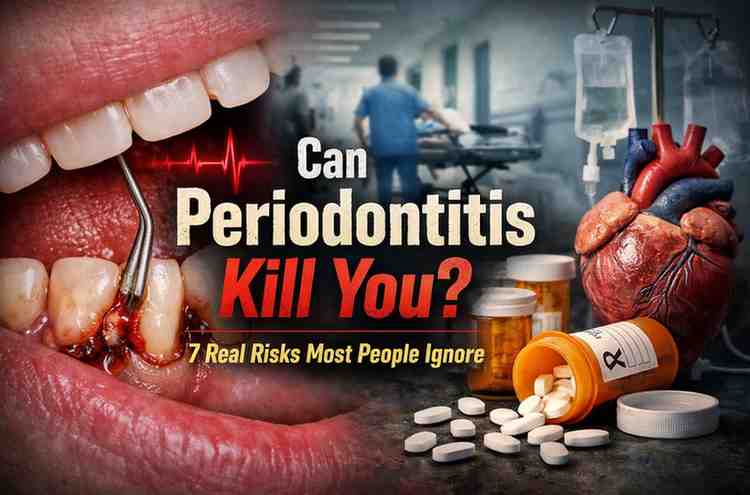
I can’t tell you how many times someone has leaned in, lowered their voice, and asked me, “Wait… can periodontitis kill you?”
Not casually. Not academically. But with that tight look in their face.
Usually after a dentist appointment. Or after googling bleeding gums at 1:30 a.m.
From what I’ve seen, the fear doesn’t come from the word periodontitis itself. It comes from the silence around it. People know it’s “serious.” They don’t know how serious. And when Google throws heart disease and infection into the mix, the mind runs.
So let’s talk about this the way I’ve talked about it with real people sitting across from me.
No drama. No minimizing. No sugarcoating either.
First, Direct Answer: Can Periodontitis Kill You?
Short answer: Not directly in most cases. But untreated periodontitis can contribute to serious, life-threatening health problems.
That nuance matters.
Periodontitis itself is a chronic inflammatory gum disease →. What makes it dangerous isn’t the gums alone. It’s what long-term inflammation and infection can do to the rest of the body.
And honestly? Most people I’ve worked with completely underestimate that part.
What I’ve Seen in Real Life (The Pattern Most People Miss)
When someone is first told they have periodontitis, their reaction usually falls into one of three camps:
-
“It’s just gums. I’ll deal with it later.”
-
“I brush every day, this makes no sense.”
-
Full panic mode: “Is this going to kill me?”
The dangerous group isn’t the panickers.
It’s the postponers.
Almost everyone I’ve seen struggle long-term with this does one thing wrong:
They treat it like a cosmetic issue instead of a systemic one.
Bleeding when brushing. Mild gum recession. Some bad breath. They think it’s annoying — not threatening.
And for months, sometimes years, it quietly progresses.
Why Periodontitis Is More Serious Than It Sounds
Here’s what surprised me after watching so many cases unfold:
The mouth is not separate from the body.
When gum infection becomes chronic, bacteria and inflammatory byproducts can enter the bloodstream. Over time, this contributes to systemic inflammation.
And systemic inflammation is not small.
Research has consistently linked untreated periodontitis with:
-
Cardiovascular disease
-
Increased stroke risk
-
Complications in diabetes
-
Respiratory infections
-
Pregnancy complications
-
In rare severe cases, bloodstream infections (sepsis)
Now — pause.
That does not mean everyone with periodontitis is in danger of dying.
But it does mean long-term neglect increases risk.
And I’ve watched people regret ignoring → that early stage when it was still manageable.
The 7 Real Risks Most People Ignore
These are the patterns I’ve seen repeatedly.
1. Tooth Loss (It Happens More Quietly Than You Think)
This is the most common outcome.
People assume teeth just “suddenly” fall out.
No. What I’ve seen is slow bone loss. Years of it.
Then one day a tooth feels loose.
That moment hits hard.
And by then, reversal isn’t possible. Only management.
2. Chronic Inflammation That Affects the Heart
From what I’ve seen, this is the one doctors take most seriously.
There’s a consistent link between advanced gum disease and cardiovascular problems.
Is it the sole cause? No.
But it contributes to overall inflammatory burden.
And if someone already has risk factors — high blood pressure, obesity, diabetes — ignoring gum disease stacks the deck against them.
3. Diabetes Complications
This one goes both ways.
I didn’t expect this to be such a common issue, but:
-
Diabetes makes gum disease worse.
-
Gum disease makes blood sugar harder to control.
It becomes a loop.
People who stabilize their gum health often see improved glucose control. That pattern shows up again and again.
4. Increased Stroke Risk
Still debated in specifics, but the association exists.
Chronic inflammation changes vascular function.
Again — not a direct cause. But a contributor.
5. Pregnancy Complications
I’ve seen OBs take this very seriously.
Untreated periodontal disease has been linked to preterm birth and low birth weight.
It’s not guaranteed.
But it’s preventable risk.
6. Respiratory Infections in Older Adults
Especially in nursing home settings.
Oral bacteria can be aspirated into the lungs.
This honestly surprised me when I first started paying attention to long-term care cases.
7. Rare but Severe Systemic Infection
This is uncommon — but possible.
If infection spreads into the bloodstream, sepsis can occur.
Rare.
But real.
And when people ask, “Can periodontitis kill you?” this is usually what they’re afraid of.
What Most People Get Wrong at First
Almost everyone I’ve worked with messes this up at first:
They think brushing harder will fix it.
It won’t.
Periodontitis isn’t about surface plaque alone. It’s about bacteria under the gumline and the body’s inflammatory response.
Another mistake?
Skipping deep cleanings because “it feels expensive.”
I’ve watched people delay scaling and root planing for two years to save money.
Then pay triple in surgical procedures later.
Short-term avoidance. Long-term cost.
How Long Does It Take for Periodontitis to Become Dangerous?
This is one of the biggest “People Also Ask” questions.
The honest answer: It’s slow. Until it isn’t.
Most progression happens over years.
But risk increases when:
-
It’s untreated for a long time
-
The person smokes
-
Diabetes is uncontrolled
-
Oral hygiene is inconsistent
-
There are other inflammatory conditions
In relatively healthy adults who treat it early?
Risk of life-threatening complications is low.
In neglected cases over a decade?
The systemic burden adds up.
What Actually Works (From What I’ve Seen)
Here’s the pattern among people who stabilize their condition:
-
They stop pretending it’s minor.
-
They commit to professional treatment.
-
They change daily habits consistently — not perfectly.
The Routine That Consistently Works
-
Professional scaling and root planing
-
Periodontal maintenance every 3–4 months
-
Soft brushing technique (not aggressive)
-
Daily flossing or water flosser
-
Antimicrobial rinse when recommended
-
Managing blood sugar → if diabetic
-
Quitting smoking (huge difference)
It’s not glamorous.
It’s repetitive.
But I’ve seen bone loss stabilize when people stick to this.
What Repeatedly Fails
Let me be blunt here.
Things that look good on paper but fail in real life:
-
DIY oil pulling as the only treatment
-
Herbal-only approaches without professional care
-
Waiting until pain appears
-
Thinking no pain = no problem
-
Switching dentists every year
-
Inconsistent follow-ups
Periodontitis can progress without pain.
That’s the trap.
Objection Section: “But My Gums Only Bleed a Little”
I hear this constantly.
Bleeding is not normal.
Healthy gums don’t bleed from brushing.
Mild bleeding can be early gingivitis — which is reversible.
But once bone loss begins, that’s periodontitis.
Waiting to see “if it gets worse” is what turns manageable cases into complicated ones.
Is It Worth Treating Aggressively?
If you’re asking whether treatment is worth it — yes.
But not because it will “save your life tomorrow.”
It’s worth it because:
-
It prevents tooth loss.
-
It reduces systemic inflammation.
-
It protects long-term health.
-
It lowers future dental costs.
-
It gives you control.
What I’ve noticed emotionally?
People feel relieved once they act.
The anxiety reduces once there’s a plan.
Who This Approach Is NOT For
If someone wants:
-
A quick fix
-
A one-time cleaning solution
-
A natural-only cure without dental intervention
-
Zero lifestyle change
They’re going to hate managing periodontitis.
Because this is maintenance-based care.
Not a cure-and-forget situation.
FAQ (Short, Direct, Search-Friendly)
Can periodontitis kill you directly?
Rarely. But untreated cases can contribute to serious systemic disease.
Is periodontitis reversible?
Gingivitis is reversible. Periodontitis is manageable, not reversible.
How fast does it progress?
Usually slowly over years, faster with smoking or uncontrolled diabetes.
Does treatment actually lower risk?
Yes. Reducing inflammation and bacterial load reduces systemic burden.
Reality Check
This isn’t about fear.
It’s about probability.
Most people with periodontitis will not die from it.
But ignoring it absolutely increases risk over time.
The people who do well are not the ones who panic.
They’re the ones who get consistent.
Practical Takeaways
If you’re dealing with this right now:
-
Get a full periodontal evaluation.
-
Ask about bone levels.
-
Don’t skip deep cleaning if recommended.
-
Improve daily hygiene slowly but steadily.
-
Address smoking or blood sugar issues.
-
Schedule maintenance before you “feel like you need it.”
Emotionally?
Expect frustration at first.
Expect annoyance at frequent appointments.
Expect some guilt for not catching it earlier.
Then expect stability.
That’s usually how it goes.
So… can periodontitis kill you?
Not in the dramatic, overnight way people fear.
But from what I’ve seen, neglecting it long-term quietly increases risks you don’t need to carry.
This isn’t magic. It’s not catastrophic either.
It’s manageable.
And honestly, I’ve watched enough people move from panic to control once they understood that.
Sometimes that shift alone is the real win.