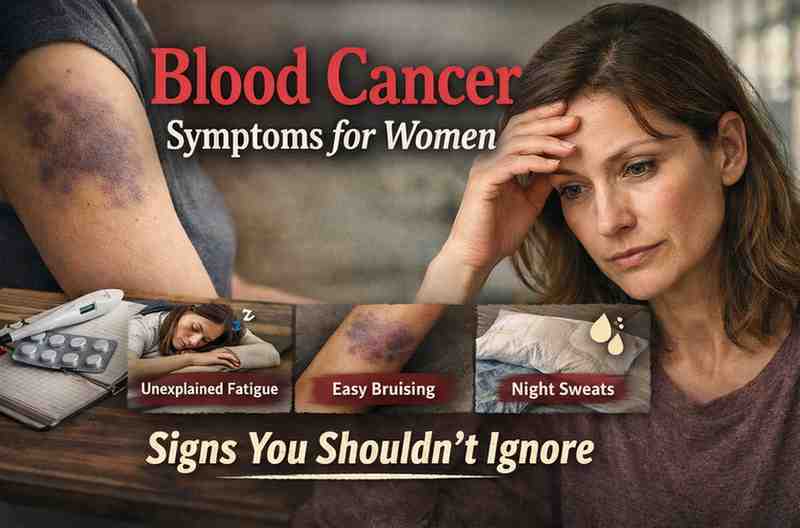
Honestly, most women I’ve sat with didn’t walk into a clinic thinking, “This might be cancer.”
They thought: stress. Hormones. Perimenopause. Iron deficiency. Burnout. Being a mom. Working too much. Not sleeping enough.
And from what I’ve seen, that’s exactly why blood cancer symptoms for women get missed early. Not because women ignore their health — but because the symptoms blend into everyday life so easily.
I’ve watched women explain away bruises. Normalize bone pain. Laugh off night sweats. Apologize for being “dramatic” about fatigue that was anything but normal.
It’s not ignorance.
It’s pattern confusion.
And when you see this across multiple cases, you start noticing the same early signals that almost everyone overlooks at first.
Let’s talk about those.
Why Blood Cancer Symptoms for Women Get Misread So Often
Most blood cancers — like Leukemia, Lymphoma, and Multiple Myeloma — don’t always start with dramatic pain.
They start vague.
Subtle.
Almost boring.
From what I’ve seen:
-
Women attribute fatigue to hormones.
-
They blame weight loss on stress.
-
They think frequent infections are just “a bad season.”
-
They assume bruising is from bumping into furniture.
This honestly surprised me after watching so many women delay testing — not because they didn’t care, but because nothing felt urgent enough.
Blood cancers affect the bone marrow and blood cells. When those cells don’t work properly, your body slowly loses efficiency.
And it whispers before it screams.
17 Blood Cancer Symptoms for Women I’ve Seen Repeatedly Overlooked
Some women have one or two. Others have clusters. The pattern matters more than a single symptom.
1. Fatigue That Doesn’t Improve With Rest
Not “I’m tired.”
More like:
-
You wake up exhausted.
-
Coffee stops working.
-
You feel physically heavy.
Almost everyone I’ve seen struggle with this dismissed it for months.
When fatigue is tied to anemia (low red blood cells), it doesn’t improve with sleep.
That’s a red flag.
2. Frequent Infections
-
Repeated sinus infections
-
UTIs
-
Lingering colds
-
Slow recovery from simple illnesses
If white blood cells aren’t functioning correctly, your immune defense weakens.
Most people I’ve worked with mess this up at first. They treat each infection separately instead of asking, “Why do I keep getting sick?”
3. Easy Bruising or Unexplained Bruises
You don’t remember hitting anything.
Bruises appear on legs or arms randomly.
This often relates to low platelets.
And almost every woman I’ve seen brushed it off as clumsiness.
4. Heavy or Unusual Menstrual Bleeding
This one is important for women.
Low platelets can cause:
-
Heavier periods
-
Bleeding between cycles
-
Longer cycles than usual
Many women assume it's hormonal.
Sometimes it is.
But sometimes it’s not.
5. Night Sweats (Not Just Warm Room Sweats)
Drenching.
Sheets soaked.
Clothes changed.
Common with lymphomas.
Women often blame perimenopause. And sometimes that’s correct. But when night sweats pair with fatigue or swollen nodes — it deserves attention.
6. Swollen Lymph Nodes
Neck.
Armpits.
Groin.
Painless swelling that lingers.
If it lasts more than a few weeks without infection, it needs checking.
7. Bone or Joint Pain
Deep ache.
Not injury-based.
Often in hips, back, ribs.
This is common in multiple myeloma.
Most women think it’s posture or aging.
8. Shortness of Breath
Especially during mild activity.
Walking upstairs suddenly feels harder.
This can tie back to anemia.
9. Pale Skin
Subtle.
Washed out.
Friends may notice before you do.
10. Unintentional Weight Loss
Not dieting.
Not increasing activity.
Just shrinking.
This honestly surprises people because they don’t feel “sick enough” to justify it.
11. Persistent Fever Without Clear Cause
Low-grade.
Comes and goes.
12. Loss of Appetite
Not dramatic.
Just less interest in food.
13. Abdominal Fullness
An enlarged spleen can cause this.
You feel full quickly.
14. Headaches + Dizziness
When anemia worsens.
15. Tiny Red Spots on Skin (Petechiae)
Pinpoint red dots.
Often on legs.
Many women mistake these for rashes.
16. Excessive Bleeding From Minor Cuts
Takes longer than usual to clot.
17. Persistent Itching Without Rash
Common in some lymphomas.
This one gets misdiagnosed as allergies often.
How Long Do Blood Cancer Symptoms for Women Usually Go Unnoticed?
From what I’ve seen?
3–12 months.
Sometimes longer.
Because:
-
Symptoms are mild early.
-
They mimic common conditions.
-
Women push through discomfort.
The delay isn’t stupidity.
It’s normalization.
What Most Women Get Wrong At First
Almost everyone I’ve seen struggle with this does one thing wrong:
They isolate symptoms.
They don’t connect them.
Fatigue + bruising + infections together tell a story.
Individually, they look harmless.
Pattern recognition is everything here.
When Should You Actually Get Tested?
This is where nuance matters.
Get evaluated if:
-
Symptoms last more than 2–3 weeks
-
You have multiple symptoms at once
-
You feel progressively worse
-
Blood work shows unexplained anemia or abnormal counts
Most blood cancers show up on basic blood tests first.
A simple CBC (complete blood count) can reveal a lot.
Still — normal labs don’t always rule everything out. If symptoms persist, push further.
Quick FAQ (People Also Ask Style)
What are the earliest blood cancer symptoms for women?
Fatigue, frequent infections, unexplained bruising, and night sweats are among the earliest patterns I’ve seen.
Are blood cancer symptoms different in women?
Not drastically, but menstrual changes and heavier bleeding often show up more noticeably in women due to platelet issues.
Can symptoms be mild at first?
Yes. That’s the tricky part. Many start vague and build slowly.
Is it worth getting checked if you’re unsure?
If symptoms cluster or persist — yes. Peace of mind alone can be worth it.
Objections I Hear All The Time
“I’m probably overreacting.”
Maybe. But I’ve seen too many women underreact.
“It’s probably stress.”
It might be. But stress doesn’t cause unexplained bruising.
“I don’t want to seem dramatic.”
Doctors would rather run a simple test than diagnose something late.
Reality Check Section
Let’s ground this.
Most fatigue is not cancer.
Most bruises are not cancer.
Most night sweats are hormonal.
Blood cancer is statistically less common than everyday explanations.
But.
If your body feels off in multiple ways and it’s not improving — ignoring it doesn’t make you strong. It just delays clarity.
Also — not every abnormal lab means cancer.
And diagnosis can take time.
And sometimes symptoms lead to something treatable and less serious.
No guarantees either way.
Who This Article Is NOT For
-
Someone with one mild symptom lasting a few days.
-
Someone with clear alternative explanations improving quickly.
-
Someone looking for self-diagnosis instead of medical evaluation.
This is for women noticing patterns that don’t resolve.
What Consistently Works (From What I’ve Observed)
-
Track symptoms.
-
Write them down.
-
Notice clusters.
-
Ask for blood work early.
-
Advocate calmly but firmly.
The women who got clarity faster were the ones who brought patterns, not panic.
What Repeatedly Fails
-
Waiting 6+ months hoping it fades.
-
Explaining away every symptom individually.
-
Letting dismissal shut down follow-up.
Emotional Reality
The hardest part?
The waiting.
The uncertainty.
The Google spirals at 2 AM.
I’ve watched women oscillate between “It’s nothing” and “It’s everything.”
That middle space is exhausting.
Practical Takeaways
If you’re worried:
-
Start with a primary care visit.
-
Ask for a CBC.
-
Discuss symptom duration honestly.
-
Follow up if results are unclear but symptoms persist.
Emotionally:
Expect anxiety.
Expect doubt.
Expect moments of embarrassment.
Still — clarity beats guessing.
Blood cancer symptoms for women don’t usually arrive dramatically. They accumulate.
And I’ve seen enough women feel relief just from finally → connecting the dots — whether the outcome was serious or not.
So no — this isn’t about panic.
It’s about attention.
Most of the time, it’s something manageable.
But on the rare occasion it isn’t, early awareness changes everything.
And sometimes that quiet shift — from brushing it off to taking yourself seriously — is the real turning point.