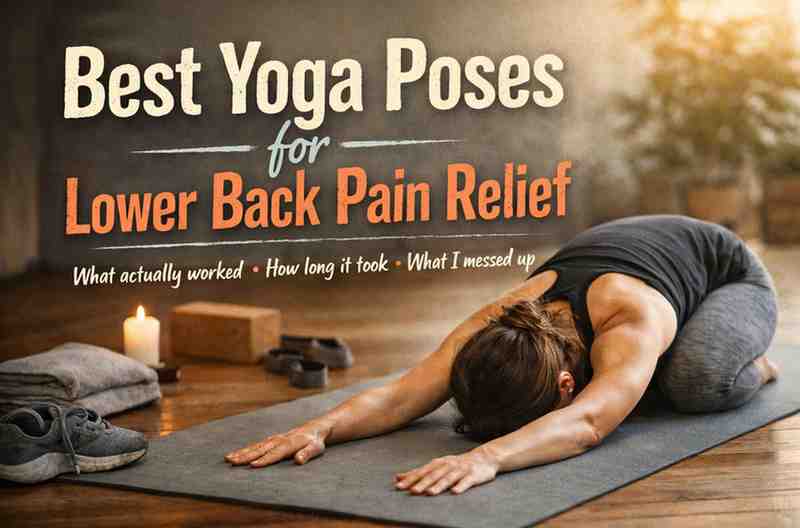
Honestly, I didn’t think this would work. I’d already tried heating pads, painkillers, YouTube “10-minute miracle” routines, and one very expensive chair that promised to fix my posture. My lower back still felt like it was quietly plotting against me every time I stood up. I was tired. A little embarrassed, too. Still, I kept circling back to Best Yoga Poses for Lower Back Pain Relief → because people wouldn’t shut up about them. So I tried. Half hopeful. Half rolling my eyes.
Not gonna lie… I messed this up at first. I rushed it. Picked random poses. Skipped warm-ups. Got sore in new, creative ways. But after a few weeks of doing it badly, then a few months of doing it less badly, something shifted. The pain didn’t vanish. It stopped running my life. That felt huge.
This is the messy, lived-in version of what actually helped my lower back. No miracles. Just real patterns I noticed, mistakes I made, and what I’d do differently if I had to start over tomorrow.
Why I even tried yoga (after swearing I wouldn’t)
I’m not a “stretchy person.” My hamstrings feel like guitar strings someone tuned too tight. I also sit a lot. Work, driving, doomscrolling. My lower back pain started as a dull ache. Then it became this constant background noise.
What I misunderstood at first:
-
I thought yoga was about flexibility.
-
I thought pain meant I was “doing it right.”
-
I thought 10 minutes once in a while would be enough.
Spoiler: none of that was true for me.
What pushed me to try anyway was frustration. Physical therapy helped a bit but felt clinical. The gym made my back angry. Walking helped… until it didn’t. Yoga felt like a low-stakes experiment. If it sucked, I could quit.
The 9 yoga poses that actually helped my lower back (from what I’ve seen, at least)
These aren’t fancy. They’re the boring basics that I kept coming back to. The order matters more than I expected. Starting gentle made everything else safer.
1) Child’s Pose (Balasana)
This one surprised me. It felt too easy to matter.
What it did for me:
-
Gave my lower back a break without collapsing into bad posture
-
Let me breathe into tight spots
-
Made my nervous system chill out (which mattered more than I thought)
Mistake I made: forcing my hips down. Don’t. Let gravity do the work.
2) Cat–Cow (Marjaryasana–Bitilasana)
This became my daily reset button.
Why it worked:
-
Gentle movement instead of static stretching
-
Helped me notice where I was stiff vs. guarding
-
Woke up my spine without drama
How long it took to feel helpful: immediately. Relief wasn’t permanent, but the session-to-session ease showed up fast.
3) Sphinx Pose
I used to jam into backbends like I was trying to win a contest. Bad idea.
Sphinx gave me:
-
A mild, controlled extension
-
Less compression than Cobra
-
A way to test if extension helped my pain (it did, but gently)
Reality check: If extension hurts your back, skip this. Not everyone’s pain likes backbends.
4) Knees-to-Chest (Apanasana)
This one feels like a hug for your spine.
Why it worked:
-
Decompressed my lower back after sitting all day
-
Gave immediate relief when things felt jammed
Tiny tweak: rock side to side. I didn’t expect that to help. It did.
5) Supine Twist (gentle version)
Twists scared me. I thought I’d “throw something out.”
What changed:
-
Keeping both shoulders heavy
-
Not forcing the knee down
-
Breathing through resistance
This honestly surprised me. Twists made my back feel less locked up the next morning.
6) Figure Four (lying down)
My lower back pain wasn’t just my back. My hips were part of the mess.
Figure Four:
-
Loosened my hips
-
Reduced that “pull” feeling in my lower back
-
Made standing up from chairs less dramatic
Common mistake: yanking the knee in. Let it float. Use patience. (I hated that advice. It works.)
7) Bridge Pose (gentle, supported)
Strength mattered more than stretching. I learned that late.
Bridge helped:
-
Wake up my glutes
-
Take pressure off my lower back
-
Build trust in extension again
What failed: holding it too long. Short holds, more reps worked better for me.
8) Seated Forward Fold (with bent knees)
Forward folds used to wreck me.
What changed:
-
Bending my knees
-
Folding from hips, not rounding my back
-
Stopping way earlier than my ego wanted
Who should avoid deep forward folds: anyone with disc issues who hasn’t been cleared by a pro. This can backfire.
9) Legs Up the Wall
This is my “I can’t deal today” pose.
Why it helped:
-
Took pressure off my spine
-
Reduced end-of-day swelling in my legs
-
Calmed my brain, which weirdly helped my pain
My real routine (what I actually stuck to)
Not a perfect flow. Just what fit my life.
On good days (15–20 minutes):
-
Cat–Cow (1–2 minutes)
-
Child’s Pose (1 minute)
-
Sphinx (30–60 seconds, twice)
-
Figure Four (30–60 seconds per side)
-
Bridge (5–8 short holds)
-
Supine Twist (30–60 seconds per side)
On bad days (5–8 minutes):
-
Knees-to-Chest
-
Child’s Pose
-
Legs Up the Wall
Consistency beat intensity. I hate that this is true. But it is.
How long did it take to feel real relief?
Short answer: I felt some relief right away.
Long answer: noticeable, lasting change took about 4–6 weeks of doing this most days.
What changed first:
-
Less stiffness in the morning
-
Easier transitions (standing up, getting out of the car)
What took longer:
-
Fewer flare-ups
-
Less fear of movement
-
More trust in my body
If you’re hoping for overnight relief, this might annoy you. It annoyed me too.
Common mistakes that slowed my progress (learn from my chaos)
-
Pushing into pain
Discomfort is one thing. Sharp pain is your body yelling. I ignored it. That backfired. -
Skipping rest days
I thought more was better. My back disagreed. -
Random YouTube hopping
Too many styles. No consistency. Pick one gentle approach and stick to it for a few weeks. -
Ignoring strength
Stretching alone didn’t fix my problem. Bridge and gentle core work mattered. -
Comparing myself to bendy people
Just… don’t. It messes with your head.
Objections I had (and what actually happened)
“Is this worth trying, or is it just another wellness trend?”
For me, it was worth trying because the downside was low. No equipment. Low cost. Low risk when done gently. The upside wasn’t magic—but it was meaningful.
“I’m not flexible. Will this even work?”
I wasn’t either. Still not. Flexibility wasn’t the point. Awareness + consistency was.
“What if yoga makes my pain worse?”
It can, if you push or pick the wrong poses. That’s real. Start slow. If pain spikes and stays, stop and reassess.
“I don’t have time.”
Five minutes on bad days still helped more than zero. That’s the honest truth →.
Who this approach is NOT for
This matters. Yoga isn’t neutral for everyone.
Skip DIY yoga for lower back pain if you:
-
Have severe or worsening pain without a diagnosis
-
Have numbness, tingling, or weakness down one leg
-
Recently had surgery or trauma
-
Were told by a clinician to avoid certain movements
Get cleared first. Please. This isn’t about toughness. It’s about not making things worse.
Reality check (no hype, just truth)
Yoga didn’t “cure” my lower back pain.
It didn’t erase bad days.
It didn’t fix my job chair.
It didn’t magically undo years of sitting.
What it did:
-
Gave me tools
-
Reduced the intensity and frequency of flare-ups
-
Helped me feel less helpless in my own body
Some weeks, progress stalled.
Some days, I felt worse after a session.
Then the pattern continued.
Then, slowly, the baseline improved.
That part isn’t sexy. But it’s real.
Quick FAQ (the stuff people actually ask)
Do the Best Yoga Poses for Lower Back Pain Relief work for sciatica?
Sometimes. Gentle poses helped my sciatica-like symptoms. Deep forward folds made them worse. Go slow. If nerve pain spikes, stop.
How often should I do these poses?
3–5 times a week worked for me. Daily short sessions beat long, random ones.
Can beginners do this at home?
Yes, if you keep it gentle and boring at first. That’s where the wins are.
Do I need props?
A pillow, a folded blanket, a wall. That’s enough.
What if nothing helps after weeks?
That’s information. It might mean you need a different approach or professional guidance. Not failure. Just data.
Practical takeaways (what I’d tell my past self)
-
Start stupidly gentle. You’re not proving anything.
-
Build strength, not just stretch.
-
Track patterns. What makes you feel better tomorrow, not just today.
-
Expect uneven progress. Two steps forward, one step back is still forward.
-
If pain spikes and sticks around, stop and get help. Seriously.
I’m not here to sell you a miracle. I didn’t find one.
But these Best Yoga Poses for Lower Back Pain Relief took my pain from “this is ruining my mood and my sleep” to “this is annoying, but manageable.”
That shift changed how I showed up to my days.
It made me less afraid to move.
Less dramatic getting out of bed.
Less mad at my own body.
So no—this isn’t magic.
But for me? It stopped feeling impossible.
And that was enough to keep going.