Honestly, most people I’ve watched try to quit drinking don’t fail because they love alcohol too much. They fail because they underestimate how social, emotional, and automatic it’s become.
I’ve sat across kitchen tables while someone swore they were “done this time.” I’ve watched friends make it 10 days, feel incredible, then cave at a Friday birthday dinner because they didn’t know how to handle that one awkward moment when everyone raised a glass.
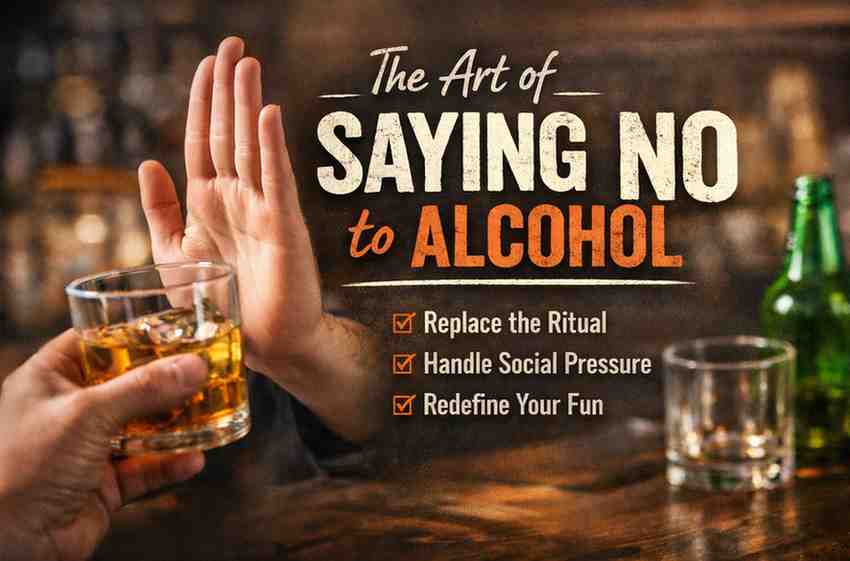
That’s where the Art of Saying No to Alcohol actually lives. Not in detox plans. Not in motivational quotes. But in those five-second social exchanges. In the pause before answering, “You’re not drinking?”
From what I’ve seen, the struggle isn’t physical after the first week. It’s identity. It’s habit. It’s belonging.
And almost everyone I’ve worked with messes this up at first.
They think saying no is about willpower.
It’s not.
It’s about strategy.
Why People Decide to Stop (But Rarely Talk About the Real Reason)
Most people don’t → wake up and suddenly hate alcohol.
The patterns I’ve noticed are quieter:
-
They’re tired of losing Saturdays.
-
Their sleep is wrecked.
-
Anxiety is creeping in.
-
They don’t like how they act after the third drink.
-
They feel behind financially.
-
They’re building something (career, business, fitness) and alcohol keeps slowing momentum.
Especially in the U.S., where drinking is normalized everywhere — sports events, work dinners, networking, dating apps, suburban barbecues. Opting out can feel like stepping sideways from culture itself.
What surprised me after watching so many people try → this?
The decision rarely comes from a dramatic rock-bottom moment.
It comes from repeated mild regret.
That quiet, “Why did I do that again?”
What Most People Get Wrong About Saying No
Here’s the biggest mistake I’ve seen:
They try to eliminate alcohol without replacing the role it plays.
Alcohol is rarely just a drink →. It’s:
-
A stress-release ritual
-
A social lubricant
-
A reward after hard work
-
A way to avoid awkward silence
-
A shortcut to feeling included
If you remove it without replacing those functions, your brain panics.
Almost everyone I’ve seen struggle with this does this one thing wrong:
They focus on resisting alcohol instead of redesigning their environment.
That’s a massive difference.
The 9 Shifts That Actually Make the Art of Saying No to Alcohol Work
These aren’t theoretical. These are patterns I’ve seen → work repeatedly across different personalities and lifestyles.
1. Decide Before You Arrive
The people who succeed don’t → negotiate at the bar.
They decide at home.
“I’m not drinking tonight.”
Not “I’ll see how I feel.”
That tiny internal contract matters. Decision fatigue disappears when the answer is pre-made.
2. Script Your First Sentence
It sounds silly. But it’s powerful.
Most relapses happen in the first 30 seconds of social pressure.
Simple scripts I’ve seen work:
-
“I’m good tonight.”
-
“Taking a break.”
-
“Early morning tomorrow.”
-
“I feel better without it.”
No speeches. No defensiveness.
Short answers reduce follow-up questions.
3. Always Hold Something
This honestly surprised me after watching so many people try → it.
If your hands are empty, people offer drinks. Constantly.
Sparkling water with lime. Club soda. NA beer. Iced tea.
Once you’re holding something, social pressure drops by at least 60%. That’s not scientific. Just a pattern I’ve seen → over and over.
4. Expect a Two-Week Identity Dip
Nobody talks about this.
Around days 7–14, people feel… weird.
-
Slightly bored
-
Slightly restless
-
Unsure who they are at social events
They assume something’s wrong.
It’s not.
You’re adjusting to being fully present without chemical smoothing.
It passes. But if you don’t expect it, you interpret it as failure.
5. Replace the Ritual, Not Just the Drink
From what I’ve seen, this is non-negotiable.
If someone used to pour wine at 7 p.m., they need a new 7 p.m. ritual.
Examples I’ve seen stick:
-
Evening walk
-
Fancy mocktail ritual
-
Tea in a specific glass
-
Gym session at the time they used to drink
-
Deep dive into a hobby
It’s not about distraction. It’s about rewiring the cue.
Cue → ritual → reward.
Change the ritual. Keep the reward.
6. Redesign Who You Spend Time With (Temporarily)
This part makes people uncomfortable.
But almost every long-term success story I’ve observed involved social adjustments.
Not necessarily cutting people off.
But reducing exposure to heavy-drinking environments during the first 30–60 days.
That window matters more than people think.
7. Track Sleep Improvements
Sleep is the secret motivator.
Within 10–21 days, most people I’ve worked with report:
-
Deeper sleep
-
Clearer mornings
-
Lower anxiety
When they see that data — even casually in a notes app — it reinforces the choice.
8. Prepare for the “You’ve Changed” Comment
You probably will hear it.
Sometimes it’s neutral. Sometimes defensive.
This is where people doubt themselves.
But from what I’ve seen, that comment usually says more about the other person’s habits than yours.
9. Redefine Fun (This Takes Longer Than You Think)
Here’s the honest timeline I’ve noticed:
-
Week 1: Physical adjustment
-
Week 2–3: Social discomfort
-
Week 4–6: Mental clarity increases
-
Month 2–3: Identity stabilizes
Fun doesn’t disappear. It shifts.
But it’s slower. Less explosive. More grounded.
Some people love that.
Some people hate it.
How Long Does It Take to Get Comfortable Saying No?
Short answer: about 30 days for it to feel less awkward.
60–90 days for it to feel natural.
The first 5 invitations are the hardest.
After that, people start remembering you as “the one who doesn’t drink.” Social resistance drops dramatically.
Common Mistakes That Slow Everything Down
Most people I’ve worked with mess this up at first:
-
They don’t tell close friends their plan.
-
They rely on motivation instead of systems.
-
They test themselves too early (“Let’s see if I can just have one.”)
-
They don’t prepare for boredom.
-
They romanticize their drinking memories.
That last one is huge.
They remember the highlight reel. Not the anxiety, the cost, the bad sleep.
Is the Art of Saying No to Alcohol Worth It?
If someone is drinking lightly and it isn’t affecting sleep, mood, finances, or relationships?
Maybe not.
This approach is not for everyone.
But for the people I’ve seen → who:
-
Feel stuck in cycles
-
Wake up with regret
-
Want sharper focus
-
Are building something meaningful
Yes.
The mental clarity alone often becomes addictive in a healthier way.
Who Will Struggle Most With This?
Honest answer:
-
People whose entire social life revolves around bars
-
People who haven’t built alternative stress outlets
-
People trying to “prove” they have control
If someone is doing this to win an argument or impress others, it rarely sticks.
It has to feel self-directed.
Objections I Hear All the Time
“I don’t have a problem. I just want balance.”
Totally fair.
But if balance hasn’t worked repeatedly, that’s data.
Not failure. Just data.
“I’ll lose friends.”
From what I’ve seen, you lose drinking buddies.
Not real friends.
Sometimes that distinction hurts.
“Life will be boring.”
Short-term? Slightly.
Long-term? Most people report more energy, deeper conversations, and stronger routines.
But yes — the early phase feels flatter.
Quick FAQ (Straight Answers)
Does saying no to alcohol improve anxiety?
For many people, yes — especially after 2–4 weeks when sleep stabilizes.
What’s the hardest part?
Social pressure in the first month.
Can you still go to bars?
Yes, but early on, it’s easier to limit exposure.
Is moderation better than quitting?
Depends on the individual. Many people I’ve observed struggle → more with moderation than full abstinence.
The Reality Check No One Likes Hearing
The Art of Saying No to Alcohol won’t fix:
-
Deep trauma
-
Chronic loneliness
-
Career dissatisfaction
-
Relationship problems
It removes a numbing agent.
That clarity can feel empowering.
Or confronting.
Sometimes both.
If someone expects instant happiness, they’ll be disappointed.
If they expect clearer data about their life?
They usually get it.
Practical Takeaways (If You’re Seriously Considering This)
If I were guiding someone starting tomorrow, I’d say:
Do this:
-
Decide for 30 days minimum.
-
Tell one trusted person.
-
Replace the evening ritual.
-
Prepare a script.
-
Track sleep and mood.
Avoid this:
-
“Just one to test myself.”
-
Announcing it dramatically.
-
Going into high-pressure drinking events in week one.
-
Comparing your timeline to others.
Expect:
-
Mild boredom.
-
Emotional clarity.
-
Subtle confidence increases.
-
Fewer regrets.
-
More free mornings.
Patience looks like this in practice:
Week 2 feels awkward.
Week 4 feels clearer.
Week 8 feels stable.
Not perfect. Stable.
I didn’t expect this to be such a common issue when I first started paying attention to it. But after watching so many people try — → some quietly succeeding, some quietly struggling — the pattern became obvious.
Saying no to alcohol isn’t dramatic.
It’s subtle.
It’s a series of small social decisions that slowly reshape identity.
So no — this isn’t magic.
But I’ve watched enough people → stop feeling stuck once they approached it strategically instead of emotionally. And sometimes that shift alone is the real win.
Not perfection.
Just fewer mornings filled with regret.