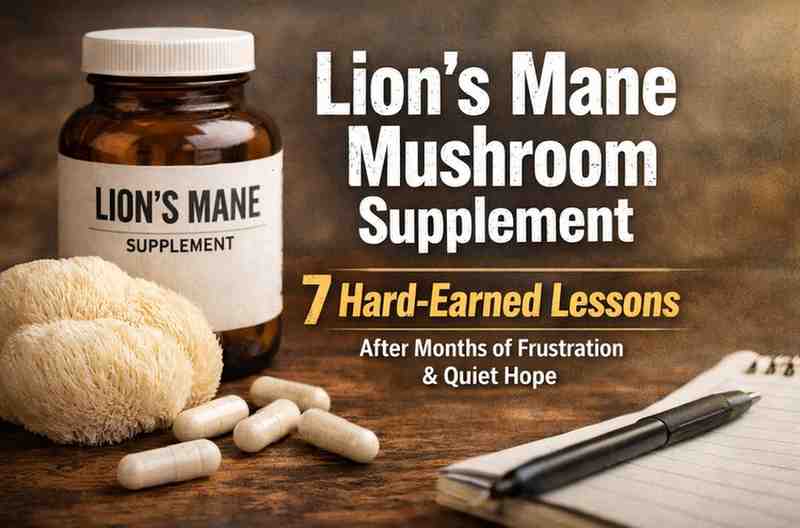
Honestly, I didn’t think this would work.
I’d already tried three other “brain things” and felt stupid for hoping again. Coffee made me anxious. L-theanine made me sleepy. Magnesium helped my legs cramp less but did nothing for the fog in my head. I was tired of feeling behind my own thoughts.
So when I bought a lions mane mushroom supplement, it wasn’t optimism. It was more like… fine, one more experiment. If this didn’t help, I’d stop chasing fixes and just accept that this weird mental drag was my new normal.
Not gonna lie, the first two weeks felt like nothing. I kept checking myself like, am I clearer yet? am I calmer? and then feeling annoyed that I even expected to notice anything. I almost quit. Again.
Still. Something small shifted. And that tiny shift is what kept me going.
Why I tried this in the first place (and what I misunderstood)
I wasn’t chasing some “limitless brain” fantasy. I just wanted to stop feeling scattered. My baseline was:
-
zoning out mid-sentence
-
rereading the same paragraph three times
-
that low-grade anxiety hum that never fully shuts up
-
motivation that showed up late and left early
I misunderstood a few things right out of the gate:
-
I thought I’d feel it on day one.
Spoiler: I didn’t. Not even a little. -
I assumed all products were basically the same.
Also wrong. Some are powdered mushroom filler with fancy labels. -
I expected a single supplement to “fix” me.
That mindset has burned me before. It burned me again here.
What pushed me to actually try a lions mane mushroom supplement was a friend who said, “It’s subtle. It just makes it easier to do the things you already know you should do.”
That line stuck. Easier sounded… believable.
What I bought (and the rookie mistakes I made)
I grabbed the first decently rated bottle I saw. Capsules. Cheap-ish. Looked fine.
Mistake #1: I didn’t check what part of the mushroom was used.
Turns out a lot of supplements use mostly mycelium grown on grain. That’s not automatically bad, but it can mean less of the compounds people actually want. I learned this after finishing half the bottle.
Mistake #2: I under-dosed because I was cautious.
I took half the suggested amount because I was worried about side effects. Which is fair. But also meant I gave myself a low chance of noticing anything.
Mistake #3: I took it randomly.
Some days morning. Some days afternoon. Some days I forgot. Consistency matters more than I wanted to admit.
If I could rewind, I’d start with:
-
a product that clearly states fruiting body content
-
a dose in the middle of the suggested range
-
same time every day (for me, morning with food)
From what I’ve seen →, at least, half the “it didn’t work” stories come down to this messy setup phase.
The slow part: how long it actually took to notice anything
This is where most people bounce.
For me:
-
Week 1–2: nothing.
No change. I felt dumb for even trying. -
Week 3: tiny shift in mental stamina.
Not focus fireworks. Just… fewer hard stops when I started something. -
Week 4–6: the fog thinned a little.
I wasn’t suddenly sharp. But I noticed I could hold a thought longer without it drifting off. -
Month 2+: the change felt normal.
Which sounds boring. But boring was the goal.
This honestly surprised me: the benefit didn’t feel like a “boost.”
It felt like removing friction.
I didn’t wake up smarter.
I just stopped hitting invisible walls as often.
What actually felt different (and what didn’t)
Here’s the cleanest way I can put it:
Things that shifted:
-
Starting tasks felt less heavy
-
My internal chatter softened a notch
-
Reading felt less exhausting
-
I could sit with a problem a bit longer before wanting to escape
Things that did NOT magically change:
-
I still procrastinated
-
My phone still hijacked my attention
-
Bad sleep still wrecked my brain
-
Stress still spiked when life got loud
So if you’re hoping a lions mane mushroom supplement will turn you into a productivity machine… yeah, you’re probably going to be disappointed.
It didn’t override my habits.
It just made better habits feel more doable.
The routine that finally stopped me from overthinking it
I kept tinkering until I landed on something boring and repeatable:
-
Take it in the morning with food
-
Pair it with one small, boring focus habit
-
for me: 10 minutes of reading before touching my phone
-
-
Drink more water than I thought I needed
-
Don’t stack five new supplements at once
That last one matters. I almost ruined this experiment by adding:
-
caffeine tweaks
-
nootropics
-
adaptogens
-
random powders
Then I couldn’t tell what was doing what. I messed this up at first and confused myself for weeks.
Once I simplified, patterns showed up.
Common mistakes that slow results (learned the annoying way)
If you’re going to try this, please don’t repeat my face-palm moments:
-
Expecting fast results
This isn’t caffeine. If you want instant, this will feel useless. -
Buying the cheapest option without checking the label
Some products are basically expensive rice. -
Changing three variables at once
You won’t know what helped. -
Quitting right before it might have started working
I almost stopped at day 18. That would’ve been peak irony. -
Ignoring sleep and still judging the supplement
If you sleep like trash, everything feels broken.
Is it worth it? (The part everyone actually wants to know)
Short answer: it depends on what you expect.
For me, it was worth it because:
-
the effect was subtle but real
-
I wasn’t chasing a miracle
-
I wanted marginal gains, not a personality transplant
For a friend of mine? Not worth it. He wanted something he could feel immediately. He got annoyed, called it placebo, and moved on.
Here’s my honest filter:
-
If you’re patient and okay with slow, quiet improvements → maybe worth trying
-
If you want a dramatic, noticeable “kick” → probably not your thing
-
If you’re already doing basics (sleep, some movement, less doom-scrolling) → better odds
-
If you’re hoping a supplement will save you from your habits → it won’t
Objections I had (and how they played out)
“Isn’t this just placebo?”
Maybe some of it. But placebo or not, the change stuck when I stayed consistent and vanished when I stopped. That pattern made me pay attention.
“Why not just drink more coffee?”
Coffee wired me and then dropped me. This didn’t spike or crash me. Different tool.
“Isn’t the research mixed?”
Yeah. That bothered me. Which is why I treated this like a personal experiment, not a belief system.
“This feels too subtle to matter.”
I said that too. Then I noticed I wasn’t dreading starting as much. Subtle can still matter.
Reality check: who this is NOT for
I wish someone had told me this upfront.
A lions mane mushroom supplement is probably not for you if:
-
you hate waiting weeks to judge anything
-
you want a guaranteed outcome
-
you’re dealing with serious mental health stuff and hoping a supplement replaces real support
-
you’re allergic to mushrooms
-
you’re already annoyed by supplements as a concept
It’s also not great if you’re the type who will forget to take it half the time and then blame the product.
No shade. I’ve been that person.
Short FAQ (the stuff people keep asking me)
How long does it take to work?
For me, 3–6 weeks for noticeable changes. Some people feel something sooner. Some don’t feel much at all.
Can I take it every day?
I did. I also took breaks to see if anything changed. The benefits faded slowly when I stopped.
What if it doesn’t work for me?
That’s possible. If you try it consistently for 6–8 weeks and feel nothing, I’d move on.
Can I stack it with other supplements?
You can, but I’d add things one at a time so you don’t confuse the signal.
Is it safe?
I didn’t have side effects. Some people report stomach issues or headaches. Start low. Listen to your body.
Practical takeaways (no hype, just what helped me)
-
Pick a product that clearly states what part of the mushroom it uses
-
Take it at the same time every day
-
Give it at least a month before judging
-
Don’t expect fireworks
-
Track one small metric (like how hard it feels to start a task)
-
Stop if your body doesn’t like it
-
Don’t let this replace sleep, food, movement, or actual support
Emotionally, expect this:
-
early doubt
-
mid-experiment boredom
-
small wins you almost dismiss
-
a weird moment where you realize things feel… less heavy
Patience here isn’t passive.
It’s paying attention without obsessing.
I won’t pretend this changed my life →.
It didn’t.
But it did something quieter that I didn’t expect. It made the gap between “I should do this” and “I’m doing this” feel a little smaller. Some days that gap is everything.
So no — this isn’t magic.
But for me? It stopped feeling impossible.
And that was enough to keep going.