Honestly… the first thing I noticed after talking to people dealing with low hemoglobin wasn’t the fatigue.
It was the confusion.
Friends, relatives, coworkers… even people who thought they were doing everything right.
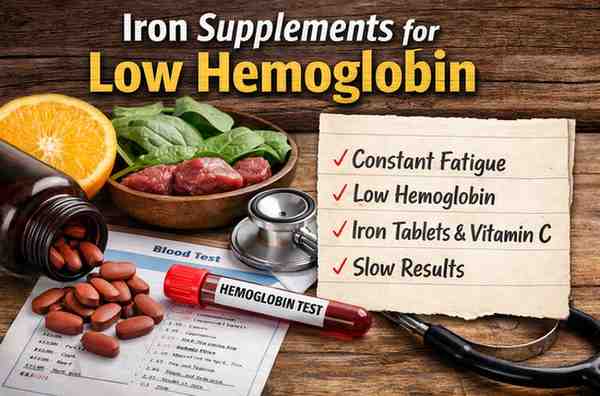
They were already taking iron supplements for low hemoglobin.
Yet months later they were still exhausted.
One woman I spoke with kept saying: “My doctor gave me iron tablets… so why do I still feel like I’m running on empty?”
That question shows up again and again.
And from what I’ve seen across dozens of people trying to fix → this — the issue usually isn’t whether they take iron.
It’s how they take it, what they expect, and what quietly sabotages absorption.
Because iron recovery isn’t as simple as swallowing a pill every morning.
I wish it were.
But the patterns are messy.
Some people feel better in three weeks.
Others take months.
Some respond beautifully to supplements.
Others struggle with stomach issues, slow blood changes →, or labs that barely move.
So what I’m sharing here isn’t theory.
It’s the patterns I’ve watched unfold again and again — the mistakes, the surprises, and the few strategies that consistently seem to help people climb out of that low-hemoglobin fog.
Why People Start Taking Iron Supplements for Low Hemoglobin
Most people don’t wake up one morning thinking about hemoglobin.
They notice the symptoms first.
Usually subtle.
Then gradually frustrating.
Across many conversations, the same complaints keep repeating:
-
Constant fatigue
-
Pale skin
-
Feeling dizzy when standing
-
Shortness of breath climbing stairs
-
Cold hands and feet
-
Brain fog
-
Headaches
One friend described it perfectly: “I thought I was just lazy. Turns out my blood literally wasn’t carrying enough oxygen.”
That’s essentially what low hemoglobin means.
Hemoglobin is the protein in red blood cells that carries oxygen through your body.
Iron is a core ingredient needed to make it.
When iron drops too low, the body struggles to produce enough healthy red blood cells.
And slowly… everything feels harder.
The First Mistake Almost Everyone Makes
Most people assume iron supplements work like pain medication.
Take pill → feel better tomorrow.
That expectation quietly destroys patience.
Because the body doesn’t rebuild blood overnight.
From what I’ve seen:
-
Energy may improve within 2–4 weeks
-
Full iron stores may need 3–6 months
That timeline surprises people.
I’ve watched several people stop supplements after only three weeks because they thought:
“It's not working.”
But iron recovery is a slow biological rebuild.
Your body has to:
-
Absorb the iron
-
Use it to make new red blood cells
-
Circulate those cells through the body
That process takes time.
What Surprised Me After Watching Many People Try Iron Supplements
This honestly shocked me.
The difference between people who improve quickly and those who struggle often comes down to small habits — not the supplement itself.
Here are the patterns I keep seeing →.
1. Coffee Is Quietly Blocking Absorption
This one comes up constantly.
People take iron in the morning… with coffee.
The problem?
Coffee contains compounds called polyphenols that reduce iron absorption.
And the reduction isn’t small.
Studies suggest it can drop absorption by 40–90%.
So what happens?
Someone takes iron daily for weeks.
Yet blood tests barely change.
Then they switch to taking it between meals with water or vitamin C.
Suddenly numbers improve.
From what I’ve seen, spacing iron at least 1–2 hours away from coffee or tea can make a real difference.
2. Calcium Is Another Hidden Blocker
Another pattern I didn’t expect to see so often.
People take iron together with:
-
Milk
-
Calcium supplements
-
Yogurt
-
Multivitamins with calcium
Calcium competes with iron during absorption.
The result?
Less iron enters the bloodstream.
Many doctors recommend taking iron separately from calcium-rich foods or supplements →.
Usually spaced by 2 hours or more.
3. Vitamin C Changes Everything
This is one of the most consistent improvements I’ve seen.
Iron absorbs much better with vitamin C.
People who struggle → with slow progress often improve after pairing iron with:
-
Orange juice
-
Lemon water
-
Vitamin C tablets
-
Citrus fruits
Vitamin C converts iron into a form the body absorbs more easily.
Simple adjustment.
But surprisingly powerful.
Types of Iron Supplements (And Why People React Differently)
This is where a lot of confusion begins.
Not all iron supplements behave the same.
Different forms affect the body differently.
Common types people try
Ferrous sulfate
-
Most commonly prescribed
-
High iron content
Ferrous gluconate
-
Slightly gentler on stomach
-
Lower iron concentration
Ferrous fumarate
-
Higher elemental iron
-
Sometimes causes constipation
Iron bisglycinate
-
Often easier to digest
-
More expensive
-
Increasingly popular
From what I’ve seen…
The best supplement is often simply the one someone → can tolerate consistently.
Because stopping due to side effects defeats the whole goal.
The Side Effects People Don’t Expect
Iron supplements help many people.
But they’re not always easy to tolerate.
Common complaints I’ve heard repeatedly:
-
Constipation
-
Nausea
-
Dark stools
-
Stomach discomfort
The frustration usually comes from people → thinking: “Something must be wrong with me.”
But honestly… these reactions are common.
A few adjustments often help:
-
Taking iron every other day
-
Switching to gentler forms
-
Taking it with small amounts of food
Not perfect solutions.
But they often make the process more manageable.
A Routine That Seems to Work for Many People
After watching many people experiment, a pattern has emerged that tends to work well.
Something like this:
Morning routine example:
-
Wake up
-
Take iron supplement with water
-
Add vitamin C or citrus juice
-
Wait 30–60 minutes before breakfast
-
Avoid coffee during that window
Evening alternative:
Some people take iron before bed, away from meals and caffeine.
Both routines can work.
The key is consistency and avoiding absorption blockers.
How Long Iron Supplements Take to Raise Hemoglobin
This is one of the most common questions people ask.
And the honest answer is:
It varies.
But these timelines appear often.
Typical recovery pattern:
Week 1–2
-
Slight energy improvement for some
-
Many people notice nothing yet
Week 3–4
-
Fatigue may start easing
-
Less dizziness
2–3 months
-
Hemoglobin levels often improve significantly
3–6 months
-
Iron stores rebuild
Many doctors recommend continuing supplements even after hemoglobin normalizes, to restore iron reserves.
Otherwise levels can drop again.
What Repeatedly Slows Progress
Almost everyone I’ve seen struggle with iron supplements makes at least one of these mistakes.
Sometimes several.
Common issues:
-
Taking iron with coffee or tea
-
Taking it with calcium-rich foods
-
Skipping doses due to stomach upset
-
Stopping too early
-
Taking incorrect dosage
-
Ignoring underlying causes of anemia
That last one is important.
Iron deficiency can come from:
-
Heavy menstrual bleeding
-
Poor diet
-
Digestive disorders
-
Blood loss
-
Pregnancy
-
Absorption problems
Iron supplements help restore levels.
But if the root cause continues, the problem often returns.
Reality Check: Iron Supplements Aren’t Always the Solution
This part deserves honesty.
Iron supplements work when iron deficiency is the cause.
But low hemoglobin can also come from:
-
Vitamin B12 deficiency
-
Chronic disease
-
Kidney issues
-
Bone marrow problems
-
Certain medications
Which means…
Taking iron without proper diagnosis can delay the real solution.
Blood tests matter.
Always.
Quick FAQ (People Ask These Constantly)
How long should I take iron supplements?
Most people need 3–6 months to fully rebuild iron stores.
But exact duration depends on blood tests.
Can iron supplements work without diet changes?
Sometimes.
But adding iron-rich foods often speeds recovery.
Foods that help include:
-
Red meat
-
Spinach
-
Lentils
-
Beans
-
Pumpkin seeds
-
Fortified cereals
What if iron supplements upset my stomach?
Options many people try:
-
Switching supplement type
-
Lower doses
-
Alternate-day dosing
-
Taking with small food portions
If symptoms persist, doctors sometimes recommend different formulations or medical treatments.
Is it safe to take iron every day?
For people with diagnosed deficiency — usually yes.
But excessive iron can be harmful.
So dosage should always follow medical guidance.
Objections I Hear All the Time
Let’s address the doubts.
Because they’re valid.
“I tried iron and it didn’t work.”
Possible reasons:
-
Poor absorption
-
Wrong supplement type
-
Inconsistent use
-
Underlying health issue
-
Too short a timeframe
It doesn’t automatically mean iron won’t help.
But it might mean the approach needs adjusting.
“I feel worse when I take iron.”
That happens.
Digestive side effects can make supplements difficult.
Switching formulations or adjusting timing often helps.
But sometimes doctors explore IV iron treatments when oral supplements fail.
“My hemoglobin improved but I still feel tired.”
This is surprisingly common.
Recovery involves more than blood levels.
People often need time for:
-
Energy restoration
-
Nutritional recovery
-
Sleep improvements
The body doesn't instantly bounce back.
Practical Takeaways (If You're Considering Iron Supplements)
If I had to summarize the lessons I’ve seen play out repeatedly:
1. Check blood levels first
Guessing rarely helps.
Diagnosis matters.
2. Take iron away from coffee, tea, and calcium
This alone fixes many slow-progress cases.
3. Pair iron with vitamin C
Simple but effective.
4. Expect slow improvement
Blood rebuilds gradually.
5. Continue supplements after hemoglobin normalizes
Iron stores take longer to recover.
6. Watch for digestive side effects
Different formulations can help.
7. Investigate the root cause
Otherwise the problem may return.
Still… the biggest shift I’ve noticed isn’t just biological.
It’s psychological.
People dealing with low hemoglobin often feel like something is wrong with them.
They feel lazy. Weak. Broken.
Then a blood test reveals the truth.
Their body was simply running low on one critical ingredient.
And once that starts getting fixed… the change can feel surprisingly → emotional.
More energy.
Clearer thinking.
The ability to climb stairs without stopping.
So no — iron supplements for low hemoglobin aren’t magic.
But from what I’ve seen watching many people work → through this…
they often become the quiet turning point where things finally start improving again.