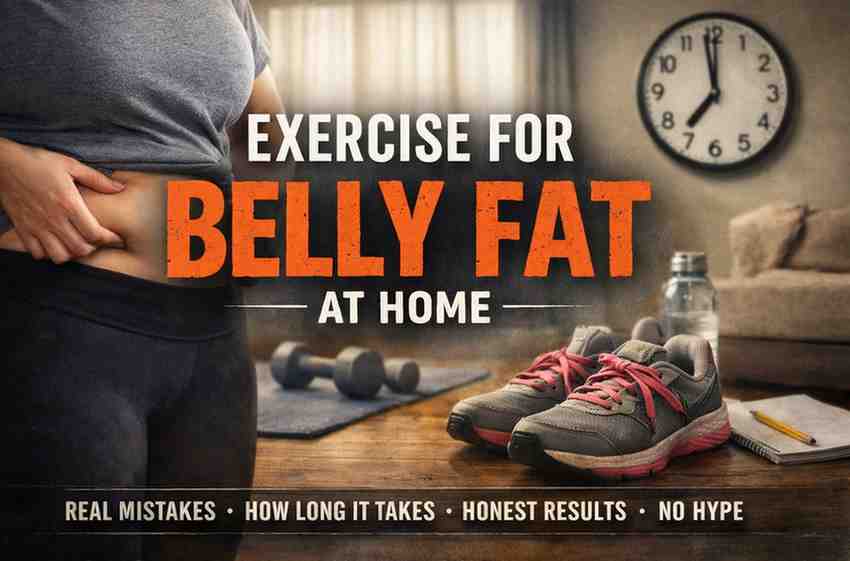
Honestly, most people I’ve watched try this hit a wall in the first two weeks. They start strong, sweat a lot, then quietly assume they’re broken when the belly doesn’t budge. I’ve seen that look on faces after late-night check-ins. Frustration mixed with this weird guilt. Like they failed a test nobody told them how to study for.
From what I’ve seen, the idea of exercise for belly fat at home pulls people in because it feels doable. No gym contracts. No staring at mirrors. No waiting to feel “ready.” But what trips people up isn’t effort. It’s expectations. They think a few ab moves will carve the middle out in ten days. Then reality shows up. Slower. Messier. Still workable. Just not the Instagram version.
I’ve been close to enough real attempts to see the same patterns → repeat. The early overkill. The week-two crash. The “why is my belly the last thing to change?” spiral. And the small wins that actually keep people going once they stop chasing the wrong signals.
Still, this is one of those things that can work. Not magically. Not for everyone. But for a lot of regular people with living rooms, uneven schedules, and zero desire to become fitness influencers.
Why people try this (and what they’re really hoping for)
From what I’ve seen, people don’t search for exercise for belly fat at home because they love exercise. They’re tired of how their body feels in everyday moments:
-
sitting down and feeling their waistband dig in
-
catching their reflection in a dark window
-
photos from family events they didn’t ask to see
-
that quiet, constant discomfort in their own skin
Most aren’t chasing a six-pack. They want relief. They want their stomach to stop being the loudest part of the room.
What surprises people is how emotional this gets. The belly is where stress sits. Where sleep deprivation shows. Where late dinners and long workdays leave a mark. When that area doesn’t change fast, people don’t just feel unfit. They feel stuck in life. I didn’t expect that connection to be such a common issue until I watched it happen over and over.
The biggest misunderstanding I keep seeing
Almost everyone I’ve seen struggle with this does this one thing wrong at first:
They try to “target” belly fat with endless core workouts.
Crunches. Planks. Russian twists until their neck hurts.
Here’s the part people hate hearing. From what I’ve seen, your body doesn’t care which muscle you’re burning when it decides where fat comes off first. The belly is stubborn. It holds on longer. Especially under stress. Especially when sleep is messy. Especially when food is chaotic.
What consistently works better (and this honestly surprised me after watching so many people try it) is when home workouts focus on:
-
full-body movement
-
getting the heart rate up in short bursts
-
building muscle across legs, back, and glutes
-
keeping the routine boringly repeatable
Core work still helps. Just not as the main driver of belly fat loss. It’s more like support staff, not the lead actor.
What actually works at home (patterns I keep seeing)
Not theory. Just what shows up across real attempts.
1. Short, repeatable routines beat heroic workouts
Most people I’ve worked with mess this up at first. They plan 60-minute sessions. Life interrupts. Then nothing happens for a week. Then guilt.
What sticks looks more like:
-
20–30 minutes
-
4–6 days per week
-
same basic structure for weeks
-
low mental friction
Example structure I’ve seen work across very different people:
-
5 minutes: easy warm-up (marching in place, arm circles)
-
12–15 minutes: circuit
-
bodyweight squats
-
incline push-ups (wall or counter)
-
step-backs or lunges
-
mountain climbers (slow is fine)
-
-
5 minutes: brisk walk in place or stairs
-
3–5 minutes: core (plank variations, dead bugs)
Nothing flashy. But repeatable beats impressive every time.
2. The “boring middle” is where results start
Week one? People feel pumped.
Week two? Sore but hopeful.
Week three and four? This is where almost everyone questions the point.
From what I’ve seen, belly changes usually lag behind:
-
better stamina
-
looser clothes in shoulders and thighs
-
mood improvements
-
energy stabilizing
The belly often changes later. People don’t expect that delay. They think the area they care about most should respond first. It almost never does.
That delay is where most drop out.
3. Walking is quietly doing more than people think
I didn’t expect this to be such a consistent factor until I watched patterns across people with totally different routines. The ones who walked daily — even casually — saw belly changes earlier.
Not power walking. Not marathon prep. Just:
-
20–40 minutes most days
-
broken into chunks if needed
-
paired with the home workouts
Walking seems to lower stress, help digestion, and smooth out fat loss in ways people don’t credit until they stop doing it and stall.
4. Consistency beats perfect form
There’s bad advice out there that makes people feel like if their form isn’t perfect, it’s pointless. That kills momentum.
From what I’ve seen:
-
decent form done often beats perfect form done rarely
-
slow progress done consistently beats bursts of intensity followed by nothing
-
adapting moves to your body beats copying videos blindly
People who gave themselves permission to look awkward stuck with it longer. That was a real pattern.
The mistakes that slow belly fat loss (I keep seeing these repeat)
Almost everyone I’ve seen struggle with this does at least one of these:
-
Going too hard, too fast
They burn out in 10 days and need two weeks to recover. -
Doing only ab workouts
Great for core strength. Weak for fat loss. -
Ignoring sleep
The worst plateaus I’ve seen came from people sleeping 4–5 hours and wondering why their belly wouldn’t change. -
Eating “healthy” but not enough protein
Leads to muscle loss and slower metabolism. The belly hangs around longer. -
Weighing daily and spiraling
Water retention masks progress. The mirror changes before the scale. -
Starting over every Monday
Reset mentality kills momentum. The people who did best treated bad days as noise, not failure.
How long does it take (for most people)?
This is where expectations usually break.
From what I’ve seen across many real attempts:
-
1–2 weeks
You feel better before you look different. Less bloated some days. More tired on others. -
3–5 weeks
Clothes fit slightly better. Belly still looks familiar in the mirror most mornings. People get discouraged here. -
6–10 weeks
Subtle belly change starts showing for many. Not dramatic. But noticeable to the person living in the body. -
3+ months
This is where the “oh, something is actually happening” moment usually lands.
Is it slow? Yeah. Is it fake slow? No. The belly just resists change more than arms or face for most people I’ve seen.
When exercise for belly fat at home doesn’t work (and why)
This isn’t magic. There are real reasons it stalls.
It often fails when:
-
stress levels stay high
-
sleep is constantly broken
-
eating swings wildly between extremes
-
workouts change every week
-
expectations are built on influencer timelines
Cause → effect → outcome:
High stress → higher cortisol → belly fat clings harder → slower visible change → frustration → quitting.
Not because you’re weak. Because biology doesn’t care about your timeline.
Who will hate this approach (honestly)
This approach isn’t for:
-
people who want visible belly change in two weeks
-
anyone who needs novelty every session
-
folks who refuse to walk because it feels “too easy”
-
anyone allergic to repetition
-
people who don’t want to adjust sleep or eating at all
From what I’ve seen, people who thrive here are okay with boring progress. They value relief over aesthetics. They want something that fits into real life.
Objections I hear all the time (and what actually happens)
“I don’t have time.”
From what I’ve seen, people who break it into two 10-minute chunks stick longer than people waiting for a perfect 45-minute window.
“My belly is genetic.”
Genetics influence where fat shows first and leaves last. They don’t override consistency. Belly fat still responds. Slower sometimes. Still responds.
“I tried this before and it didn’t work.”
Most of the time, what didn’t work was:
-
doing it for 10 days
-
changing routines every week
-
quitting during the boring middle
Not the approach itself.
“I’m doing everything and nothing’s changing.”
When we actually looked closer with people, something was off:
-
under-eating protein
-
overestimating workout intensity
-
sleeping 5 hours
-
high stress
-
skipping walking
Tiny leaks add up.
Mini FAQ (for search clarity)
Can you lose belly fat with exercise at home?
From what I’ve seen, yes — if the routine is full-body, consistent, paired with walking, and not rushed.
Are ab workouts enough to lose belly fat?
No. They strengthen the core but don’t drive fat loss by themselves.
How many days a week should you exercise at home?
Most people who saw results did 4–6 days per week with short sessions.
What if I see no belly change after a month?
That’s common. Belly changes often lag behind other body changes. Check stamina, clothes fit, and energy first.
Is walking really that helpful?
Weirdly, yes. I didn’t expect it to matter this much until I saw consistent patterns across people.
A quick reality check (no hype, just limits)
Let’s be real:
-
you might lose fat elsewhere before your belly changes
-
stress can stall progress even with perfect workouts
-
results can come in waves, not straight lines
-
some weeks will feel pointless
-
plateaus are normal
This isn’t failure. It’s the shape of real change.
Practical takeaways (what to do, what to avoid, what to expect)
What to do
-
Pick a simple home routine and keep it for 6–8 weeks
-
Walk most days, even casually
-
Train full body, not just abs
-
Track consistency, not perfection
-
Sleep like it matters (because it does)
What to avoid
-
restarting every week
-
chasing soreness as proof
-
comparing your timeline to others
-
expecting belly change first
-
letting one bad day turn into quitting
What to expect emotionally
-
early excitement
-
mid-phase doubt
-
random frustration
-
quiet wins you almost miss
-
a strange moment where your clothes fit differently and you realize something shifted
That’s what patience looks like in practice. It’s not calm. It’s showing up while annoyed.
So no — this isn’t magic. But from what I’ve seen, people who stop trying to outsmart the process and just repeat simple home → movement long enough do eventually feel relief. The belly doesn’t change on your schedule. But it does change when the rest of your life → gets just a little steadier.
Sometimes the biggest win isn’t the mirror. It’s realizing you stopped feeling trapped in the same cycle.