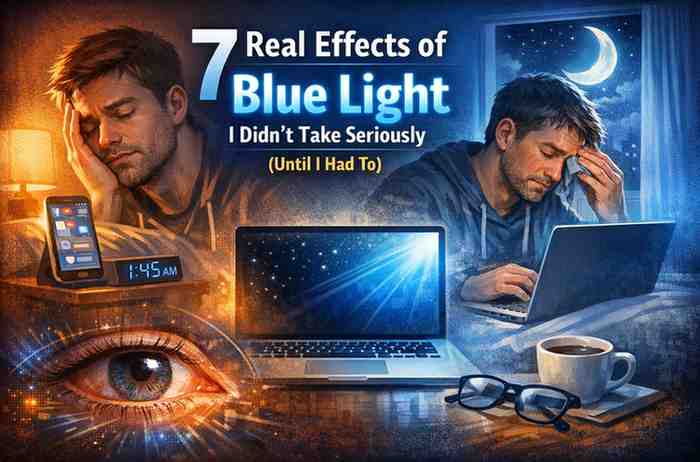
Not gonna lie — I used to roll my eyes whenever someone blamed screens for feeling tired.
Bad sleep? Phone.
Headaches? Laptop.
Mood off? “Too much blue light.”
Yeah… okay.
I thought it was one of those internet things people say when they don’t want to admit they stayed up too late scrolling. I’m on my computer all day. Always have been. If blue light was that bad, wouldn’t I be completely wrecked by now?
That was my logic. And honestly, it felt solid.
Then my sleep fell apart. Like… really fell apart.
And that’s when I started paying attention to the real effects of blue light, not the dramatic ones, not the fear-mongering ones — the subtle, annoying, slow-burn kind that sneak up on you.
This isn’t a scare piece.
This isn’t medical advice.
And it’s definitely not perfect.
It’s just what I noticed after messing this up for years.
How I Even Ended Up Testing This Stuff
I didn’t wake up one day and decide to “optimize my circadian rhythm.” That’s not how real life works.
What happened was messier.
I was tired all the time but couldn’t sleep.
I’d lie in bed exhausted, eyes burning, brain buzzing.
Then I’d grab my phone. Big mistake. Bigger than I knew.
At first, I blamed stress. Work. Coffee. Age. Anything but the screens.
But here’s what kept bugging me:
-
I slept better on weekends
-
My eyes hurt more on workdays
-
I felt weirdly alert at night, not calm
Same caffeine. Same food. Same bed.
Different screen exposure.
That’s when I stopped dismissing the real effects of blue light as hype and started watching my own habits.
What I Got Wrong at the Start (Important)
I messed this up early. Badly.
I thought blue light was only a “night thing.”
So I:
-
Used dark mode
-
Turned on Night Shift at 10 p.m.
-
Felt proud of myself
Still slept like trash.
What I didn’t understand yet is that the real effects of blue light aren’t just about when — they’re about how much, how close, and how long.
And yeah… intention doesn’t cancel biology.
The First Real Effect I Noticed: Sleep Delay (Not Insomnia)
This one hit me before anything else.
I wasn’t unable to sleep.
I just couldn’t fall asleep when I wanted to.
I’d go to bed at 11.
My body said, “Cool story. How about 1:30?”
That’s the part people don’t explain well.
Blue light doesn’t always cause insomnia.
Sometimes it just pushes sleep later.
From what I’ve seen, at least, the real effects of blue light show up as:
-
Delayed melatonin
-
Fake alertness
-
That wired-but-tired feeling
Once I stopped screens 90 minutes before bed (not 30, not “one last scroll”), my sleep timing slowly shifted back.
Not instantly.
Not magically.
But noticeably.
Eye Strain Was Sneakier Than I Expected
I thought eye strain meant pain.
It didn’t.
For me, it showed up as:
-
Heavy eyelids
-
Dryness that wouldn’t quit
-
Blinking a lot without realizing
And here’s the part that surprised me — my vision wasn’t blurry. It was just… tired. Like my eyes were done with the day before my brain was.
The real effects of blue light on my eyes weren’t dramatic. They were cumulative.
Eight hours on a screen didn’t hurt.
Eight hours every day for months? Yeah. That added up.
Blue light wasn’t the only factor.
Brightness. Distance. Breaks. All of it mattered.
But reducing blue exposure plus lowering brightness helped more than I expected.
Mood Changes Were the Weirdest Part
This is where it got uncomfortable.
I didn’t expect my mood to change.
I’m not talking depression or anxiety — nothing clinical.
Just… irritability.
Short fuse.
Restless evenings.
That low-grade tension you can’t explain.
Once I cut late-night screen use, my evenings got calmer. Not perfect. Just quieter.
From my experience, the real effects of blue light can mess with your wind-down phase. Your body thinks it’s still daytime. So emotionally? You don’t land.
You hover.
And hovering is exhausting.
Don’t Make My “Blue Light Glasses” Mistake
Okay, confession.
I bought cheap blue light glasses online.
Wore them nonstop.
Felt smug.
They did almost nothing.
Why?
Because I didn’t change my behavior. I just added an accessory.
The real effects of blue light don’t disappear if you:
-
Stare at a bright screen two inches from your face
-
Keep notifications buzzing
-
Scroll in a dark room
Glasses can help. Filters can help.
But they’re not a free pass.
I had to change habits, not just settings.
What Actually Helped (After Trial and Error)
Here’s what worked for me. Not theory. Just lived-in stuff.
1. Morning Light First
This was huge.
I started getting real daylight within an hour of waking up. Even five minutes.
That made me less sensitive to screens at night.
2. Screens Off Earlier Than Felt Reasonable
Not “when I’m sleepy.”
Before that.
Annoying? Yes.
Effective? Also yes.
3. Dim Screens, Always
Max brightness is the enemy.
I keep everything dim by default now.
4. One Device Rule at Night
No laptop + phone combo.
Just one screen. Or none.
Once I did all that, the real effects of blue light stopped feeling mysterious. They felt… predictable.
How Long It Took to Notice Changes
This matters, so I’ll be honest.
-
Eye comfort: 3–5 days
-
Sleep timing: 1–2 weeks
-
Mood shifts: subtle, gradual
Nothing overnight.
If someone says they fixed everything in one night, I don’t buy it. Bodies don’t work like that.
Would I Do It Again?
Yeah. No question.
Not because it fixed my life.
But because it removed friction I didn’t need.
The real effects of blue light aren’t dramatic enough to scare you — and that’s why people ignore them.
But stacked over time? They matter.
Practical Takeaways (No Fluff)
If you want the short version:
-
Blue light isn’t evil — timing is
-
Filters help, habits help more
-
Sleep delay is more common than insomnia
-
Mood changes can be subtle but real
-
Consistency beats gadgets
That’s it. No miracle hacks.
FAQ: What I’ve Learned Messing With This Myself
Does blue light affect everyone the same way?
Nope. Some people are way more sensitive than others. I’m somewhere in the middle.
Is daytime blue light bad?
No. It’s actually helpful. The real effects of blue light during the day can improve alertness.
Are night mode and dark mode enough?
Better than nothing. Not enough on their own.
Do kids get affected more?
From what I’ve seen and read, yeah. Their eyes absorb more light.
Can you undo damage from too much screen time?
You can reduce strain. “Undo” might be the wrong word, though.
So yeah… the real effects of blue light aren’t dramatic. They’re not scary. They’re just persistent.
And once you notice them, it’s hard to un-notice them.
No, it didn’t turn me into a monk. I still use screens. A lot.
But now?
I use them with my eyes open — literally and figuratively.
And honestly? That’s been enough.