Low Residue Diet for Colonoscopy: 9 Hard Lessons I Learned the Uncomfortable Way

Low Residue Diet For Colonoscopy 9 Hard Lessons I Learned The Uncomfortable Way 1
Low Residue Diet for Colonoscopy 9 Hard Lessons I Learned the Uncomfortable Way

Honestly, I didn’t think food could stress me out this much.

I’ve dealt with bigger things. Bills. Health scares. Life stuff.

But the low residue diet for colonoscopy?
That little phrase wrecked my confidence for a solid week.

Not gonna lie — when my doctor first said it, I nodded like I understood.
I absolutely did not.

I went home, Googled for five minutes, thought “yeah, I got this”… and then promptly ate the wrong thing. Twice.
Cue panic. Cue regret. Cue me staring at my plate like it personally betrayed me.

This is the version I wish someone had told me — not the medical pamphlet, not the sterile checklist, but the real experience. The confusion. The trial-and-error. The “wait… can I eat that?” moments at 10 p.m.


Why I Even Ended Up on This Diet (and Why I Underestimated It)

The colonoscopy itself already freaked me out.
The prep? Even worse.

When the nurse said, “You’ll need to follow a low residue diet for a few days before,” I assumed it meant “eat lighter.”

Wrong. So wrong.

I thought:

  • Smaller portions = fine

  • “Healthy” food = safe

  • Salads = definitely okay

Yeah… no.

From what I’ve seen, at least, this diet isn’t about health in the usual sense.
It’s about leaving as little behind as possible. No fiber. No bulk. No surprises.

That clicked way later than it should have.


The First Thing I Messed Up (Learn From This)

Day one, I made oatmeal.

Oatmeal feels gentle, right?
Warm. Soft. Basically hospital food.

Except it’s full of fiber.
Which I learned after eating it.

That’s when the anxiety hit. I went back to Google, deeper this time, and realized how many “healthy” foods are actually the worst choices here.

Things I assumed were safe but absolutely weren’t:

  • Whole wheat bread

  • Brown rice

  • Oats (still mad about this)

  • Raw fruits

  • Vegetables with skins

This honestly surprised me. I’d spent years training myself to eat these foods.

Suddenly, white bread was the hero?
What timeline is this?


What “Low Residue” Actually Meant in My Real Life

Once I stripped away the medical language, here’s how it finally made sense to me: Eat foods that your body barely has to process.

That’s it.

If it’s soft, refined, and kind of boring — it’s probably okay.
If it has texture, seeds, skins, crunch, or bragging rights — avoid it.

This mental shortcut saved me.


What I Actually Ate (No Sugarcoating)

I’ll be honest — it wasn’t fun food.
But it wasn’t starvation either.

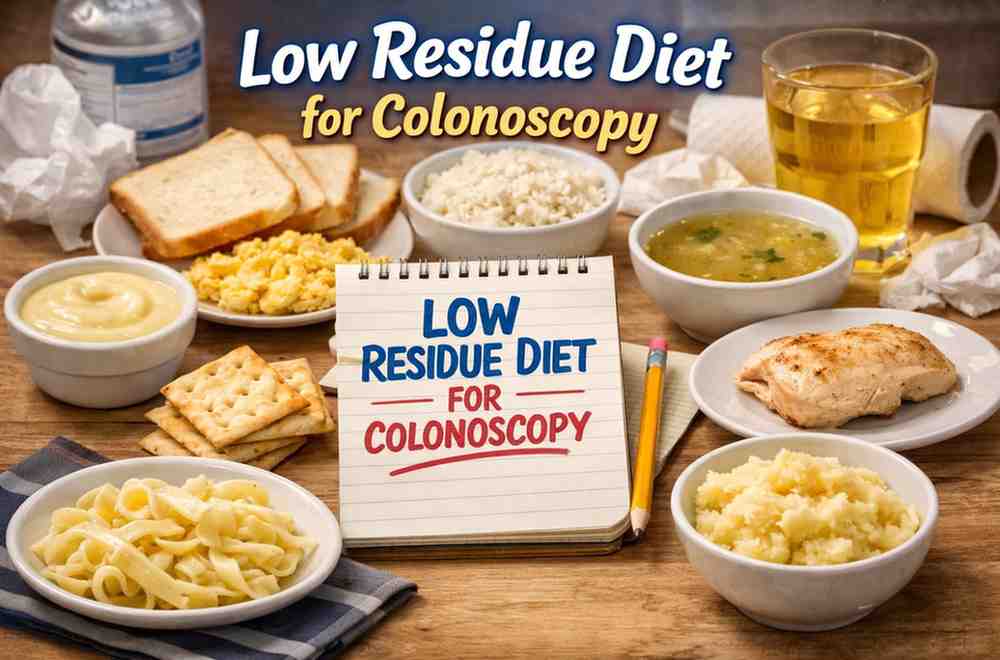
My real, lived menu looked like this:

Breakfasts

  • Scrambled eggs (no veggies, no cheese at first)

  • White toast with a little butter

  • Plain pancakes (this felt illegal but worked)

Lunch

  • White rice with salt

  • Plain chicken breast

  • Egg salad (no celery — learned that the hard way)

Dinner

  • Pasta with butter

  • Mashed potatoes (no skin)

  • Clear soup broth

Snacks were… sad, but manageable:

  • Vanilla pudding

  • Plain yogurt

  • Saltines

Water, tea, apple juice. That’s it.

Still — it filled me up more than I expected.


The Hunger Fear Was Overblown (For Me)

I was convinced I’d be starving.

I wasn’t.

Was I bored? Absolutely.
Cranky? Sometimes.
But actually hungry? Not really.

What helped:

  • Eating more often

  • Not trying to “diet” on top of this

  • Accepting that food was just fuel for a few days

Once I stopped fighting it mentally, my body adjusted fast.


The Emotional Part No One Mentions

This part caught me off guard.

Food is comfort.
Food is routine.
Food is how I cope when I’m anxious.

Taking away my usual foods right before a medical procedure?
That messed with my head.

I felt:

  • Weirdly irritable

  • Overly emotional

  • Hyper-focused on every bite

Then again, I was already nervous. The diet just amplified it.

If this happens to you — you’re not broken. You’re human.


Timing Mistakes I Almost Made

Here’s a big one.

I assumed the diet only mattered the day before.
Nope.

Starting late makes everything harder.

From what I experienced, easing into the low residue diet for colonoscopy a few days early helped a lot:

  • Less digestive chaos

  • Less stress during prep

  • Fewer “oh no” moments

If I had waited until the last minute? Disaster.


What Actually Went Wrong (Yes, There Were Slip-Ups)

I didn’t do it perfectly.

I accidentally ate:

  • A banana (too fibrous — who knew?)

  • A slice of cheese with bits in it

  • Soup with tiny vegetable pieces

Did it ruin everything? No.

But it did spike my anxiety.
And I wouldn’t repeat it.

Perfection isn’t required. Awareness helps more.


How I Knew It Was Working

This part is awkward, but important.

My digestion felt… quieter.

Less bloating.
Less heaviness.
Less “movement.”

That’s kind of the point.

By the time prep day arrived, my body felt ready. Not empty, but calm.

That gave me confidence I didn’t expect.


Would I Do This Again?

Honestly? Yes.

Not because I enjoyed it — I didn’t.
But because it worked.

If I ever need another colonoscopy (hopefully not soon), I wouldn’t fight the diet next time. I’d plan for it.

And I wouldn’t pretend I understand it until I actually do.


Practical Takeaways (The Stuff I’d Text a Friend)

If you’re about to start and feeling overwhelmed, here’s the distilled version:

  • Boring food is your friend

  • White > whole grain (temporarily!)

  • Start earlier than you think

  • Don’t “healthify” this diet

  • Eat enough — hunger helps no one

  • One small mistake won’t ruin everything

Also… give yourself grace. This is temporary.


One Last Thing I Wish Someone Had Said

This diet isn’t a test of discipline.
It’s a setup step. Nothing more.

You’re not failing if you’re confused.
You’re not weak if you’re frustrated.
You’re just doing something unfamiliar under pressure.

So no — this isn’t magic.
But for me? Yeah. It made the whole process smoother than I expected.

And that alone made it worth the annoyance.

Colon Hydrotherapy Can Radically Transform Your Health: 7 Hard Lessons I Learned the Messy Way

Colon Hydrotherapy Can Radically Transform Your Health 1
Colon Hydrotherapy Can Radically Transform Your Health

I didn’t wake up one morning excited to flush my colon.
That’s not how this started.

It started with bloating that wouldn’t quit. Brain fog. This weird heaviness I couldn’t explain. I was eating “clean,” drinking water like a responsible adult, doing all the things Instagram wellness people swear by. Still felt off. Not sick. Just… not right.

A friend casually mentioned colon hydrotherapy. I laughed. Out loud.
Sounded extreme. Borderline ridiculous. Maybe even unsafe.

Then I got desperate enough to Google it at 1 a.m.
That’s when the phrase Colon Hydrotherapy Can Radically Transform Your Health showed up again and again. I rolled my eyes. Hard.

Still clicked.

And yeah — that decision took me down a path I didn’t expect at all.


Why I Even Considered This (Because I Didn’t Want To)

Not gonna lie, I tried to avoid this idea.

I did supplements first. Fiber powders. Probiotics that tasted like regret. “Gentle” detox teas that were anything but gentle. I told myself that was enough.

It wasn’t.

Here’s what kept happening:

  • I’d eat normal meals and feel six months pregnant after

  • My energy crashed mid-afternoon, every day

  • My skin looked dull no matter what I used

  • Bathroom habits were… inconsistent at best

Doctors said everything was “within range.”
That phrase haunts me.

I wasn’t sick enough to treat.
But not healthy enough to feel good.

So when I finally booked my first session, it wasn’t excitement.
It was frustration mixed with “fine, let’s just see.”


My First Session: Humbling, Awkward, Eye-Opening

Let’s get this part out of the way.

Yes, it’s awkward.
Yes, you feel vulnerable.
Yes, you question your life choices for about five minutes.

But here’s what surprised me.

It wasn’t painful.
It wasn’t gross.
It wasn’t dramatic.

It was quiet. Clinical. Almost boring.

The therapist explained everything slowly. Water temperature. Pressure. Timing. She emphasized listening to my body. Not forcing anything.

That alone eased my nerves.

About halfway through, I felt something release. Not emotionally — physically. Pressure I didn’t realize I was carrying.

I remember thinking:
“Oh. That’s been sitting there?”

That moment messed with my head more than my gut.


What I Got Wrong at First (Learn From This)

I assumed one session would fix everything.

Classic mistake.

I walked out expecting fireworks. Some instant glow-up. A life-altering revelation.

Instead, I felt… lighter. Calm. Slightly tired. Hungry.

That’s it.

I almost wrote the whole thing off.

But here’s what I misunderstood:

  • This isn’t a one-and-done thing

  • Your body needs time to adjust

  • Detox reactions can be subtle

  • Hydration matters more than I realized

I also messed up by eating like garbage afterward.
Don’t do that. Seriously.

From what I’ve seen, at least, the people who say it “did nothing” usually skip the follow-through.

I almost became one of them.


The Slow Shift Nobody Talks About

The changes didn’t scream.
They whispered.

Over the next week, I noticed:

  • Less bloating after meals

  • Better sleep (this shocked me)

  • Clearer head in the mornings

  • A weird sense of calm in my body

No miracle. No instant transformation.

Just… ease.

That’s when the idea that Colon Hydrotherapy Can Radically Transform Your Health stopped sounding so dramatic. It wasn’t radical in a flashy way. It was radical because things stopped feeling like a constant battle.

And honestly? I didn’t expect that at all.


The Emotional Part I Wasn’t Prepared For

This part gets ignored.

Your gut is tied to your nervous system. I knew that intellectually. I wasn’t ready to feel it.

During my third session, I got emotional. Out of nowhere. Not sobbing. Just heavy. Old stress surfaced. Stuff I hadn’t thought about in years.

I felt silly mentioning it.
The therapist nodded like it was normal.

Apparently, it is.

That freaked me out a little. Then it made sense.

When your body holds onto things physically, it often holds onto them emotionally too.

That realization stuck with me longer than any physical result.


Let’s Talk Safety (Because I Had Concerns Too)

I went down some dark internet rabbit holes before committing.

Horror stories. Fear-based articles. Extreme opinions on both sides.

Here’s my grounded takeaway:

  • Go to a licensed professional

  • Ask questions, even the awkward ones

  • Avoid places that promise cures

  • Listen to your body, not hype

This isn’t for everyone.
And it’s not something I’d recommend casually.

I treated it like body maintenance, not a miracle fix.

That mindset made all the difference.


How Long It Took Before I Could Honestly Say It Helped

Short answer? About a month.

Long answer? It was gradual.

Here’s my rough timeline:

  • After 1 session: lighter, curious, skeptical

  • After 2–3: noticeable digestion changes

  • After 4: energy stabilized

  • After 5: I stopped thinking about my gut constantly

That last part mattered most.

When something stops being loud, you realize how much space it was taking.

That’s when the claim that Colon Hydrotherapy Can Radically Transform Your Health finally felt… earned. Not guaranteed. Not universal. But possible.


Things That Didn’t Happen (Let’s Be Real)

I didn’t lose 20 pounds.
My life didn’t magically align.
I didn’t become a wellness guru.

Also:

  • My diet still mattered

  • Stress still affected me

  • Skipping water made everything worse

  • Consistency mattered more than intensity

Anyone promising otherwise is lying or selling something.

This worked because it fit into a bigger picture, not because it replaced one.


Would I Do It Again?

Yes. Carefully.

Not constantly.
Not obsessively.
Not as a shortcut.

More like a reset when things feel stuck.

I space sessions out now. I pay attention to signals. I don’t force it.

That balance took time to learn.

And yeah, I messed it up at first.


Practical Takeaways I Wish Someone Told Me Earlier

If you’re even considering this, here’s what I’d say friend-to-friend:

  • Research the practitioner, not just the method

  • Eat light before and after

  • Drink more water than you think you need

  • Don’t expect instant results

  • Stop if something feels wrong

  • Pair it with better habits, not excuses

And please — don’t do this just because someone online swears it cured everything.

That’s not how bodies work.


Where I Landed After All This

I used to think the idea that Colon Hydrotherapy Can Radically Transform Your Health was overblown marketing.

Now? I think it’s incomplete truth.

It can help.
It can support healing.
It can shift things that feel stuck.

But only if you’re honest with yourself.
Only if you respect your body’s limits.
Only if you stop looking for magic.

For me, it didn’t fix everything.
It made things manageable.

And sometimes, that’s the real win.

So yeah. I’m glad I tried it.
Confused at first. Skeptical still. But clearer.

And that clarity?
That alone made it worth it.

Soya Chunks Digestion Time: 7 Real Truths That Kinda Ruined My Expectations

Soya Chunks Digestion Time 7 Real Truths That Kinda Ruined My Expectations 1
Soya Chunks Digestion Time 7 Real Truths That Kinda Ruined My Expectations

Not gonna lie… I didn’t think a bag of dry little soy nuggets would send me into a full-on stomach spiral. I picked up soya chunks because I was trying to eat “better.” More protein. Less meat. Easy wins, right?
Yeah. No. My gut had other plans.

The first time I cooked them, I spent the whole night Googling soya chunks digestion time like I was cramming for a final exam I didn’t study for. I felt bloated, weirdly heavy, and low-key mad at myself for not reading the fine print on my own body. I thought digestion was digestion. Turns out, it’s personal. Very personal.

This is messy. It’s what I learned the slow way. And yeah, I messed this up at first.


Why I Even Tried Soya Chunks (and Why My Stomach Hated Me for It)

I was in a “fix my life” phase. You know the one.
New groceries. New routines. Big hopes. Zero patience.

I wanted:

  • more protein without eating chicken every day

  • something cheap and easy

  • meals I could meal-prep without thinking

Soya chunks checked all the boxes. They’re everywhere. They look harmless. And every fitness bro online acts like they’re magic.

So I soaked them, tossed them in a pan, added some spice, and called it dinner.
Five hours later, my stomach felt like it swallowed a bowling ball.

Not sharp pain.
Just… slow heaviness.
Like my food was taking a nap inside me.

That was my first lesson: digestion speed isn’t just about what you eat. It’s about how your body reacts to it.


The First Few Times Were Rough (Here’s What I Did Wrong)

I didn’t ease into it.
Classic me.

I went from barely eating fiber to dropping a full bowl of soya chunks into my system. That’s like going from walking to sprinting without warming up.

Mistakes I made:

  • Ate a big portion on an empty stomach

  • Didn’t chew enough (I know, gross, but true)

  • Drank soda with it (why did I do that??)

  • Cooked them dry the first time

My stomach didn’t like any of that.

The digestion felt slow. Not painful, but heavy and draggy. Like the food was just… sitting there.

From what I’ve seen, at least for me, soya chunks take longer to break down than eggs or rice. That doesn’t mean they’re bad. It just means my body needed a heads-up.


What “Digestion Time” Felt Like in Real Life (No Lab Coats Here)

People love to throw numbers around.
“X hours.”
“Y minutes.”
Cool. That’s not how my body reports back.

Here’s what I noticed instead:

  • I didn’t feel hungry for a long time

  • I felt full, then heavy, then tired

  • Bathroom timing shifted (yeah, we’re going there)

The soya chunks digestion time felt slower than:

  • oatmeal

  • eggs

  • chicken soup

But faster than:

  • steak

  • cheesy pizza

  • greasy takeout

This honestly surprised me. I expected plant food to move faster. But these are dense little protein bricks. My stomach had to work.

If you’ve got a sensitive gut, you’ll probably feel this more.
If your digestion is chill, you might not notice much.

I didn’t expect that at all.


The “Oh… That Helps” Tweaks I Accidentally Found

After a few bad nights, I almost gave up on them. Then I started tweaking small stuff. No grand plan. Just trial and error.

Things that helped me digest them better:

  • Soaking longer
    I started soaking them in hot water for 10–15 minutes. They puff up and get softer. My stomach thanked me.

  • Cooking them properly
    Dry, chewy chunks = regret.
    Simmered, soft chunks = way easier on my gut.

  • Pairing with easy foods
    Rice. Veggies. Soup.
    Not just a bowl of chunks alone like some protein goblin.

  • Smaller portions
    This one hurt my pride. But yeah, half a bowl was way kinder than a full bowl.

  • Eating slower
    I hate this advice.
    It works anyway.

Once I did that, the soya chunks digestion time felt more normal. Still slower than toast. But not the whole-night discomfort I had before.


The Part No One Told Me About: Your Gut Might Need Training

This was a weird realization.
My body wasn’t “bad” at digesting soya chunks.
It just wasn’t used to them.

The more I ate them (not every day, chill), the less dramatic my stomach got. The bloating dropped. The heaviness eased.

It felt like my gut was learning.
Slow learner.
But learning.

If you’re new to high-protein plant foods, your body might throw a tantrum at first. That doesn’t mean you’re broken. It means you changed the routine.

Still, if something feels off for days? Don’t force it. Listen to your body. It’s annoying. It’s also right a lot.


When It Went Wrong Again (Because Yeah, It Did)

I got cocky.

I thought, “Oh, I’ve figured this out now.”
So I doubled my portion. Added spicy sauce. Ate late at night.

Bad idea.

Same heavy feeling.
Same slow digestion.
Same “why do I keep learning this lesson twice?” moment.

So yeah, progress isn’t a straight line.
I still mess this up sometimes.

The difference is now I know why my stomach complains. And I can usually fix it the next day by:

  • drinking more water

  • going for a short walk

  • eating lighter meals after

Not magic. Just basic care.


How Long Did It Actually Take to Feel Normal Again?

For me?
The heaviness passed in a few hours.
The full digestion feeling took longer.

Not overnight dramatic.
Just slow and steady.

Some days, I felt fine in 3–4 hours.
Other days, my stomach was like, “We’re processing this all evening, buddy.”

So when people ask about soya chunks digestion time, I always say:
It depends on you. Your gut. Your habits. Your portions. Your mood, honestly.

Stress makes my digestion worse.
Eating fast makes it worse.
Drinking soda with it? Instant regret.


Would I Do This Again?

Yeah.
But I don’t romanticize it.

Soya chunks are useful.
They’re filling.
They’re cheap.
They’re not magical gut-healing angels.

I treat them like a tool now.
Not a miracle food.

Some days they work great.
Some days I skip them and eat something lighter.
That’s the balance I didn’t have at first.


Practical Takeaways (aka Don’t Be Me in Week One)

Here’s the stuff I wish someone had told me before I googled my symptoms at 2 a.m.:

  • Start small. Your gut needs time.

  • Soak and cook them well. Soft beats chewy.

  • Pair them with easy foods.

  • Eat slower than you think you need to.

  • Don’t load them with soda and late-night spice.

  • If your stomach hates them after multiple tries, it’s okay to move on.

No food is worth feeling miserable over.
Not even the “healthy” ones.


So yeah. That’s my very un-glam journey with soya chunks digestion time. I went in thinking it would be simple. I came out knowing my stomach has opinions and they matter.

If you’re struggling with this too, you’re not broken. You’re just learning your body’s rules the slow way. Same.

Irritable Bowel Movement: 9 Frustrating Patterns I’ve Seen (And What Finally Brings Relief)

Irritable Bowel Movement 9 Frustrating Patterns Ive Seen And What Finally Brings Relief 1
Irritable Bowel Movement 9 Frustrating Patterns Ive Seen And What Finally Brings Relief

I can’t count how many quiet conversations I’ve had about stomach problems that people were embarrassed to even name.

Usually it starts the same way.

Someone leans in a little closer and says something like: “My digestion has been weird lately… I keep having these irritable bowel movements. Is that normal?”

And you can see the frustration behind the question.

Because most people dealing with irritable bowel movement issues have already tried a few things:

  • cutting random foods

  • drinking more water

  • trying probiotics they saw online

  • googling symptoms at 2 AM

And yet the problem keeps circling back.

Some days things feel normal.
Other days their stomach feels unpredictable.

From what I’ve seen watching friends, clients, and family struggle through this — the problem is rarely just one thing.

It’s patterns.

Tiny daily habits that quietly stack up until the digestive system starts reacting.

And once those patterns set in… people feel stuck.


What People Mean When They Say “Irritable Bowel Movement”

Most people aren’t using a clinical definition.

They’re describing a pattern of uncomfortable bowel activity, usually involving things like:

  • sudden urgency to use the bathroom

  • inconsistent stool (sometimes loose, sometimes hard)

  • stomach cramping before bowel movements

  • bloating that shows up randomly

  • feeling like digestion is unpredictable

A lot of people assume they have something seriously wrong.

But honestly… from what I’ve seen, the majority are dealing with digestive rhythm disruption, not a catastrophic disease.

That doesn’t mean it’s minor though.

Because when digestion becomes unpredictable, it messes with daily life.

People start thinking about bathrooms before leaving the house.

They skip certain meals.

They cancel plans.

And mentally… it’s exhausting.


Why People Start Experiencing Irritable Bowel Movements

This part surprised me when I started paying attention to patterns.

Most people think digestion problems start with food.

But in real life?

Food is usually just the trigger — not the root cause.

Here are the patterns that show up again and again.


1. Stress That Lives in the Gut

I didn’t expect stress to show up this consistently.

But it does.

People going through:

  • work pressure

  • financial worry

  • sleep deprivation

  • relationship stress

almost always report digestion changes.

Because the gut and brain talk constantly.

When the nervous system stays in fight-or-flight mode, the digestive system becomes erratic.

Food moves too fast.

Or too slow.

Or digestion becomes hypersensitive.

One friend told me: “The moment my work stress peaked, my stomach started acting like it had its own personality.”

That line stuck with me.


2. Eating Patterns That Confuse the Gut

Almost everyone I’ve seen struggle with this does one thing wrong at first.

They eat inconsistently.

Examples I see constantly:

  • skipping breakfast

  • huge late-night meals

  • long fasting periods followed by overeating

  • irregular meal timing every day

The gut actually likes rhythm.

When meal timing becomes chaotic, bowel movements follow that chaos.


3. Fiber Done the Wrong Way

This one is a classic mistake.

Someone Googles digestion help and reads: “Eat more fiber.”

So they suddenly add huge amounts of:

  • raw vegetables

  • bran cereal

  • fiber supplements

And then everything gets worse.

More gas.
More cramping.
More urgency.

From what I’ve observed, fiber needs to increase slowly, and the type matters a lot.

Sudden fiber overload irritates the gut.


4. The Coffee and Caffeine Trap

Coffee is one of the most common triggers I’ve seen.

Not because coffee is bad.

But because people drink it on an empty stomach under stress.

That combination can push the colon into overdrive.

Morning routine I see often:

  • wake up

  • drink strong coffee

  • skip food

  • rush to work

And suddenly the digestive system is in sprint mode.


The Patterns That Actually Improve Irritable Bowel Movement Issues

This is where things get interesting.

Because when people finally start improving digestion, it’s rarely from one dramatic change.

It’s small adjustments stacking together.


Pattern #1: Restoring Meal Rhythm

The first thing that quietly helps many people is this:

consistent meal timing

Nothing fancy.

Just something like:

  • breakfast within 1–2 hours of waking

  • lunch at a similar time daily

  • dinner not too late

The gut has a natural movement rhythm called the gastrocolic reflex.

Regular meals activate it predictably.

And bowel movements start stabilizing.

It’s boring advice.

But honestly… it works more often than people expect.


Pattern #2: Gentle Fiber Instead of Aggressive Fiber

People tend to overcorrect.

What tends to work better:

  • oats

  • cooked vegetables

  • chia seeds

  • bananas

Instead of immediately jumping to heavy raw fiber.

Cooked fiber is usually easier for irritated digestion.


Pattern #3: Hydration That’s Actually Consistent

Most people think they drink enough water.

But when we actually pay attention… it’s usually something like:

  • coffee

  • one glass of water

  • another coffee

  • maybe water at night

Digestive rhythm improves dramatically when water intake spreads throughout the day.

Not chugging.
Just steady.


Pattern #4: Slowing Down While Eating

I didn’t expect this to matter so much.

But after watching dozens of people adjust this habit… digestion changes.

Fast eating means:

  • more swallowed air

  • incomplete chewing

  • stressed nervous system

When people slow down meals — even slightly — stomach discomfort often decreases.


The Mistakes That Keep Irritable Bowel Movement Problems Going

Almost everyone I’ve seen struggle with this hits at least one of these traps.


Mistake #1: Trying Too Many Solutions at Once

People often attempt:

  • probiotics

  • elimination diets

  • supplements

  • herbal teas

  • digestive enzymes

All at the same time.

Then they have no idea what actually helps.

Slow adjustments work better.


Mistake #2: Panic After One Bad Day

Digestive recovery is rarely linear.

Someone improves for a week…

Then has one bad day.

And they assume nothing works.

But digestion fluctuates naturally.

Consistency matters more than perfection.


Mistake #3: Ignoring Sleep

This is wildly underrated.

Sleep deprivation disrupts gut bacteria and digestive signals.

People running on 5 hours of sleep often report worsening bowel patterns.

It’s not coincidence.


How Long Does It Usually Take to Improve?

This is one of the first questions people ask.

From what I’ve seen:

  • minor digestion disruption: 1–2 weeks

  • moderate patterns: 3–6 weeks

  • long-standing issues: several months

The gut doesn’t reset overnight.

It responds to repeated signals.

That’s why small habits matter.


What If Irritable Bowel Movement Problems Don’t Improve?

There are moments where self-adjustments aren’t enough.

People should consider medical evaluation if they notice:

  • blood in stool

  • unexplained weight loss

  • severe abdominal pain

  • persistent diarrhea lasting weeks

Those signals deserve professional evaluation.

Digestive issues shouldn’t always be self-managed.


Quick FAQ People Usually Ask

Is irritable bowel movement the same as IBS?

Not necessarily.

Many people describing irritable bowel movement symptoms are referring to irregular digestion, which may or may not meet IBS diagnostic criteria.


Can diet alone fix it?

Sometimes.

But digestion also responds to stress, sleep, and routine.

Food is just one piece.


Are probiotics always helpful?

Honestly… results are mixed.

Some people improve.
Others feel worse.

Probiotics are highly individual.


Does exercise help digestion?

Usually yes.

Light movement like walking often improves bowel rhythm.

Extreme workouts, though, can sometimes worsen symptoms.


Objections I Hear All the Time

“I already eat healthy.”

Healthy foods can still irritate digestion if:

  • portion sizes are huge

  • fiber intake jumps suddenly

  • meals are rushed

Healthy food doesn’t always equal easy digestion.


“My symptoms come out of nowhere.”

Sometimes they seem random.

But when people track patterns, triggers appear:

  • stress spikes

  • sleep changes

  • travel

  • caffeine habits

The gut rarely behaves randomly.


Reality Check: When Improvement Feels Slow

This part frustrates people.

Digestive recovery can feel painfully gradual.

One week better.

One week messy again.

And that’s normal.

The gut microbiome adapts slowly.

Which means progress looks more like waves than a straight line.


Practical Takeaways That Actually Help

If someone asked me where to start, I’d suggest focusing on these basics first:

1. Stabilize meal timing
Your gut likes predictability.

2. Increase fiber gradually
Slow adjustments beat sudden diet overhauls.

3. Hydrate consistently
Not just coffee.

4. Reduce stress where possible
Even small changes help.

5. Walk after meals
Gentle movement supports digestion.

And honestly…

Patience matters more than perfection.


A lot of people dealing with irritable bowel movement patterns feel like their body is working against them.

I’ve watched that frustration up close.

People blame themselves.

Or assume something is permanently broken.

But digestion is incredibly adaptable.

It just responds slowly.

So no — there isn’t a magic fix here.

Still… I’ve watched enough people gradually move from constant frustration to predictable digestion once they started paying attention to these patterns.

Sometimes that shift alone feels like getting part of your life back ????

Fat Burning Workouts: 9 Hard-Earned Patterns That Finally Bring Relief

Fat Burning Workouts 9 Hard Earned Patterns That Finally Bring Relief 1
Fat Burning Workouts 9 Hard Earned Patterns That Finally Bring Relief

Honestly, most people I’ve watched try fat burning workouts hit a wall in the first two weeks. They start fired up, follow something intense they found online, then quietly assume they’re the problem when it doesn’t work. I’ve seen that moment play out in kitchens, parking lots after gym sessions, late-night texts that read like, “Maybe my body just doesn’t burn fat.” It’s not that simple. From what I’ve seen, the frustration isn’t about effort. It’s about doing the wrong kind of effort for too long.

What follows isn’t a perfect system. It’s a set of field notes from watching a lot of real people try, quit, adjust, and sometimes finally find something that sticks. Patterns repeat. The same mistakes show up. The same small wins change how people feel about their bodies and their mornings. This honestly surprised me after watching so many people try it.


Why people reach for fat burning workouts in the first place (and what they expect)

Most folks don’t start this because they love exercise. They start because:

  • Their clothes fit tighter.

  • Their energy dipped.

  • A doctor hinted at numbers creeping up.

  • A mirror moment landed harder than expected.

What they expect:

  • Quick visual change

  • A number on the scale to behave

  • A routine that “melts fat” without wrecking their schedule

What they don’t expect:

  • How long the awkward phase lasts

  • How much trial-and-error it takes to find the right pace

  • How emotional the first few weeks can be

From what I’ve seen, the emotional part is the real barrier. People can push through sore legs. They struggle with the quiet doubt that shows up when nothing changes fast.


The biggest misunderstanding I see (over and over)

Most people I’ve worked with mess this up at first: they think fat burning workouts are a specific “type” of workout. Like HIIT vs. steady cardio vs. lifting. They ask, “Which one burns fat?” as if there’s a single switch you flip.

What actually matters is how the workout fits the person’s life and recovery. The body burns fat when the overall setup makes sense:

  • You can repeat the workouts without burning out

  • You’re not constantly under-fueled

  • You’re sleeping enough to recover

  • The intensity matches your current capacity

Almost everyone I’ve seen struggle with this does this one thing wrong: they go too hard, too soon, too often. Then they’re shocked when motivation tanks.

Looks good on paper. Fails in real life.


What consistently works (not flashy, just repeatable)

Here’s what shows up as “quietly effective” across a lot of people:

1) A boring base of movement you can repeat

Not heroic workouts. Repeatable ones.

  • Brisk walking most days

  • Two or three short strength sessions weekly

  • One slightly harder cardio session if energy allows

It doesn’t look impressive on social media. It works because people keep doing it.

2) Intensity waves, not constant redline

People burn out when every workout is max effort. What works better:

  • 1 hard-ish session

  • 2–3 moderate sessions

  • Easy movement on the other days

This rhythm lets the body adapt instead of revolt.

3) Strength training as the anchor

This surprised me after watching so many people try to cardio their way to fat loss. Lifting doesn’t always move the scale fast, but it changes how bodies use energy. People who stick with basic strength moves (squats, presses, rows) tend to feel firmer and less “soft” even when weight loss is slow.

4) Food support that isn’t punishment

When workouts go up and food goes down at the same time, fatigue hits hard. People who fuel just enough:

  • Show up to workouts

  • Recover faster

  • Stick with it longer

No one thrives on constant hunger. Period.


What repeatedly fails (even when it looks “optimal”)

I didn’t expect this to be such a common issue, but here we are.

  • All HIIT, all the time: short-term sweat. Long-term burnout.

  • Chasing calorie burn numbers: devices are estimates. People feel cheated when the math doesn’t add up.

  • Switching plans every week: no time for the body to adapt.

  • Ignoring sleep: fat loss stalls when sleep is trash. I’ve watched this play out too many times to ignore it.

  • Punishment workouts after “bad” meals: this builds a guilt loop that kills consistency.


Real routines I’ve seen people actually stick with

These aren’t magic. They’re realistic.

Routine A: The “I have a life” plan

  • 30–45 min brisk walk, 4–5 days/week

  • 20–30 min strength, 2 days/week

  • One optional harder session (bike, intervals, sports)

Routine B: The “gym-friendly” plan

  • Full-body strength, 3 days/week

  • 10–15 min easy cardio after lifting

  • Weekend hike or long walk

Routine C: The “burned out before” plan

  • Daily walking

  • Two short strength sessions

  • Zero HIIT for the first month

People on Routine C often lose less weight early. They also don’t quit.

That trade-off matters.


How long does it take (for most people)?

Short answer: longer than they want. Shorter than they fear.

From what I’ve seen:

  • 2–3 weeks: energy changes. Some feel better. Some feel worse. Both are normal.

  • 4–6 weeks: clothes fit a little different. Subtle shifts.

  • 8–12 weeks: visible changes for people who stuck with it.

  • 3–6 months: this is where others finally notice.

Scale movement? Unpredictable. Bodies adapt in uneven ways. People who focus only on the scale usually quit right before things start changing.

Still. It’s frustrating.


When fat burning workouts don’t “work” (and what to check first)

If nothing seems to change after 6–8 weeks, I’ve seen these patterns:

  • Workouts are intense but inconsistent

  • Recovery is poor (sleep, stress, food)

  • People are under-eating and over-training

  • Expectations are based on highlight reels

Sometimes the fix isn’t “work harder.” It’s “do slightly less, more consistently.”

Counterintuitive. Effective.


Common mistakes that slow results

  • Starting with daily HIIT

  • Copying routines built for athletes

  • Skipping strength work

  • Treating rest days as weakness

  • Waiting for motivation instead of building a routine

Most people don’t fail from lack of effort. They fail from unsustainable effort.


Who will hate this approach

Let’s be honest:

  • People who want fast, dramatic change in two weeks

  • People who get bored easily

  • People who need novelty to stay engaged

  • Anyone allergic to routine

If that’s you, this path might feel slow and dull. No shame. Just reality.


Who this actually helps

  • People tired of starting over

  • Folks with limited time

  • Anyone who’s burned out on extremes

  • People who want progress without hating their life

That’s the crowd I’ve seen stick with it.


Is it worth it?

This question comes up a lot. Usually late at night.

Is it worth it to build a slow, repeatable system instead of chasing fast results?

From what I’ve seen, yes. Not because it’s perfect. Because it’s survivable. People stop feeling stuck when the routine fits their life instead of fighting it.

Relief shows up before abs do.

That counts.


Short FAQ (for the stuff people ask quietly)

Do fat burning workouts have to be intense?
No. Intensity helps, but consistency matters more. Moderate work done often beats extreme work done briefly.

Can walking really burn fat?
Yes. Especially when paired with basic strength work and decent sleep. It’s boring. It works.

Should I work out fasted?
Some people feel fine. Many don’t. From what I’ve seen, fasted workouts aren’t magic. They can backfire if energy drops.

Do supplements help?
Mostly no. The few that “work” barely move the needle compared to routine and recovery.


Objections I hear (and the grounded response)

“I don’t have time.”
Most people I’ve seen succeed didn’t find time. They reshaped it. Shorter sessions. Walking meetings. Parking farther away. It’s messy.

“I’ve tried everything.”
You’ve tried a lot. Not everything. More importantly, you might not have tried anything long enough to see compound results.

“My metabolism is broken.”
Bodies adapt. They’re not broken. They respond to stress and recovery. Change one without the other and progress stalls.


Reality check (stuff that’s hard to hear)

  • Results may be slow.

  • You might feel worse before you feel better.

  • Progress isn’t linear.

  • Life will interrupt your routine.

  • You will have weeks where nothing changes.

No guarantees. No hacks. Just patterns that work more often than they fail.


Practical takeaways (what to actually do)

Do this:

  • Pick a routine you can repeat for 8 weeks

  • Anchor with basic strength training

  • Walk more than you think you need to

  • Sleep like it matters (because it does)

  • Adjust one variable at a time

Avoid this:

  • Starting with max intensity

  • Changing plans weekly

  • Punishing yourself with workouts

  • Tracking every calorie burned

  • Comparing your timeline to someone else’s highlight reel

Expect emotionally:

  • Early doubt

  • Small wins that don’t look impressive

  • Random plateaus

  • Quiet confidence when consistency starts stacking

Patience in practice looks like showing up on boring days. It’s not inspiring. It’s effective.


The patterns I wish people knew earlier

From what I’ve seen:

  • The routine you keep beats the routine you admire.

  • Feeling better often comes before looking different.

  • Most plateaus are recovery problems, not effort problems.

  • The first sustainable plan usually feels “too easy.”

  • Easy done often beats hard done rarely.

That last one trips people up. It feels wrong. Then it works.


A few small stories (names changed, details fuzzy, patterns real)

The lunch-break walker:
Started with 15 minutes. Felt silly. Three months later, energy up, waist down, no dramatic workouts. Just boring consistency.

The HIIT burnout:
Went hard for two weeks. Quit. Restarted with walking + two short strength sessions. Stayed for six months. Quiet progress. Less drama.

The scale-obsessed lifter:
Gained weight. Freaked out. Clothes fit better. Energy up. Stopped weighing daily. Finally stuck with it.

These aren’t miracles. They’re patterns.


Still. None of this is magic. Fat burning workouts don’t rescue you from your life. They have to live inside it. I’ve watched enough people stop feeling stuck once they built something repeatable instead of chasing perfect. The relief shows up first. The rest follows when it follows. Sometimes that shift alone is the real win.

Ways to Transform Fat into Muscle: 9 Real Fixes for Frustration (and the Slow Relief That Follows)

Ways To Transform Fat Into Muscle 9 Real Fixes For Frustration And The Slow Relief That Follows 1
Ways to Transform Fat into Muscle 9 Real Fixes for Frustration and the Slow Relief That Follows

Honestly, most people I’ve watched try this hit a wall in the first two weeks. They come in fired up about ways to transform fat into muscle, then quietly assume they’re broken when the scale doesn’t move and the mirror feels rude. I’ve seen the same pattern play out across gym buddies, family members, coworkers who tried lunchtime workouts, and a handful of folks I helped plan routines for. The problem isn’t effort. It’s expectations—and a few sneaky habits that undo the work before it has time to show.

One guy I know trained hard for ten days, got sore, skipped two workouts, and decided “my body doesn’t respond.” A friend meal-prepped like a champ but kept under-eating protein because she thought “lighter is better.” Another person chased sweat sessions every day and burned out by week three. Different people. Same stall. That’s where most frustration comes from: doing something hard without doing the few boring things that actually work.

From what I’ve seen, the people who stick with this long enough to see their body change don’t do anything dramatic. They do a handful of simple things… consistently. They also stop trying to outsmart biology.


What people are really trying to do (and what they usually misunderstand)

Most people mean one of two things when they talk about transforming fat into muscle:

  • They want to lose body fat while building muscle at the same time.

  • Or they want to look leaner and stronger, even if the scale barely moves.

The misunderstanding I see over and over: thinking fat literally turns into muscle. It doesn’t. Fat and muscle are different tissues. What actually happens is fat mass goes down while muscle tissue grows. The “transformation” is visual and functional, not alchemy.

This honestly surprised me after watching so many people try it: the ones who fix their expectations early tend to stay calm when results feel slow. The ones who expect a swap get discouraged fast.


The patterns that actually move the needle (after watching lots of real attempts)

1) Lift heavier than you think you should (but not like a hero)

Most people I’ve worked with mess this up at first. They pick weights they can breeze through because it feels productive to move fast. Then they wonder why nothing changes.

What consistently works:

  • 2–4 strength sessions per week

  • Big moves that load muscle: squats, hinges (deadlifts), presses, rows

  • Sets that feel hard by rep 8–12

  • Resting long enough to actually lift with intent (yes, 60–120 seconds)

What fails:

  • Endless light reps “for tone”

  • Changing the program every week

  • Chasing soreness as proof of progress

Why this works: muscle grows when it’s given a reason to adapt. Comfortable weights don’t give that signal. Heavy-enough weights do. Cause → effect → outcome.

2) Eat enough protein to give your muscles a chance

Almost everyone I’ve seen struggle with this does this one thing wrong: they under-eat protein while trying to lose fat. Then they train hard and wonder why their body looks the same.

Real-world patterns that work:

  • Aim for ~20–30g protein per meal (most adults hit this with chicken, fish, eggs, Greek yogurt, tofu, beans + grains)

  • Spread it across the day

  • Don’t “save” protein for dinner only

What surprises people: they often feel like they’re eating protein, but when they actually tally it, they’re low. This is one of those boring fixes that quietly changes outcomes.

3) Don’t starve the process (small calorie deficits beat dramatic cuts)

I didn’t expect this to be such a common issue, but a lot of people go too aggressive with cutting calories. They lose a little weight fast, then hit a wall. Energy drops. Workouts get sloppy. Muscle gains stall.

What tends to work better:

  • A small, steady calorie deficit

  • Enough food to train with focus

  • Patience with slower fat loss

Why this works: your body protects muscle when it doesn’t feel threatened. Starving tells your body to conserve. Then muscle growth becomes collateral damage.

4) Cardio is a tool, not the main event

I’ve watched people try to outrun body fat. It looks productive. It’s exhausting. And it often backfires.

Useful patterns:

  • 1–3 cardio sessions per week for heart health and stress

  • Walking on rest days

  • Using cardio to support mood, not punish calories

What fails:

  • Daily all-out cardio layered on top of hard lifting

  • Using sweat as a proxy for fat loss

Still, some people genuinely love cardio. If you’re one of them, cool. Just don’t let it crowd out the strength work that actually builds muscle.

5) Sleep is the silent multiplier

This one feels boring until you see the pattern: the people who sleep 6–8 hours most nights progress. The people who don’t… stall. Every time.

What I’ve seen help:

  • Regular sleep window

  • Phone down earlier than feels comfortable

  • Protein in the evening for some folks (helps recovery)

What goes wrong:

  • Late nights + early workouts = poor lifts

  • Poor lifts = no stimulus

  • No stimulus = no muscle change

Cause → effect → outcome again. Unsexy. Reliable.


Mini routines I’ve seen people stick to (and actually change their bodies)

These aren’t perfect programs. They’re realistic ones people kept doing.

Routine A (Busy schedule)

  • Day 1: Full-body strength (45 minutes)

  • Day 2: Walk 30–45 minutes

  • Day 3: Full-body strength

  • Day 4: Off

  • Repeat

Routine B (Gym lovers)

  • Day 1: Lower body

  • Day 2: Upper body

  • Day 3: Cardio or sport

  • Day 4: Lower body

  • Day 5: Upper body

  • Weekend: Walks

Routine C (Home workouts)

  • 3x/week: Dumbbells or bands

  • 20–30 minutes

  • Progressive overload (tiny increases)

The common thread: simple. Repeatable. No theatrics.


How long does it take (for most people)?

Short answer: longer than you want, shorter than you fear.

From what I’ve seen:

  • 2–3 weeks: you feel stronger before you look different

  • 6–8 weeks: others start noticing subtle changes

  • 3–6 months: the mirror finally agrees with your effort

  • 6–12 months: this is where the “transformation” feeling lands

If it doesn’t work at first, it’s usually not your body. It’s one of these:

  • Not lifting heavy enough

  • Not eating enough protein

  • Too big a calorie cut

  • Inconsistent weeks

Fix the input. The output changes.


The mistakes I keep seeing repeat

  • Program hopping every two weeks

  • Chasing sweat instead of progressive load

  • Eating too little protein

  • Doing cardio to “undo” meals

  • Letting one bad week turn into quitting

Most people I’ve worked with mess this up at first. The ones who stop repeating the same mistake usually see change within a month or two.


“Is it worth it?” (The honest answer)

Worth it if:

  • You’re tired of yo-yo dieting

  • You want to feel stronger, not just smaller

  • You can tolerate slow wins

Not worth it if:

  • You need dramatic change in 30 days

  • You hate lifting anything heavy

  • You’re unwilling to track basics for a few weeks

This approach pays back slowly. The payoff is that it sticks.


Objections I hear (and what usually happens)

“I don’t have time.”
Most people I’ve seen succeed didn’t have time. They made 30–45 minute windows and protected them.

“My body type doesn’t build muscle.”
This honestly surprised me after watching so many people try it. Bodies vary, yes. But consistency narrows the gap more than people expect.

“I tried before and failed.”
Almost everyone I’ve seen struggle with this does this one thing wrong: they try to change everything at once. Start smaller. Stack wins.


Reality check (what can go wrong)

  • You can lose fat and muscle if you cut calories too hard

  • You can gain muscle without losing fat if food is too high

  • You can burn out if recovery is ignored

  • You can stall if weights never increase

This is not magic. It’s inputs and outputs. Still, bodies aren’t spreadsheets. Plateaus happen. Emotions happen. Motivation dips.


Short FAQ (for quick SERP answers)

Can you really transform fat into muscle?
No. Fat and muscle are different tissues. You lose fat while building muscle. The “transformation” is the combined effect.

How many days a week should I train?
2–4 strength days works for most people I’ve seen. More isn’t always better.

Do I need supplements?
No. Protein from food + consistent training beats most powders. Creatine helps some people, but it’s optional.

What if the scale doesn’t move?
The mirror and how clothes fit often change before the scale. That’s normal.


Practical takeaways (the boring stuff that actually works)

Do this:

  • Lift with intention 2–4x/week

  • Eat protein at each meal

  • Keep a small calorie deficit (if fat loss is the goal)

  • Sleep like it matters (because it does)

  • Track progress every 2–4 weeks

Avoid this:

  • Extreme dieting

  • Program hopping

  • Daily punishment cardio

  • Comparing your timeline to someone else’s

Expect emotionally:

  • Early doubt

  • Midway boredom

  • Small wins before big ones

  • Random weeks where nothing seems to happen

What patience looks like in practice:

  • Showing up when motivation dips

  • Increasing weight by tiny amounts

  • Repeating the same meals for a while

  • Trusting slow progress over flashy hacks


Still, if you’re reading this because you’re stuck, I get it. I’ve watched enough people feel quietly embarrassed by their own effort not “working” to know how heavy that feels. The shift usually isn’t some secret routine. It’s deciding to stop negotiating with the basics and giving them time to do their thing.

So no — this isn’t magic. But I’ve seen enough people finally stop feeling trapped in the same body loop once they approached ways to transform fat into muscle like a long game instead of a stunt. Sometimes that shift alone is the real win.

Rooibos Iced Tea Benefits: 9 Real-World Wins That Brought Actual Relief (and a Few Frustrations)

Rooibos Iced Tea Benefits 9 Real World Wins That Brought Actual Relief And A Few Frustrations 1
Rooibos Iced Tea Benefits 9 Real World Wins That Brought Actual Relief and a Few Frustrations

Most people I’ve watched switch to rooibos iced tea do it for the same reason: they’re tired of feeling wired, bloated, or disappointed by “healthy” drinks that promise the moon and deliver a headache. A friend of mine gave up afternoon coffee after her third heart-racing episode at 3 p.m. Another kept grabbing bottled green tea and couldn’t figure out why her stomach felt off every evening. They both landed on rooibos iced tea almost by accident—something mild, caffeine-free, not flashy.

And then the questions started.

“Is this actually doing anything?”
“Why does it taste… different?”
“Am I doing this wrong?”

From what I’ve seen, rooibos iced tea benefits don’t show up like a light switch. They show up like a slow settling. Fewer jitters. Calmer evenings. Less second-guessing your drink choice at 9 p.m. Small wins, stacked over weeks. But people mess this up at first. Almost everyone I’ve seen struggle with this does one thing wrong: they expect it to work like caffeine or a supplement. It doesn’t. It works like a habit that quietly stops causing problems.

Honestly, that difference trips people up.


Why people reach for rooibos iced tea in the first place

It’s rarely about the flavor alone. It’s usually about friction in someone’s day:

  • Afternoon energy crashes that coffee makes worse

  • Acid reflux that flares with black tea or citrus drinks

  • Trouble sleeping after “just one more iced tea”

  • Wanting something cold and flavorful that isn’t soda

  • Trying to cut sugar without drinking plain water all day

I’ve seen people come to rooibos iced tea after bouncing between kombucha, matcha, flavored seltzer, and every “clean” bottled tea on the shelf. They’re not chasing perfection. They’re trying to stop feeling punished by their drink choices.

What surprises most people: rooibos doesn’t act like a stimulant replacement. It’s more like removing friction from your system. Less irritation. Less “why is my stomach mad again?” energy.

That subtlety is the whole point—and the whole frustration.


What most people misunderstand about rooibos iced tea benefits

1. They expect an instant boost

This honestly surprised me after watching so many people try it. Rooibos iced tea won’t give you a buzz. No kick. No rush. If you’re used to caffeine, the first few days feel flat. Some people bail right there.

What actually happens over time:

  • Fewer afternoon crashes

  • More stable energy

  • Less temptation to reach for sugar

It’s a trade: stimulation for steadiness. If you’re expecting fireworks, you’ll think it’s useless.

2. They assume all rooibos tastes the same

Most people I’ve worked with mess this up at first by buying pre-sweetened bottled rooibos iced tea and thinking that’s the standard. It’s usually overloaded with sugar or “natural flavors” that drown out the plant itself.

Loose-leaf or plain bags brewed strong and chilled? Completely different drink. Earthy. Slightly sweet on its own. Way easier to sip all day.

3. They drink it like water without checking how their body reacts

Rooibos is gentle, but not everyone loves it. I didn’t expect this to be such a common issue, but some people get mild bloating if they drink a ton of it right away. Not dangerous. Just uncomfortable. Most ease into it and it passes.


The real-world benefits people notice (when they stick with it)

I’m not going to hype this as a miracle drink. But these patterns show up again and again across people who keep rooibos iced tea in their rotation.

Calmer evenings and better sleep (for a lot of people)

Caffeine sneaks into evenings more than people admit. I’ve watched folks swear they “don’t drink coffee late” while downing black iced tea at dinner. Rooibos is naturally caffeine-free. The benefit isn’t that it knocks you out. It’s that it stops sabotaging your sleep.

From what I’ve seen:

  • Sleep improves over 1–3 weeks

  • Nighttime heart racing becomes less common

  • People stop waking up wired at 2 a.m.

It’s boring. And it works.

Fewer stomach flare-ups

This one comes up a lot with people who deal with reflux, ulcers, or just sensitive guts. Rooibos iced tea is gentler than most teas. Less acidity. No caffeine. People who rotate it in often report:

  • Less burning after cold drinks

  • Fewer “why did that upset my stomach?” moments

  • More confidence choosing a drink when eating out

Still, if you brew it super strong and chug it on an empty stomach, you can irritate yourself. Seen that happen more than once.

A sneaky help with sugar cravings

Almost everyone I’ve seen struggle with cutting soda does this one thing wrong: they switch to plain water and white-knuckle it. Then they rebound hard. Rooibos iced tea gives flavor without the sugar hit. Over weeks, people say:

  • Soda cravings fade

  • Sweet drinks feel “too much”

  • Hydration becomes less of a chore

It’s not that rooibos kills sugar cravings. It replaces the ritual of something cold, flavorful, and satisfying.

Skin changes (slow, inconsistent, but noticeable for some)

This one’s messy. Some people swear their skin calmed down after switching from sugary drinks and caffeine to rooibos iced tea. Less redness. Fewer random breakouts. Others notice nothing.

The pattern I’ve seen: the benefit comes less from rooibos being magical and more from removing what was inflaming them (sugar, caffeine, dehydration). Rooibos is the neutral middle ground.

Better hydration without forcing it

Plain water is great. It’s also boring for a lot of people. Rooibos iced tea becomes a hydration bridge. People drink more fluid without feeling like they’re “being healthy.” That alone leads to:

  • Fewer headaches

  • Less dry mouth

  • More stable energy

This is one of those “looks good on paper” benefits that actually works in real life.


How long does it take to notice rooibos iced tea benefits?

Short answer:

  • First few days: Mostly noticing what’s missing (caffeine, sugar)

  • 1–2 weeks: Sleep and digestion changes start showing up

  • 3–4 weeks: Cravings and habits shift

  • 1–2 months: The drink feels normal, not like a “health choice”

If someone tells you they felt transformed in 24 hours, I side-eye that. The benefits are cumulative. They come from what rooibos replaces more than from rooibos itself.


The mistakes that slow everything down

Almost everyone I’ve seen struggle with this does at least one of these:

  • Sweetening it like dessert
    Turns it into soda in disguise. Kills most of the point.

  • Only drinking it when they’re already exhausted
    Then blaming rooibos for not “fixing” burnout.

  • Brewing it weak and complaining it tastes like water
    Rooibos needs a longer steep. It’s forgiving. Use it.

  • Drinking it late and expecting sleep to improve overnight
    The sleep benefit comes from removing caffeine consistently, not one night.

  • Using it as a cure-all
    Rooibos iced tea benefits show up best as part of a pattern, not a rescue move.


A few routines I’ve seen actually stick

People don’t fail because rooibos iced tea doesn’t work. They fail because they don’t build it into something real.

Morning swap

  • Rooibos iced tea first, coffee later

  • Cuts the caffeine spike

  • Keeps hydration up early

Afternoon replacement

  • Rooibos instead of second coffee

  • Energy feels flatter, but steadier

  • Fewer 5 p.m. crashes

Evening default

  • Rooibos iced tea when the “snack drink” craving hits

  • Keeps people from soda or sweet tea

  • Helps sleep without feeling like a rule

This is what consistently works vs. what looks good on paper: routines beat intentions.


Is it worth trying if you’re already frustrated with “healthy drinks”?

Honestly? If you’re expecting a dramatic payoff, you’ll be annoyed. Rooibos iced tea benefits are mostly about removing irritation from your system. Less friction. Fewer small self-inflicted problems.

It’s worth trying if:

  • Caffeine messes with your sleep or anxiety

  • Sugary drinks keep creeping back in

  • Your stomach reacts to acidic beverages

  • You want something cold and flavorful that won’t backfire later

It’s probably not worth it if:

  • You live for caffeine highs

  • You hate earthy flavors

  • You want fast, noticeable results

  • You’re looking for a weight-loss hack


Objections I hear all the time (and what actually happens)

“It tastes weird.”
Yeah. At first. Most people expect tea to taste like black tea. Rooibos is its own thing. I’ve seen people warm up to it after a week.

“It didn’t change anything for me.”
Then it might not be your lever. Some bodies don’t react strongly. The benefit is often indirect.

“I miss the energy boost.”
That’s real. Rooibos iced tea benefits don’t include stimulation. People either accept that trade or go back to caffeine and manage the downsides.

“I’m bored.”
Rotate with mint, citrus peel, or light fruit infusions. Not syrup. Flavor without sugar.


Reality check: what can go wrong

Let’s be honest about the limits:

  • Some people get mild bloating at first

  • Some hate the taste and never come around

  • Some replace soda with sweetened rooibos and see no benefit

  • Some expect it to fix fatigue that’s really about sleep debt or stress

And yeah—results can be slow. This isn’t a 7-day transformation. It’s a quiet shift in how much your drinks mess with you.


Quick FAQ (for the stuff people keep Googling)

Is rooibos iced tea safe to drink every day?
From what I’ve seen, yes—for most people. It’s caffeine-free and gentle. If you notice stomach discomfort, dial it back.

Can kids drink rooibos iced tea?
Many families use it because there’s no caffeine. Just don’t load it with sugar.

Does rooibos iced tea help with weight loss?
Indirectly. It helps when it replaces sugary drinks. It doesn’t burn fat.

Is hot rooibos better than iced?
Same plant. Iced just makes it easier to drink more of it.

Does it interact with medications?
Rarely reported, but if you’re on something sensitive, it’s smart to ask your doctor. I’ve seen people with complex meds keep it in rotation without issues, but that’s not a guarantee.


Practical takeaways (no hype, just what holds up)

Do this

  • Brew it strong, then chill

  • Use it to replace one problem drink at a time

  • Give it 2–4 weeks before judging

  • Keep it unsweetened or lightly flavored

Avoid this

  • Turning it into sugar water

  • Expecting energy highs

  • Forcing it if you hate the taste

  • Treating it like a cure for burnout

What to expect emotionally

  • Mild disappointment at first

  • Then quiet relief

  • Then forgetting it’s a “healthy choice” at all

What patience actually looks like

  • Letting it be boring

  • Letting small benefits add up

  • Not chasing dramatic signals


So no—rooibos iced tea benefits aren’t flashy. They don’t announce themselves. But I’ve watched enough people stop feeling betrayed by their own drink choices once they made this swap. That steadiness alone? For a lot of folks, that’s the relief they were actually looking for.

Turmeric benefits for healthy lifestyle: 7 relief-soaked lessons I learned the hard way

Turmeric Benefits For Healthy Lifestyle 7 Relief Soaked Lessons I Learned The Hard Way 1 1
Turmeric benefits for healthy lifestyle 7 relief soaked lessons I learned the hard way 1

Not gonna lie… I rolled my eyes the first time someone told me to try turmeric benefits for healthy lifestyle stuff. I’d been stuck in that low-energy, always-inflamed, “why does my body feel older than my age?” phase. I’d already bought the powders, the capsules, the trendy golden milk mix. Half of it expired in my cupboard. I wanted a simple fix. What I got was… slower. Messier. A bunch of small, annoying lessons that only made sense after I stopped treating turmeric like a miracle and started treating it like a habit I had to earn.

I’m sharing this the way I wish someone had shared it with me—warts, doubts, tiny wins and all.


Why I even tried this (aka: I was tired of being tired)

I didn’t wake up one day inspired by spice rack wisdom. I was worn down.

  • My joints felt creaky after basic workouts.

  • My stomach flared up when I stressed-ate.

  • My sleep was choppy.

  • My mood? Let’s call it “fragile but pretending to be fine.”

Friends kept saying turmeric helped them “feel less puffy” or “bounce back faster.” I assumed placebo. Still, curiosity beat my cynicism. I figured if it did nothing, at least my food might taste better.

First mistake: I treated turmeric like a pill that fixes a problem. I swallowed something for a week, felt nothing, and declared it useless. I quit. Then I’d restart when I felt bad again. Rinse. Repeat. That stop-start rhythm killed any chance of noticing subtle changes.

What finally changed things wasn’t turmeric alone. It was the routine around it.


What I misunderstood at first (and why it didn’t work)

I thought turmeric was:

  • Fast. It’s not.

  • Standalone. It isn’t.

  • Uniform. Different forms hit differently.

  • Harmless no matter what. That’s… complicated.

Here’s where I messed up:

  • I used it randomly. One day in tea. Next day not at all.

  • I expected a dramatic “before/after” feeling.

  • I ignored how I ate the rest of the day.

  • I took it on an empty stomach and felt off.

  • I forgot about consistency because life got loud.

Nothing about that setup gives you a fair read. From what I’ve seen, at least, turmeric shows up as a background player. You notice it only when other basics are in place.


The routine that finally stuck (simple, boring, effective)

I stopped hunting hacks and built a boring routine:

My low-drama approach

  • I added turmeric to meals I already cooked. Soups, rice, scrambled veggies.

  • I paired it with fat (olive oil, avocado, yogurt).

  • I kept it small and steady instead of sporadic and dramatic.

  • I paid attention to how my body reacted instead of chasing vibes.

What changed

  • Less post-workout “why do my knees hate me?” moments.

  • Digestion felt calmer on average (not perfect).

  • I didn’t feel cured. I felt… less stuck.

That honestly surprised me. The change wasn’t fireworks. It was fewer bad days in a row.


What worked vs. what didn’t (don’t repeat my mistakes)

Worked (for me):

  • Building it into food I already loved

  • Keeping expectations low

  • Tracking how I felt over weeks, not days

  • Being consistent even when nothing felt different

Didn’t work:

  • Treating turmeric like a painkiller

  • Skipping days and hoping for results

  • Taking more when I felt impatient

  • Ignoring the rest of my habits (sleep, hydration, movement)

There was a moment around week three where I realized I hadn’t complained about stiffness in a few days. That’s it. That’s the “result.” Quiet. Easy to miss.


How long does it take to feel anything?

Short answer: longer than your patience wants.

What I noticed:

  • First week: Mostly nothing. Maybe mild stomach weirdness if I messed up timing.

  • Weeks 2–3: Subtle shifts. Less “heavy” feeling after meals.

  • Weeks 4–6: Patterns became clearer. Fewer flare-ups, more “okay” days.

If you’re waiting for a moment where your body throws a parade, you’ll be disappointed. The signal is quieter. You catch it in hindsight.


Is it worth it?

Honestly? Depends on what you’re hoping for.

Worth it if you want:

  • A gentle, low-key support habit

  • Something that nudges your baseline in a better direction

  • A food-based ritual you can stick to

Not worth it if you want:

  • Instant relief

  • A replacement for actual medical care

  • A cure-all you don’t have to think about

For me, it was worth it because it made “healthy lifestyle” feel less like a punishment and more like seasoning my life a little better.


People Also Ask–style quick answers

Does turmeric help with everyday inflammation?
From what I noticed, it helped reduce the frequency of flare-ups when I was consistent. It didn’t erase pain on demand.

Can I just add it to food and call it a day?
That’s what finally worked for me. It kept me consistent.

Is turmeric good for digestion?
It felt gentler on my stomach once I stopped taking it randomly and paired it with meals.

Do I need fancy blends?
Nope. Simple worked fine. The habit mattered more than the product.


Common mistakes that slow results

  • Going all-in, then quitting. Consistency beats enthusiasm.

  • Expecting one symptom to vanish. Results show up as patterns, not miracles.

  • Forgetting context. Late nights + junk food + turmeric = still a rough week.

  • Ignoring your body’s signals. If something feels off, pause and reassess.


Who will hate this approach?

  • People who want fast fixes

  • People who don’t cook or won’t change food routines

  • Anyone who expects supplements to replace sleep, movement, and stress management

  • Folks who get frustrated by subtle progress

If you need dramatic, this will feel underwhelming.


Objections I had (and how I answered them)

“This feels like placebo.”
Maybe. But placebo that nudges me into better routines still nudges me into better routines. I’ll take the win.

“I tried it and nothing happened.”
Same. Until I stopped dipping in and out and gave it a few weeks of consistency.

“I don’t want to micromanage my diet.”
Fair. I didn’t micromanage. I just swapped a few seasonings and kept moving.

“Isn’t this just another wellness trend?”
Some of the marketing is trend-y. The habit itself? Old and boring. That’s why it stuck.


Reality check (stuff people don’t love to say out loud)

  • This is not magic.

  • Results can be slow or subtle.

  • It won’t override a chaotic lifestyle.

  • Some people don’t tolerate it well.

  • If you have certain health conditions, are pregnant, or take medications that affect blood clotting or gallbladder issues, you should check with a professional before making this a habit. I didn’t think about that at first. I should’ve.

If your body says “nope,” listen. Forcing a wellness habit is still forcing.


A short FAQ (because I kept asking these)

Do I need to take it every day?
Consistency helped me notice anything. Daily with meals worked best.

Can I stop once I feel better?
You can. I noticed my baseline slipped back when I dropped the habit completely.

Is food better than supplements?
Food kept me consistent. Supplements made me impatient. Your call.

Will this fix everything?
No. It just made the bad days less frequent.


What surprised me most

I expected a physical shift. What I got was a mental one.

Cooking with turmeric nudged me into cooking more. Cooking more nudged me into eating slower. Eating slower nudged me into noticing how my body reacted. That chain reaction mattered more than the spice itself.

I didn’t expect that at all.


Practical takeaways (no hype, just reality)

What to do

  • Add turmeric to meals you already make

  • Pair it with fats

  • Keep it boringly consistent

  • Notice patterns over weeks

What to avoid

  • On-off habits

  • Expecting instant relief

  • Overdoing it out of impatience

  • Ignoring discomfort

What to expect emotionally

  • Mild disappointment at first

  • Doubt around week two

  • Small “oh… that’s different” moments later

  • A quieter sense of progress

What patience looks like

  • Measuring progress in fewer bad days

  • Letting habits compound

  • Accepting that subtle wins still count


I’m not here to sell you turmeric as a cure. It didn’t save me from bad weeks or fix everything that was broken. But it did make the whole “healthy lifestyle” thing feel less dramatic and more doable. Fewer flare-ups. More okay days. A routine I didn’t dread.

So no—this isn’t magic. But for me? It stopped feeling impossible. And that was enough to keep going.

Ways to Boost Heart Health: 11 Realistic Steps That Bring Relief (Without the Usual Frustration)

Ways To Boost Heart Health 11 Realistic Steps That Bring Relief Without The Usual Frustration 1
Ways to Boost Heart Health 11 Realistic Steps That Bring Relief Without the Usual Frustration

I’ve lost count of how many people I’ve watched get excited about fixing their heart health… and then quietly give up two weeks later.
Not because they’re lazy.
Because the advice they followed looked clean on paper and felt impossible in real life.

From what I’ve seen, most people come into ways to boost heart health already frustrated. They’ve tried a “heart-healthy plan,” felt overwhelmed, missed a few days, and decided they’re just bad at consistency. The problem isn’t them. It’s the gap between advice and real life.

I’ve been close to enough people dealing with blood pressure scares, cholesterol warnings, post-cardiac-event routines, and plain old “I’m tired of feeling out of breath” moments to see the patterns repeat. Same mistakes. Same surprises. Same small wins that actually change momentum.

This is field notes from watching real people try to fix their heart health while juggling work, kids, stress, and habits they didn’t build overnight.

No miracle talk.
No moralizing.
Just what actually seems to move the needle.


Why people try to boost heart health (and what’s usually driving it)

Almost no one starts this journey casually.

It’s usually triggered by:

  • A doctor saying, “We need to talk about your numbers.”

  • A family scare. Someone had a heart attack way too young.

  • Getting winded doing something that used to be easy.

  • That low-grade anxiety of, “I know I should care about this more.”

What surprised me:
Most people don’t start because they want to live longer.
They start because they’re tired of feeling fragile in their own body.

That emotional driver matters. Because if you treat this like a checklist, you burn out. If you treat it like regaining trust in your body, you last longer.


What most people misunderstand at the start

Almost everyone I’ve seen struggle with this does this one thing wrong:

They try to change everything at once.

Food.
Exercise.
Sleep.
Stress.
Supplements.
Cold plunges. (Yes, really.)

Then life hits. One bad week. They miss the plan. And suddenly the whole thing feels pointless.

From what I’ve seen:

  • People think heart health is about intensity.
    It’s actually about consistency.

  • They expect results in days.
    Their body is playing a longer game.

  • They assume more effort = faster results.
    Usually, smarter effort works better.

This honestly surprised me after watching so many people try it:
The people who made the biggest improvements weren’t the most disciplined. They were the ones who built routines that didn’t require hero-level motivation.


What consistently works (and why it works in real life)

Not theory. Patterns I’ve watched repeat.

1. Walking beats “waiting for the perfect workout”

Most people I’ve worked with mess this up at first. They wait until they have time for a proper workout. Which means… they don’t move much at all.

What actually sticks:

  • Daily walking

  • Short walks count

  • Ugly walks count

  • Phone calls while walking count

Why this works:

  • It lowers friction.

  • It regulates blood pressure and glucose in a way that’s repeatable.

  • It builds identity: “I’m someone who moves every day.”

I’ve seen people get more heart benefit from 20–30 minutes of daily walking than from two heroic gym sessions a week they hate.

2. Fixing when people eat helps more than perfecting what they eat

This one catches people off guard.

People obsess over perfect foods.
What helps more, at first:

  • Eating at roughly the same times

  • Not stacking late-night meals + stress + screens

  • Leaving a small window between last meal and sleep

Why this works:

  • It stabilizes blood sugar.

  • It improves sleep quality.

  • Better sleep = better heart metrics over time.

I didn’t expect this to be such a common issue until I started noticing how many people’s “bad food choices” were really late-night exhaustion choices.

3. Reducing one stressor beats adding five wellness habits

Everyone wants to “add” healthy things.

The people who made progress often removed one stress source instead:

  • Fewer late-night work emails

  • Saying no to one recurring obligation

  • Creating one quiet window per day

Why this works:
Chronic stress keeps heart rate and blood pressure elevated. You can eat salads and still be wired all day.

From what I’ve seen, stress reduction is the most underrated way to boost heart health. And the least glamorous.

4. Simple food swaps > perfect diets

What consistently works better than full diet overhauls:

  • Switching one daily processed snack to something whole

  • Adding fiber before cutting everything “bad”

  • Making the healthy option easier to grab

People fail when they go “all clean.”
They succeed when they go “slightly better.”

Cause → effect → outcome:
Small changes → less resistance → consistency → measurable improvement over months.

5. Blood pressure and cholesterol changes lag behind behavior changes

This messes with people’s heads.

They walk.
They eat better.
They feel different.
Then the numbers don’t move right away.

And they think it’s not working.

From what I’ve seen:

  • 4–8 weeks = you might feel better

  • 8–12 weeks = numbers start to shift

  • 3–6 months = patterns show up in labs

Bodies don’t reward effort instantly. They reward consistency.


What repeatedly fails (even though it looks good on paper)

These come up again and again.

  • Overhauling everything at once
    Leads to burnout.

  • Following influencer-level routines
    Real people don’t live like wellness influencers.

  • Relying on motivation
    Motivation is unreliable. Systems last longer.

  • Ignoring sleep
    I’ve seen people nail food and exercise and still struggle because sleep was wrecked.

  • Using supplements to avoid habits
    Supplements can support. They don’t replace movement, sleep, and food patterns.

Don’t repeat this mistake:
If your plan only works on your best week, it won’t work long-term.


How long does it take (for most people)?

Short answer: longer than you want, shorter than you fear.

From what I’ve seen:

  • 2–3 weeks:
    Energy shifts. Mood improves. Still messy.

  • 1–2 months:
    Stamina improves. Some early lab changes.

  • 3–6 months:
    Clear trends in blood pressure, resting heart rate, cholesterol patterns.

  • 6–12 months:
    This becomes part of identity, not a project.

Still… progress isn’t linear. People backslide. Holidays happen. Stress spikes. The ones who do best aren’t the ones who never mess up. They’re the ones who restart faster.


Mini routines that real people actually stick to

Not perfect plans. Real-life patterns I’ve watched work.

Morning

  • 5–10 minutes of movement (walk, stretch, stairs)

  • One glass of water before caffeine

Midday

  • Walk after lunch (even 5 minutes)

  • One fiber-forward food added

Evening

  • Earlier dinner when possible

  • One device-free window before bed

This isn’t optimal.
It’s survivable.

And survivable beats optimal.


Common mistakes that slow results

Almost everyone I’ve seen struggle with heart health falls into at least one of these:

  • Skipping movement because it “doesn’t feel like enough”

  • Eating well all day, then undoing it with late-night stress eating

  • Expecting visible results before invisible systems improve

  • Going silent when they fall off instead of restarting

That silence phase kills momentum.


Is this worth trying if you already feel discouraged?

Honestly?
Yes — if you’re willing to let go of the “all-or-nothing” mindset.

I’ve watched people who felt completely stuck get traction from boring, repeatable habits. Not exciting. But relieving. There’s something emotionally grounding about watching your resting heart rate slowly come down over weeks. It builds trust with your body again.

If you’re looking for fast transformation… this will annoy you.
If you’re looking for steady improvement… this actually works.


Who will hate this approach?

Let’s be real.

This will frustrate:

  • People who want dramatic changes in two weeks

  • People who hate routines

  • People who need novelty every day

  • People who want “one weird trick” solutions

This approach is slow. It’s repetitive. It’s kind of boring.
But boring is sustainable.


Objections I hear all the time (and what usually helps)

“I don’t have time.”
Most people don’t lack time. They lack low-friction defaults. Walking calls. Meal timing. Tiny windows.

“I tried before and failed.”
Most people I’ve worked with didn’t fail the method. They tried to live like someone else.

“My numbers aren’t that bad yet.”
That’s actually the best time to start. Progress comes easier when the body isn’t already in crisis.

“This feels too small to matter.”
Small things compound. I’ve seen it over and over.


Reality check (what this is NOT)

This isn’t:

  • A cure

  • A guarantee

  • A replacement for medical care

  • A shortcut

This is pattern-based guidance from watching what people actually sustain. Some people move fast. Some slow. Some stall. That’s normal.

Also — this is not for people who need urgent medical intervention. If someone has serious symptoms, this supports care. It doesn’t replace it.


Short FAQ (for quick answers)

Do ways to boost heart health work without exercise?
From what I’ve seen, movement is the backbone. You can improve markers with food and stress management, but progress is slower without regular movement.

How long before I see real changes?
Most people notice how they feel within weeks. Lab changes usually show clearer trends after 2–3 months of consistency.

What’s the biggest mistake beginners make?
Trying to be perfect instead of consistent.

Can older adults still improve heart health?
Yes. I’ve seen meaningful improvements across age groups. The pace just varies.


Practical takeaways (no hype, just what holds up)

What to do

  • Walk daily, even if it’s short

  • Stabilize meal timing

  • Reduce one stress source

  • Build boring routines you can repeat

What to avoid

  • All-or-nothing plans

  • Influencer-level routines

  • Waiting for motivation

  • Ignoring sleep

What to expect emotionally

  • Early frustration

  • Periods of doubt

  • Small wins that feel too small

  • Quiet confidence building over time

What patience actually looks like

  • Restarting after slip-ups

  • Letting progress be uneven

  • Tracking trends, not single days

  • Staying when it’s boring


If I’m honest, the people who end up improving their heart health aren’t the ones who become obsessed with doing everything “right.” They’re the ones who stop punishing themselves for being human.

I’ve watched enough people slowly regain energy, calm their anxiety about their health, and trust their body again once they stopped chasing perfect plans and started repeating doable ones.

So no — this isn’t magic.
But from what I’ve seen, it’s the closest thing to relief that actually lasts.

14 Day Diet Plan for Extreme Weight Loss: 7 Hard Truths Most People Miss (Relief + Warning)

14 Day Diet Plan For Extreme Weight Loss 7 Hard Truths Most People Miss Relief Warning 1
14 Day Diet Plan for Extreme Weight Loss 7 Hard Truths Most People Miss Relief Warning

Honestly, most people I’ve watched try this hit a wall in the first two weeks. They go in fired up, print a meal plan, clear the pantry, swear this time is different. Then around day five or six, something small happens — a late night, a bad mood, a stressful call — and suddenly the 14 Day Diet Plan for Extreme Weight Loss feels less like a plan and more like a trap they set for themselves.

I’ve seen this play out with friends, coworkers, people I’ve helped troubleshoot their routines, and readers who DM after a week saying, “I messed up. Should I just quit?” The frustration is real. Not dramatic. Just… heavy. Because when you’re already feeling stuck in your body, failing a strict plan feels personal.

From what I’ve seen, this approach doesn’t fail because people are lazy. It fails because the plan on paper and real life rarely match up. The difference between people who get something out of these two weeks and people who spiral is not willpower. It’s expectations, structure, and a few unsexy habits most plans never mention.

Let me walk you through what actually happens when people try this. The patterns. The surprises. The stuff that quietly works. The stuff that looks good on Instagram but collapses in the kitchen at 9:47 p.m.


Why people reach for a 14-day extreme plan (and what they’re really hoping for)

Most people don’t wake up one morning and casually choose something extreme.

They’re usually here because:

  • A doctor’s comment finally landed

  • A photo caught them off guard

  • Clothes stopped fitting

  • A breakup or life reset made them want to feel “new” again

  • They’ve tried slow changes and felt nothing move

There’s this emotional logic to it: “If I go hard for two weeks, I can get momentum. Then I’ll do the healthy stuff.”

That part actually makes sense. Short timelines feel survivable. Two weeks feels like something you can white-knuckle. It feels contained. Temporary pain for visible results.

What most people misunderstand is what “extreme” actually means in practice.

On paper, extreme weight loss plans promise:

  • Rapid fat loss

  • Detox vibes

  • Tight rules

  • Clean eating

  • Fast visual changes

In real life, the “extreme” part often shows up as:

  • Energy crashes

  • Mood swings

  • Social friction

  • Food obsession

  • Weirdly strong cravings for things you don’t even like that much

This honestly surprised me after watching so many people try it. The physical part is tough, sure. But the emotional whiplash is what catches people off guard.


What I’ve consistently seen work (and what quietly ruins results)

Let’s get specific. Not theory. Patterns I’ve watched repeat.

What tends to work across multiple people

These are boring. They’re not flashy. But they show up in almost every “this actually helped me” story I’ve heard.

1. Eating enough protein early in the day

People who front-load protein:

  • Feel less desperate at night

  • Snack less impulsively

  • Don’t spiral as hard on day 6–9

It’s not magic. It just blunts hunger and stabilizes energy. Eggs, Greek yogurt, chicken, tofu, protein shakes. Doesn’t matter. The pattern matters.

2. Simple, repeatable meals

The people who do best don’t rotate 14 different Pinterest recipes.

They eat:

  • The same breakfast most days

  • 2–3 lunch options on repeat

  • 2–3 dinners they don’t hate

Decision fatigue is real. When food choices are boring, discipline lasts longer.

3. Walking > intense workouts (for most beginners)

Most people I’ve worked with mess this up at first.

They go: “Extreme plan = extreme workouts.”

Then they:

  • Go too hard

  • Get sore

  • Miss days

  • Feel like failures

  • Quit entirely

The people who stick with it usually:

  • Walk daily

  • Add light strength training

  • Keep intensity low enough to repeat

Consistency beats heroic effort. Almost every time.

4. Planning for the 9 p.m. danger zone

I didn’t expect this to be such a common issue, but night eating is where most people slip.

Not because they’re hungry.

Because:

  • They’re tired

  • They’re bored

  • They want comfort

  • They finally stop being “on” for the day

People who plan a low-calorie evening ritual — tea, broth, fruit, yogurt, gum, brushing teeth early — do way better. It sounds small. It’s huge.


What repeatedly fails (even when people are motivated)

These show up over and over.

1. Cutting calories too aggressively

Extreme doesn’t have to mean reckless.

When people drop too low:

  • Energy tanks

  • Sleep gets weird

  • Cravings spike

  • They binge or quit

The result? The 14 days turn into 4 days of restriction + 10 days of guilt eating.

2. Treating one “off-plan” moment as failure

Almost everyone I’ve seen struggle with this does this one thing wrong:

They mess up once and mentally end the whole plan.

One cookie becomes: “Screw it, today’s ruined.”

Then the day becomes a write-off. Then the plan becomes pointless. Then the shame cycle kicks in.

The people who succeed treat slip-ups as data, not identity.

3. Copying influencer routines without context

What works for someone with:

  • A home gym

  • No kids

  • Flexible work hours

  • Years of dieting experience

…often collapses for someone juggling shifts, family, stress, and inconsistent sleep.

What looks good on paper fails in real kitchens.


What typically surprises people in the first 14 days

From what I’ve seen, these moments catch people off guard:

  • Scale drops fast at first.
    Mostly water weight. Still motivating. Then it slows.

  • Hunger isn’t linear.
    Day 2 might feel easy. Day 6 can feel brutal. Then day 10 feels manageable again. It comes in waves.

  • Emotions get louder.
    Food is comfort. Remove it suddenly and feelings show up. Irritation, sadness, restlessness. This is normal. Annoying. Normal.

  • The mirror changes before the scale does (sometimes).
    Bloating goes down. Face leans out. Clothes fit different. The number might lag.

  • The second week is more mental than physical.
    The novelty is gone. This is where routines either hold or collapse.


Is a 14-day extreme approach actually worth it?

Short answer: it depends on what you think “worth it” means.

From what I’ve observed:

It’s worth trying if:

  • You treat it as a reset, not a solution

  • You’re okay with temporary discomfort

  • You want momentum, not perfection

  • You plan what comes after day 14

It’s usually not worth it if:

  • You expect permanent results from 2 weeks

  • You have a history of binge-restrict cycles

  • You’re already exhausted or under-eating

  • You’re hoping this will “fix” your relationship with food

The people who benefit most use the 14 days to:

  • Prove they can follow a structure

  • Learn what triggers their eating

  • Notice how certain foods affect hunger

  • Build a few habits they keep

The people who get hurt by it use it as punishment.

That difference matters more than the meal plan itself.


Common mistakes that slow results (or backfire completely)

Let me call these out clearly:

  • Skipping electrolytes and then blaming the plan for headaches

  • Not drinking enough water and mistaking dehydration for hunger

  • Sleeping 5 hours and wondering why cravings are wild

  • Overtraining to “speed things up”

  • Weighing daily and emotionally reacting to normal fluctuations

  • Comparing your day 5 to someone else’s day 12

None of this is moral failure. It’s just how bodies behave.


Who should avoid this approach altogether

I’m going to be straight here.

This is not for:

  • People with a history of eating disorders

  • Anyone currently pregnant or breastfeeding

  • People with medical conditions requiring stable nutrition

  • Those who emotionally spiral when rules are strict

  • Anyone hoping to “shock” their body into permanent change

There are gentler paths that work better long-term for these situations. Extreme plans can reopen old patterns in ways people don’t expect.


A quick FAQ (the stuff people keep asking)

How much weight do people usually lose in 14 days?
From what I’ve seen, the range is wide. Some drop several pounds quickly (mostly water + some fat). Others see slower movement. Bodies vary. Expect fluctuation, not a straight line.

What if nothing changes by day 7?
This is common. Water retention, stress, hormones, and sleep can mask fat loss early. Look for non-scale changes too.

Can you keep the weight off?
Only if what you learn in these two weeks turns into calmer habits after. The plan doesn’t keep weight off. Behavior does.

Do you need supplements or detox products?
No. Most “detox” claims I’ve seen are marketing. Hydration, protein, fiber, sleep, and movement matter more.


Objections I hear (and what usually sits underneath them)

“Extreme plans are unhealthy.”
Sometimes. The unhealthy part isn’t the timeline. It’s when people ignore their body’s signals, under-eat severely, or turn discipline into self-punishment.

“This is just crash dieting.”
It becomes crash dieting when there’s no after-plan. When people use it as a short learning phase and transition into something sustainable, the harm drops a lot.

“I always gain it back.”
Most people do. Not because they failed the 14 days. Because they return to the same routines that led them here in the first place.


Reality check (the part most plans won’t tell you)

Here’s the grounded truth:

  • Two weeks can create momentum

  • Two weeks cannot fix years of habits

  • You will still be you on day 15

  • The cravings don’t magically disappear

  • Motivation fades. Systems matter

The people who do best plan the “boring middle” ahead of time. Not just the intense beginning.


Practical takeaways if you’re going to try this

No hype. No guarantees. Just what I’ve seen help real people get something out of it without wrecking themselves.

Do this:

  • Eat enough protein

  • Drink more water than you think you need

  • Walk daily

  • Sleep like it matters (because it does)

  • Repeat simple meals

  • Plan your night routine

  • Decide now what day 15 looks like

Avoid this:

  • Starving yourself

  • Going all-or-nothing after one mistake

  • Copying someone else’s routine blindly

  • Using the scale as your emotional scoreboard

  • Turning this into self-punishment

Expect emotionally:

  • Irritability

  • Doubt

  • A few “why am I doing this?” moments

  • Some small wins that feel bigger than they look

Patience here doesn’t mean waiting for magic. It means not quitting on yourself the first time it feels uncomfortable.


So no — this isn’t magic. I’ve watched enough people try to make it magic, and that’s usually where things fall apart. But I’ve also watched people stop feeling stuck after these two weeks because they finally saw their patterns clearly. Sometimes the shift isn’t the weight. It’s the way they stop lying to themselves about what actually helps them.