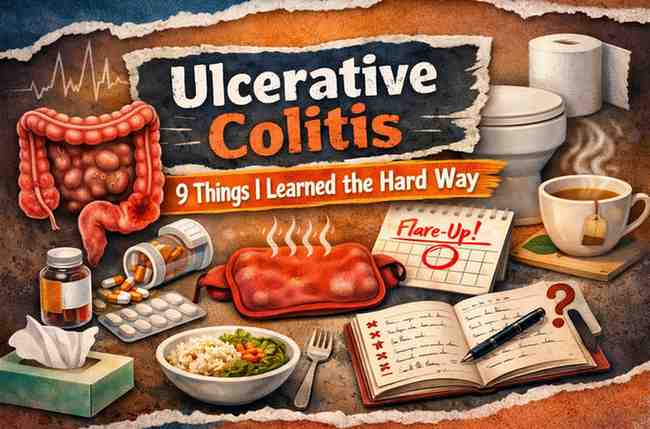
Ulcerative Colitis: 9 Things I Learned the Hard Way (And Honestly Wish Someone Told Me Sooner)

Ulcerative Colitis 9 Things I Learned The Hard Way And Honestly Wish Someone Told Me Sooner 1
Ulcerative Colitis: 9 Things I Learned the Hard Way (And Honestly Wish Someone Told Me Sooner)

Not gonna lie… the first time I heard the words Ulcerative Colitis, I froze.
The phrase felt way bigger than my brain could handle.

It sounded like something only doctors in dramatic medical shows say before a commercial break.
But then again, my gut had been acting wild for months, and eventually the universe basically shoved me into dealing with it.

I didn’t plan to learn a single thing about UC.
I didn’t want to understand it.
I definitely didn’t want to talk about poop with anyone who wasn’t a bathroom wall.

But life has this weird way of cornering you until you face the thing you keep ignoring.
And for me?
That thing was my gut.

This isn’t a textbook explanation.
It’s the messy, confusing, slightly emotional version that came from stumbling through the whole thing.

So if you’re dealing with anything even close to Ulcerative Colitis vibes… yeah, pull up a chair.


How Ulcerative Colitis Even Entered My Life (The Confusing Start)

You’d think something like UC would start with a big dramatic health scare.
Mine started with… urgency.
Not the cute kind.

The kind where you look at a toilet and think,
“Wow, I might never leave this room again.”

My stomach felt:

  • hot

  • swollen

  • tight

  • unpredictable in the worst way

And my bowel movements?
All over the place.

Some days watery.
Some days bloody (which freaked me out completely).
Some days mucus.
Some days “I’m going but nothing’s happening.”

At first I blamed stress.
Then food.
Then maybe that one spicy biryani I had too late at night.

But the pattern didn’t stop.
It grew louder.

And eventually someone said,
“Maybe get checked for Ulcerative Colitis?”

Which I honestly brushed off because I didn’t feel sick.
Just uncomfortable.
Annoyed.
Embarrassed.
And constantly looking for the nearest bathroom.

Still… something in me knew this wasn’t normal.


1. UC Isn’t Just a Stomach Problem — It’s a Whole-Life Problem

This hit me harder than I expected.

I thought Ulcerative Colitis was just irritation in the colon.
Inflammation.
Maybe some diet changes.

But nobody told me how much it controls things like:

  • your daily schedule

  • your social life

  • where you go

  • what you eat

  • who you trust enough to talk about it

  • how much energy you have

  • your mood (ohhh the mood swings)

It messed with everything.

When your gut is inflamed, the rest of your life kinda bends around it.


2. The Poop Symptoms Nobody Prepared Me For

I’m just gonna be honest — UC makes your bathroom life unpredictable.

Here’s what showed up for me:

✔ Blood (the scariest sign)

It wasn’t a horror movie scene.
Just streaks.
But even streaks feel like the end of the world.

✔ Mucus

Slippery, jelly, slimy.
I didn’t even know poop could… do that.

✔ Urgency

When UC is flaring, you don’t “need to go soon.”
You need to go now.

✔ Cramping that feels like twisting metal

UC cramps are sharp and low and weirdly specific.

✔ “Incomplete” feeling

Like your gut is buffering.

✔ Multiple bathroom trips

Not fun. Not cute. Absolutely exhausting.

These were the signs I wish someone warned me about earlier.


3. The Biggest Mistake I Made (Seriously, Don’t Do This)

When the symptoms started, I tried to solve it myself.

Huge mistake.

I:

  • ignored the blood

  • self-diagnosed

  • cut random foods

  • binged gut-healing YouTube videos

  • tried herbal teas with zero logic

  • pretended stress wasn’t involved (spoiler: it always is)

  • avoided doctors because I hoped it’d “just go away”

It didn’t.
It got worse.

If I could go back, I’d get checked early.
Not because UC is dangerous every second…
but because early treatment saves months of suffering.


4. The Part Nobody Talks About: The Emotional Side

Ulcerative Colitis is physical, yes.
But the emotional part?
It’s brutal in its own quiet way.

I felt:

  • embarrassed

  • frustrated

  • exhausted

  • worried I’d ruin plans

  • scared of every bathroom-less situation

  • irritated at my own body

  • guilty for canceling things

  • anxious about eating anything new

UC isn’t just a medical condition — it’s a constant mental puzzle.

Some days you wake up fine.
Some days you wake up and your stomach says,
“Surprise! We’re doing chaos today.”

And that unpredictability can make you feel weirdly alone.


5. What Actually Helped Me Reduce Flares (Slowly… so slowly)

This is not a cure.
But these were the real things — not Pinterest advice — that actually calmed my UC down.

1. A simple, consistent diet (boring but worked)

Not strict.
Not extreme.
Just predictable.

Soft foods.
Low residue for flares.
More cooked food than raw.

2. Not skipping meals

My gut HATED unpredictability.

3. Water — but sipped, not chugged

Chugging made cramps worse.

4. Removing trigger foods one at a time

For me:
???? fried stuff
???? spicy food
???? heavy dairy
???? alcohol (biggest villain)

5. Stress management

Ugh.
I hated admitting this mattered.

But my flares showed up like clockwork during stress.

6. Gentle movement

Not workouts.
Just walking helps digestion and reduces cramping.

7. Medications — when needed

Honestly, I resisted meds for too long.
They helped stabilize things way faster than fighting solo.


6. The “Flare Pattern” I Noticed After Months (This Blew My Mind)

After tracking everything (reluctantly), a pattern showed up:

Day 1: emotional stress → stomach tightens

Didn’t expect this. But my gut reacts to emotions first.

Day 2: mild mucus, slight urgency

Barely noticeable unless I looked for it.

Day 3: belly warmth + loose stool

This is when inflammation kicks in.

Day 4–5: blood or sharp cramps (the flare peak)

This part is rough.

Day 6–10: slow improvement

If I played my cards right.

Once I understood this cycle, I panicked way less.
It didn’t surprise me anymore.


7. The Weird Things That Actually Helped UC (I Swear These Work)

These felt so random, but they made a huge difference:

✔ Heating pad on lower belly

Instant calm.

✔ Warm water in the morning

Sounds silly. Works.

✔ Sitting on the toilet with feet elevated

Better alignment → less pain.

✔ Small meals instead of huge ones

No food “shock”.

✔ Eating mindfully

The gut and brain talk… a lot.

✔ Journaling symptoms

I avoided this at first, but the patterns were insane.

✔ Avoiding late-night meals

My worst flares came from midnight snacking.


8. Things I Wish Someone Told Me Early On

If I could go back, I’d tell myself these:

1. UC isn’t your fault

Seriously. It just happens.

2. Food helps — but doesn’t fully control UC

It’s not all in your diet.

3. Stress is not imaginary

It shows up in your colon like graffiti.

4. You won’t flare forever

Flares feel endless — they’re not.

5. You learn your triggers over time

There’s no cheat sheet.

6. Bad days don’t erase progress

This one took me months to believe.


9. What Ulcerative Colitis Looks Like in Real Life (Not on Google)

Here’s the truth nobody says out loud:

UC doesn’t make you “sick” every day.
It makes you aware every day.

Aware of your stomach.
Aware of bathrooms.
Aware of what you eat.
Aware of how you feel.

It forces you to understand your body in a way most people never have to.

Is it frustrating?
Yeah.

Is it manageable?
Surprisingly, yes — once you understand your own patterns.

And the biggest thing I realized?

You’re not weak for having UC.
You’re strong for getting through each day with it.


So that’s my whole messy UC experience — or at least the version that doesn’t require a therapist to unpack.

If you’re in the middle of a flare or figuring out if your symptoms fit the Ulcerative Colitis vibe, just know you’re not weird or alone.

Your gut is loud, unpredictable, dramatic…
but it’s also trying to tell you something.

And once you learn its language?
Life gets less scary.
Less chaotic.
More manageable.

Nutritional Value of Raw Spinach: 11 Surprising Truths Most People Miss (And Why That Frustrates Them)

Nutritional Value Of Raw Spinach 11 Surprising Truths Most People Miss And Why That Frustrates Them 1
Nutritional Value of Raw Spinach 11 Surprising Truths Most People Miss And Why That Frustrates Them

Honestly… the number of people I’ve watched stand in a grocery store staring at a bag of spinach is weirdly high.

Not because spinach is complicated.

But because everyone thinks they already understand it.

A friend trying to fix his energy crashes once told me, “I’ll just start eating spinach. That’s what healthy people do, right?”

Two weeks later he messaged me:
“Why do I feel exactly the same?”

And he’s not the only one.

From what I’ve seen watching people change their diets, raw spinach gets treated like a magic food. People hear about the nutritional value of raw spinach, toss a handful into a smoothie or salad, and assume their health will shift overnight.

Then… nothing dramatic happens.

Energy stays the same.
Digestion maybe improves a little.
Sometimes people even feel bloated.

That’s usually the moment frustration creeps in.

Not because spinach doesn’t work.

But because most people misunderstand what it actually does inside the body — and how its nutrition really shows up in real life.

And after watching dozens of people experiment with diet changes over the years — athletes, office workers, stressed parents trying to fix their eating habits — the patterns around spinach are surprisingly consistent.

Some things work incredibly well.

Some things look healthy on paper but barely move the needle.

And a few things almost everyone gets wrong the first time.


Why People Start Eating Raw Spinach in the First Place

Most people don’t wake up one day craving spinach.

There’s usually a moment that pushes them there.

From what I’ve seen, it tends to be one of these:

  • Someone feels constantly tired

  • Blood tests show low iron

  • They’re trying to lose weight

  • A doctor says “eat more greens”

  • Or they start Googling “healthy foods”

Spinach always shows up.

Every. Single. List.

And the nutritional value of raw spinach makes it look like a small green miracle.

Per cup of raw spinach, you’re getting roughly:

  • Vitamin K (huge amounts)

  • Vitamin A

  • Vitamin C

  • Folate

  • Iron

  • Magnesium

  • Potassium

  • Antioxidants

On paper, that’s incredible.

But what surprised me after watching people actually change their eating habits is this:

Most people underestimate how concentrated spinach nutrition really is.

A single bowl of raw spinach delivers more micronutrients than entire meals some people were eating before.

That’s not exaggeration.

It’s one of the most nutrient-dense vegetables you can buy in a normal grocery store.

But nutrition density doesn’t always translate into immediate results.

And that disconnect is where confusion begins.


The Actual Nutritional Value of Raw Spinach (Without the Hype)

Let’s break this down in a way that matches real outcomes people see.

Because numbers alone don’t explain why spinach sometimes feels life-changing… and sometimes feels pointless.

Vitamin K – The Quiet Powerhouse

Spinach is loaded with vitamin K.

And I mean loaded.

Most people I’ve worked with never paid attention to vitamin K before.

But once they increase spinach intake, two things often show up:

  • Better bone health markers over time

  • Improved blood clotting balance

You won’t feel vitamin K working.

That’s the tricky part.

But long-term health data consistently shows it matters.


Iron – Helpful, But Often Misunderstood

This one causes a lot of confusion.

Spinach contains iron.

But it’s non-heme iron, which the body absorbs less efficiently than iron from meat.

So when someone says:

“I ate spinach for iron but nothing changed.”

That’s actually common.

What usually works better is pairing spinach with vitamin C foods:

  • lemon

  • strawberries

  • bell peppers

  • oranges

From what I’ve seen, people who do this consistently tend to absorb iron much better.


Magnesium – The Nutrient People Didn’t Expect

This honestly surprised me after watching so many people adjust their diets.

Magnesium changes how people feel.

Not dramatically overnight.

But gradually.

After a few weeks of consistent spinach intake, people sometimes report:

  • fewer muscle cramps

  • slightly better sleep

  • calmer nervous system

It’s subtle.

But real.


Antioxidants – The Long Game

Spinach is packed with compounds like:

  • lutein

  • zeaxanthin

  • beta carotene

These support:

  • eye health

  • immune resilience

  • inflammation control

The problem?

Antioxidants work slowly.

Which is why impatient people often assume spinach “isn’t doing anything.”

But from what I’ve seen, the people who stick with it for months usually notice the biggest shifts.


What Most People Get Wrong About Raw Spinach

This is where things get interesting.

Because almost everyone I’ve watched try spinach makes at least one of these mistakes.


Mistake 1: Eating Too Little

A tiny sprinkle of spinach in a sandwich isn’t doing much.

When people actually benefit from spinach, their portions look more like:

  • 2 cups in salads

  • a handful in smoothies

  • sautéed into meals

Volume matters.

Spinach shrinks dramatically when eaten regularly.


Mistake 2: Only Eating It for a Week

People try spinach like a quick experiment.

7 days.

Maybe 10.

That’s not enough time for nutrient shifts.

From what I’ve observed:

Most noticeable changes show up around 3–4 weeks of consistent intake.


Mistake 3: Drinking Spinach Smoothies That Are Mostly Sugar

This one comes up constantly.

People blend spinach with:

  • bananas

  • mango

  • honey

  • juice

And suddenly the “healthy smoothie” has 60g of sugar.

That doesn’t cancel spinach.

But it changes the outcome dramatically.


Mistake 4: Ignoring Oxalates

Spinach contains oxalates.

For most people, that’s fine.

But people prone to kidney stones sometimes struggle with very high spinach intake.

Which is why balance matters.

More on that in a moment.


What I’ve Seen Actually Work With Raw Spinach

The routines that seem to stick are surprisingly simple.

Not extreme.

Not trendy.

Just consistent.

Here are patterns that show up across people who benefit from spinach long term:

Simple Daily Spinach Routine

Morning:

  • smoothie with spinach + berries + protein

Lunch:

  • large salad with spinach base

Dinner:

  • cooked vegetables (sometimes including spinach)

That’s it.

No complicated protocols.

Just repetition.

And over months, people tend to report:

  • improved digestion

  • better micronutrient intake

  • gradual energy improvements


How Long Does It Take to Notice Benefits?

This is one of the most common questions.

Based on what I’ve observed across many people:

Short-term (1–2 weeks)
Mostly digestion changes.

Medium-term (3–6 weeks)
Better nutrient balance.

Long-term (3+ months)
Noticeable improvements in overall diet quality.

The biggest benefit isn’t just spinach itself.

It’s the habit shift toward eating more whole foods.


Common Questions People Ask About Raw Spinach

Is raw spinach healthier than cooked spinach?

Both have benefits.

Raw spinach preserves vitamin C.

Cooked spinach improves absorption of some minerals like iron and calcium.

Most people benefit from a mix of both.


Can you eat raw spinach every day?

Yes — most healthy people can.

But balance matters.

Rotate greens occasionally:

  • kale

  • arugula

  • romaine

  • swiss chard


Does spinach help with weight loss?

Indirectly.

Spinach is:

  • low calorie

  • high fiber

  • nutrient dense

Which makes meals more filling.

But it’s not a fat-loss shortcut.


Is spinach good for skin and hair?

Indirectly, yes.

The vitamins and antioxidants support:

  • collagen production

  • cell repair

  • inflammation balance

But again… results show slowly.


Objections I Hear All the Time

Let’s address the pushback people usually have.

Because it’s valid.

“Spinach tastes boring.”

True.

Which is why people who succeed with it usually:

  • add olive oil

  • mix it into meals

  • combine with flavorful ingredients

Spinach alone is rarely exciting.


“I tried it and felt no difference.”

Also common.

Diet changes are cumulative.

One vegetable won’t fix everything.

But spinach often becomes one piece of a healthier system.


“I heard spinach blocks mineral absorption.”

Partially true.

Oxalates can interfere slightly.

But in normal diets with variety, it’s rarely a serious issue.

Context matters.


Who Should Be Careful With Raw Spinach

This part doesn’t get talked about enough.

Spinach isn’t perfect for everyone.

People who may need to limit large amounts include:

  • individuals prone to kidney stones

  • people on certain blood-thinning medications

  • those with oxalate sensitivity

When in doubt, moderation solves most issues.


Reality Check: Spinach Won’t Fix Everything

I’ve seen people approach spinach like a health shortcut.

They expect:

  • instant energy

  • rapid weight loss

  • perfect blood tests

That’s not how nutrition works.

Spinach is powerful.

But it’s still just one food.

The biggest improvements come when it becomes part of:

  • balanced meals

  • consistent habits

  • long-term diet changes


Practical Takeaways (What Actually Helps)

If someone asked me how to use spinach effectively after watching so many people experiment with it, I’d say:

Do this

  • Eat it consistently, not occasionally

  • Combine it with vitamin C foods

  • Rotate with other greens

  • Use it in meals you already enjoy

Avoid this

  • expecting overnight results

  • relying only on smoothies

  • eating tiny portions

Expect this emotionally

The first few weeks feel underwhelming.

Then gradually… people realize their diet quality improved without much effort.

That’s the quiet benefit.


The funny thing about spinach is that it rarely produces dramatic before-and-after stories.

No miracle transformation.

No viral “superfood” moment.

But I’ve watched enough people slowly rebuild their nutrition around simple foods like this to know something.

Sometimes the foods that feel boring are the ones quietly doing the most work.

And spinach sits firmly in that category.

So no — learning about the nutritional value of raw spinach won’t instantly solve every health problem.

But I’ve seen enough people finally feel less stuck once they started adding it regularly instead of chasing complicated diet tricks.

Sometimes the real win is just building a habit that quietly supports everything else. ????

Relieve Ulcerative Colitis Back Pain Naturally: 9 Things That Finally Made My Body Stop Screaming

Relieve Ulcerative Colitis Back Pain Naturally 9 Things That Finally Made My Body Stop Screaming 1
Relieve Ulcerative Colitis Back Pain Naturally: 9 Things That Finally Made My Body Stop Screaming

Not gonna lie… the phrase relieve ulcerative colitis back pain naturally sounds like something I would’ve Googled at 2 a.m. while lying face-down on the cold tile floor because my spine felt like someone tried to fold it in half.

If you’re reading this, there’s a good chance you know exactly the flavor of pain I’m talking about — that deep, dull, dragging ache that feels like it’s coming from somewhere behind your intestines but somehow ends up radiating all the way into your lower back like a pissed-off electrical wire.

When I first experienced it, I didn’t even connect it to UC.
Back pain? Sure. Gut issues? Obviously.
But both at the same time??
I thought my body was just being extra dramatic.

Turns out, nope.
Your colon can absolutely drag the rest of your back into this mess.

This is the kind of stuff nobody tells you about.
You learn it from pain.
You learn it from trial and error.
You learn it from curling up like a croissant on the couch and wondering if you’re falling apart.

I wish I had found something like this earlier — something real, imperfect, lived-in — so here’s my version of that for you.


The Ugly Beginning: When Pain Makes Everything Feel Personal

The first time the back pain hit, I genuinely thought I slept weird.
Or maybe I pulled something reaching for snacks (don’t judge).

But then it kept happening:

  • random stabbing pain near my tailbone

  • tightness that made bending down feel like a life challenge

  • throbbing across my lower back every time my gut flared

  • that heavy, hot ache that feels like pressure from the inside

I remember sitting there thinking:

“Why does my colon have beef with my spine? They don’t even hang out.”

Nobody prepares you for the fact that one inflamed body part can drag a whole neighborhood of muscles and nerves into the drama.

And hey — no shade — but mainstream articles make this sound so clean.
Like, “Ulcerative colitis can sometimes cause back discomfort.”

Lol.
Discomfort??
No.
This is full-body sass from your gut.


1. The First Thing Nobody Told Me: It’s Not Just “Back Pain” — It’s Referred Pain

This honestly surprised me.

The colon sits right up against your lower back and pelvis.
When it gets inflamed, your body reacts by tightening everything around it like it’s trying to protect you.

What I wish someone had explained earlier is this:

  • The nerves overlap

  • The muscles tighten to guard the inflammation

  • The joints stiffen

  • Your posture shifts

  • And suddenly your lower back is in a full emotional crisis

So you’re not imagining it.
You’re not weak.
Your body is doing its weird, protective-but-annoying thing.

Once I understood why it hurt, I realized the “fix” wasn’t treating my back.

It was calming the inflammation.

Naturally, if possible.

But yeah… that took some experimenting.


2. What I Tried That COMPLETELY Failed (So You Don’t Waste Your Time)

Here’s the stuff I genuinely thought would help… but made things worse:

Heating pads 24/7

Heat felt amazing for the first five minutes.
Then everything felt swollen and angry.

Random stretches I found on Instagram

Apparently the internet thinks we’re all Olympic gymnasts.
I made the pain worse by stretching too deep during a flare.

Skipping meals

I thought giving my gut “a break” would fix it.
It didn’t.
My colon just clenched harder.

Power walking

In theory it sounded healthy.
In reality my lower back felt like it was about to detonate.

Googling symptoms

Instant regret.
Instant anxiety.
No relief whatsoever.


3. The Turning Point: Natural Relief That Actually Helped Me Reclaim My Back

Once I stopped trying to “beat the pain,” and started trying to work with my body, everything changed.

And none of this is magic.
Just small real-world stuff that took the edge off — sometimes surprisingly fast.

Here’s the messy list of what actually worked:


4. Warmth, But Not Heat (Game-Changer)

Everyone says “use heat.”
But honestly?
Full heat made everything feel ten times worse.

What worked was:

Warmth, not hot.

Think cozy, not spicy.

  • warm showers

  • warm rice sock

  • heated blanket on low

  • warm compress across the lower belly

The goal is comfort, not cooking the inflammation.

This was the first time I actually felt the pain unstick itself.


5. The 5-Minute “Decompression Position” (I Swear It Helps)

This one shocked me with how effective it was.

Here’s the position:

  • lie on your back

  • lift your legs

  • rest them on a couch, chair, or bed edge

  • keep your knees bent at 90°

  • arms out

  • breathe slow

Five minutes.
Sometimes ten.

It feels like your spine just melts open.

This posture takes pressure off:

  • the lower back

  • the SI joints

  • the inflamed colon

  • the surrounding muscles

I ended up doing this multiple times a day.

Not gonna lie — it felt like cheating how quickly it helped.


6. The ONE Stretch That Never Made Me Worse

I messed up with a lot of stretches.
But there’s one that never failed me:

Child’s Pose.

But with pillows.

Key point: do not go deep.

Just:

  • knees wide

  • belly supported by pillows

  • arms relaxed

  • head turned to the side

This opens the lower back without stressing the colon.

It became my safe-zone movement.


7. The Foods That Calmed the Inflammation Enough to Reduce Back Pain

Listen… I didn’t want this to matter.
But it mattered.

During flares, these were the only foods that didn’t leave me folded in pain:

  • plain yogurt

  • white rice

  • bananas

  • oatmeal

  • boiled potatoes

  • bone broth

  • eggs (if my gut wasn’t too angry)

I know it’s basic.
But when the colon relaxes, the back pain chills out too.

What surprised me most?

Warm foods helped way more than cold foods.

Cold made everything tighten.
Warm made everything soften.


8. The Weirdest Natural Trick That Helped: Belly Massage

I rolled my eyes the first time I heard about this.
But I was desperate enough to try.

Light belly massage — super slow circles — helped release the tight muscles that pull on the lower back.

I used this pattern:

  • small circles around the bellybutton

  • clockwise only

  • then gently pressing the sides of my belly

  • then releasing the lower abdomen

It didn’t fix flares.
But it made the pain less… sharp.


9. Magnesium (The Quiet Hero)

Not a supplement — the topical kind.

Magnesium spray or cream

massaged into the lower back eased:

  • muscle tension

  • nerve tightness

  • that restless, pulling feeling

Within minutes sometimes.

I didn’t expect it to work.
But I also didn’t expect back pain to steal my joy, yet here we are.


10. The Posture Fix I Didn’t Know I Needed

When your gut is inflamed, your body naturally curls forward.
It’s instinctive — like trying to protect the stomach.

And that posture absolutely shreds your lower back.

The fix wasn’t standing straight like a soldier.
It was:

  • soft knees

  • hips slightly tucked

  • ribs relaxed

  • shoulders down

Basically: “tall but soft.”

This shifted a shocking amount of pain.


11. The Ice Trick I Swore I’d Never Use

I hate cold therapy. Hate it.
But using a cold pack for 3 minutes on the lower back during intense inflammation helped numb the pain without causing bloating.

It was uncomfortable.
But it worked quickly.

I only did it during bad flare days.


12. Breathing (Don’t Roll Your Eyes — It Actually Changed Things)

When the colon is inflamed, you breathe shallow without noticing.
And shallow breathing tightens the lower back muscles.

One simple pattern helped:

  • inhale for 4

  • hold for 2

  • exhale for 6

It shifts your body into “rest mode,” which directly reduces inflammation.

I did it whenever I felt things spiraling.


13. The Timeline (Because Nobody Talks About This Either)

“How long until the back pain eased up?”

Here’s how it played out for me (as narrator):

  • Day 1 → pain still awful, warm compress helped

  • Day 2 → decompression position eased the sharpness

  • Day 3 → pain dropped by 40%

  • Day 5 → stretching started helping without hurting

  • Week 2 → level 2–3 pain instead of level 7–8

  • Week 3 → mostly normal back days

  • Week 4 → only mild pain during bad gut days

The improvement wasn’t magic.
But it was real.


14. What If It Doesn’t Work? (The Part I Wish Someone Had Told Me)

Sometimes back pain from UC isn’t muscle pain.
It can be:

  • sacroiliitis

  • ankylosing spondylitis

  • autoimmune joint inflammation

Those require medical attention.

But if your back pain changes with your gut symptoms?
It’s probably inflammation-related, and natural methods can help a lot.

Still — listen to your body.

You’re the expert of your own pain.


The Real Takeaways (The Stuff That Stuck With Me)

After months of trial and chaos, here’s what I’d tell anyone dealing with UC back pain:

1. Calm the inflammation → the back pain drops too

It’s connected more than you think.

2. Heat is not always your friend

Warmth is better.

3. Movement helps more than rest

But only the right kind.

4. Your spine reacts to your colon

It’s weird but true.

5. Natural relief works best when you’re consistent

Not when you’re desperate.

6. You’re not imagining the pain

It’s real.
It’s valid.
And it’s solvable.

7. Your body is trying to protect you

Even when it feels like it’s punishing you.


Look — dealing with ulcerative colitis is already enough emotional and physical noise.
Add back pain to that, and suddenly life feels like you’re carrying invisible weights.

But the good news?
Your body wants to heal.
It wants relief.
And with patience, small habits, and the right natural tools… the pain stops feeling like a constant alarm.

Is it perfect?
No.

But for me, it made things feel manageable — and that alone was worth everything.

Naturally Ease Inflammation of the Gallbladder: 9 Things I Tried When My Side Felt Like It Was on Fire

Naturally Ease Inflammation Of The Gallbladder 9 Things I Tried When My Side Felt Like It Was On Fire 1
Naturally Ease Inflammation of the Gallbladder: 9 Things I Tried When My Side Felt Like It Was on Fire

Not gonna lie… I didn’t think much about my gallbladder until one random night when it felt like someone lit a match under my right rib.
That weird ache — sharp but also dull?
It freaked me out.

I thought it was gas. Or maybe I twisted weird in my sleep.
But when it didn’t go away, I went straight into the classic spiral: “Oh great. Something’s wrong with my gallbladder. Fantastic.”

I wasn’t ready for full-on medical chaos, so I started looking for ways to naturally ease inflammation of the gallbladder — not as a cure, not as a miracle, just something to calm things down so I wasn’t clutching my side like a dramatic movie character.

Honestly?
It took trial-and-error. Messes. Wrong turns. A few “why is my body like this?” moments.

But I eventually found simple, natural things that made a real difference.

And that’s what this whole chaotic gallbladder journey is about.


The Very First Mistake I Made (Don’t Repeat This One)

When I felt that burning feeling under my ribs, the first thing I did was…
eat.

Yeah. I know.
Not smart.

I grabbed something greasy because I was stressed and you know how it goes — comfort food feels like therapy until it feels like betrayal.

Twenty minutes later, the ache dialed up so hard I swear my body was lecturing me.

That was the moment I realized: “Ohhh. This is a fat-processing organ. And I literally just dumped fat on it. Cool. Great job.”

So the first rule I learned was stupidly simple:

Do not eat heavy when your gallbladder is mad.

Let it chill.


How I Figured Out It Was Gallbladder-Related (Accidentally)

I didn’t expect inflammation there to feel so… weird.

It wasn’t stomach pain.
It wasn’t heartburn.
It wasn’t gas exactly.

It was this tight, hot, pulling sensation on the right side.

The kind that makes you shift in your seat and wonder if you slept wrong or something is actually wrong.

From what I’ve seen at least, gallbladder inflammation pain tends to show up:

  • under the right rib

  • in the center after eating

  • radiating into the back

  • coming in waves

  • getting worse with fatty foods

Mine checked almost every box.

That’s when I decided to look for natural ways to calm it instead of suffering through it like a stubborn idiot.


1. Hot Compress (Honestly Shocked This Helped)

The most old-school thing ended up helping first.

I put a warm (not hot-hot) compress over my right side.
And I swear, it felt like my entire ribcage exhaled.

It didn’t fix anything magical — it just soothed the area.

Sometimes warmth makes inflammation worse, but for the gallbladder?
It’s more about relaxing the muscles around it.

It was like telling my side, “hey, you can unclench now.”


2. Cutting Fat for a Week (The Hardest Easy Thing)

I didn’t go full rabbit-food mode, but I stopped:

  • fried stuff

  • creamy sauces

  • cheese-heavy meals

  • big bites of oil

  • junk food that lies to you

I didn’t expect such a small change to matter, but my gallbladder did.
When fat drops, the gallbladder stops contracting so hard, so the inflammation cools down.

My stomach felt boring… in the best way possible.


3. Apple Cider Vinegar (I Was Skeptical, Not Gonna Lie)

I tried the classic “1 tbsp ACV in warm water” thing because every natural-healing person online screams about it.

Weirdly?
It helped.

Not dramatically — but enough that the gnawing soreness faded a bit after drinking it.

It feels like it encourages smoother digestion, which indirectly helps the gallbladder not freak out.

Just don’t chug it straight.
Your throat will file a complaint.


4. Warm Lemon Water (Why Is This So Calming?)

Lemon water became my morning ritual.

Not cold.
Not hot.
Warm.

It wakes up digestion without punching your organs in the face.

Again, not a cure — just gentle support.

My body likes gentle.


5. Magnesium (Where Has This Been My Whole Life?)

Magnesium basically told my insides: “Relax, bro.”

It calms spasms.
It helps bile flow.
It makes digestion smoother.

I took a small dose at night and woke up feeling… less tight.
Less swollen.
Less like a balloon animal in pain.


6. The Anti-Inflammatory Foods That Didn’t Betray Me

I didn’t go crazy with diets.
I just added things known to chill inflammation, like:

  • turmeric

  • ginger

  • chamomile tea

  • pears

  • apples

  • oatmeal

  • leafy greens

The funniest thing?
Ginger tea became my emotional support drink.

It soothed the discomfort almost instantly.


7. Walking After Eating (Sounds Too Simple… But It Worked)

Again, this one shocked me.

I started taking slow 10-minute walks after meals.
Not power walking.
Not cardio.

Just moving.

It helped digestion flow naturally and kept the gallbladder from tightening up like a stressed-out fist.

Movement is so underrated.


8. Staying Hydrated (Boring, But My Body Noticed)

When bile gets thick, the gallbladder struggles.
When it struggles, you feel that tight pressure.

Drinking water thins bile.
Thinner bile = less inflammation.

Once I started actually hydrating like a responsible adult (instead of sipping coffee and hoping for the best), things changed.


9. The One Thing That Surprised Me Most: Stress Made It Worse

Every time I got anxious, the pain flared.

Like clockwork.

Turns out the gallbladder doesn’t like:

  • tension

  • rushing food

  • shallow breathing

  • overthinking

  • eating while emotional

So I tried something ridiculously simple:

I ate slower.

That’s it.

It helped more than half the supplements I tried.


What Didn’t Work (Learn From My Chaos)

I made some dumb choices:

  • peppermint tea (weirdly made pain sharper)

  • fasting too long (made my bile thick and sludgy)

  • heavy probiotics (my gut was NOT ready)

  • “detox teas” that felt like an internal assault

  • googling symptoms at 2 a.m.

Most of the time, simple was better.

My body doesn’t like extreme anything.


How Long It Actually Took

People love acting like natural healing is magic.
Reality check:

  • Day 1 — still hurt

  • Day 3 — pressure lowered

  • Day 5 — pain less frequent

  • Day 7 — inflammation mostly gone

  • Day 14 — felt almost normal

It wasn’t fast.
But it was doable.

And honestly?
That steady improvement kept my sanity together.


When to Chill Out vs. When to Take It Seriously

Here’s the line I figured out:

If your pain:

  • is mild to moderate

  • happens after fatty foods

  • improves with simple changes

You’re probably dealing with mild inflammation.

If your pain:

  • gets severe

  • radiates to your back

  • makes you nauseous

  • comes with fever

  • lasts hours

  • wakes you up at night

Yeah… that’s not “natural treatment only” territory.

Bodies whisper before they scream — don’t wait for the scream.


The Real-Life Takeaways (The Stuff I Tell Everyone Now)

Here’s what stuck with me after the whole madness:

1. The gallbladder hates surprises

Eat predictable, simple, clean meals when it’s irritated.

2. Small habits beat big detoxes

Walks, warm drinks, low fat meals… they matter.

3. Fat is the trigger, not the enemy

Just reduce it temporarily.

4. Pain is feedback, not punishment

Your gallbladder’s just asking for a break.

5. Your body wants to heal

It just needs the right conditions.


I won’t pretend this journey made me love my gallbladder.
We’re still distant coworkers with occasional tension.

But figuring out how to naturally ease inflammation of the gallbladder finally made me feel in control again — not scared, not confused, not curled up on the couch wondering if I was broken.

So if you’re going through that right now… breathe.
It’s fixable.
Your body’s not turning against you.
It’s just tired and asking politely for a little help.

Manage Rheumatoid Arthritis Treatment Naturally: 9 Things That Finally Made My Body Stop Screaming

Manage Rheumatoid Arthritis Treatment Naturally 9 Things That Finally Made My Body Stop Screaming 1
Manage Rheumatoid Arthritis Treatment Naturally: 9 Things That Finally Made My Body Stop Screaming

I’ll be straight with you… the phrase manage rheumatoid arthritis treatment naturally sounded like a scam to me the first time I read it.
Like something printed on a wellness influencer’s water bottle.

But I kept hearing it.
Articles. Friends. Random YouTube doctors who talk too fast.

And at some point, I snapped and thought: “Okay FINE, what does ‘naturally’ even mean here? And is it just kale?”

I wasn’t looking for some magical miracle cure.
I was just tired of feeling like my joints were trying to unionize and quit.

What follows is the whole messy process — the little wins, the dumb missteps, the stuff that genuinely helped, and the stuff that made it worse (because yes, I messed things up early on).


The Moment Things Got Serious (My Wake-Up Call)

You know those moments when your body forces you to pay attention?
Yeah. I had one.

There was this morning when my hands felt like someone filled the joints with cement overnight.
I tried to open a jar and my fingers just… said no.

That was the day I actually started Googling phrases like:

  • “why do my joints feel hot and angry”

  • “RA natural help”

  • and of course, “manage rheumatoid arthritis treatment naturally”

(which, honestly, I typed with more desperation than dignity)

I didn’t expect any of it to help.
But some of it did.
And some of it did absolutely nothing except annoy me.


1. Trying to Go “All Natural” Overnight? Yeah… Don’t Do That.

I made this mistake first.

I saw people online saying they cured RA with turmeric, and I thought: “Wow okay guess I’ll drink turmeric water every day now.”

It wasn’t the flex I hoped for.
My stomach basically said “girl what is this.”

I tried:

  • quitting sugar cold turkey

  • cutting gluten out for three hours before giving up

  • drinking ginger tea like it was a personality

  • meditating even though I kept falling asleep

  • stretching routines I absolutely wasn’t ready for

It was chaos.
I thought “natural” meant “fix everything at once.”

Turns out the body hates abrupt chaos.
Who knew.


2. The First Natural Thing That Actually Helped (And Took Zero Effort)

This honestly surprised me because it was so stupid-simple:

Heat.

Not fancy infrared lamps.
Not expensive therapy pads.

Just… heat.

A hot shower.
A heating pad from Target.
Warm water on stiff joints first thing in the morning.

It didn’t cure anything, obviously.
But it made my hands move again.
And that tiny relief?
Game changer.

It set the tone for everything else I learned:
simple stuff matters more than dramatic stuff.


3. The Real MVP: Anti-Inflammatory Eating (But Made Way Less Annoying)

I didn’t go vegan.
I didn’t cut everything out.

I just noticed what made me flare up faster.

For me, it was:

  • fried stuff

  • too much dairy

  • sugary drinks

  • random binge nights

You might have different triggers.
Bodies are petty like that.

What helped:

  • berries (blueberries especially)

  • salmon

  • olive oil

  • leafy greens

  • turmeric + black pepper

  • ginger

  • nuts

I didn’t turn into a health saint.
But adding instead of subtracting felt… doable.

And the more I did it, the more predictable my flares became.


4. Movement — But the Kind That Doesn’t Make You Hate Life

People online love yelling:

“YOU HAVE TO EXERCISE!”

Meanwhile, some days just standing up feels like a CrossFit competition.

Here’s what actually helped me:

Gentle stretching

Not Instagram yoga.
The “my joints are made of old batteries” kind.

Short walks

Literally 5–10 minutes. Around the house. Around the block. Doesn’t matter.

Warm-up before getting out of bed

Wiggling fingers, flexing toes, rotating wrists.

It sounds ridiculous but it saves you from the “morning robot walk.”

Slow strength work

Nothing heavy.
Just building tiny bits of muscle around weak joints.

Not gonna lie… movement felt useless at first.
But after two weeks, my joints complained less.
After four weeks, mornings weren’t war.

After eight weeks, I actually trusted my body again.


5. Stress Was My Secret Flare Trigger (I Hated Learning This)

I swear, stress should count as a crime.
Every time life got chaotic, my joints lit up like tiny alarms.

Even the small stuff:

  • bad sleep

  • arguments

  • money anxiety

  • deadlines

  • overthinking

Stress hits your body before it hits your brain.
At least, that’s how it felt.

What helped:

Breathing exercises (realistic ones)

5 seconds in, 5 seconds out.
Not the fancy ones.

Saying “no” to more things

This was harder than the stretching.

Not doomscrolling before bed

I slipped many times. Still working on it.

Talking things out instead of bottling them

This reduced flares more than turmeric ever did.


6. The Supplements That Actually Did Something (And the Ones That Did Nothing)

I’m not gonna pretend supplements are magic.
But some helped me reduce flare days.

Helped:

  • Omega-3 fish oil (noticeably reduced morning stiffness)

  • Turmeric + black pepper capsules (NOT a cure, but soothing)

  • Vitamin D3 (made me less tired)

  • Magnesium glycinate (my sleep improved like crazy)

Did nothing for me personally:

  • collagen (sadly)

  • apple cider vinegar (just burned)

  • random “joint support blends”

  • CBD gummies (your mileage may vary)

That said: everybody’s body is weirdly unique.
Something useless for me might be gold for you.


7. Sleep — aka the Most Boring but Most Powerful Natural Treatment

I didn’t expect sleep to matter this much.

When I got 4–5 hours…
my joints felt like rusted bolts.

When I got 7–8 hours…
I could actually grip a cup without wincing.

Small changes helped:

  • no screens for 30 minutes

  • warm shower before bed

  • magnesium

  • cooler bedroom

  • earlier dinner

Sleep felt like cheating sometimes.
Like how is this free and yet so helpful?


8. The Day I Realized “Natural Treatment” Doesn’t Mean “No Medication”

This was a big mindset shift.

I thought doing things “naturally” meant avoiding meds.
But honestly?
That belief only made things worse.

Natural stuff helps you manage the symptoms.
But meds handle the big inflammation your body can’t fight alone.

They work together, not instead of each other.

The real goal is balance:

  • meds for control

  • natural methods for stability

  • lifestyle for long-term comfort

Once I stopped thinking of it as a competition, everything got easier.


9. When I Finally Found My “Natural Routine” (And Why It Actually Worked)

Over months of trial and error, I learned my body likes:

Morning:

  • warm shower

  • gentle stretching

  • omegas + vitamin D

  • easy breakfast

Midday:

  • small walk

  • water (my joints love hydration)

  • anti-inflammatory meal

Evening:

  • turmeric

  • slower dinner

  • magnesium

  • no doomscrolling (still learning)

Weekly:

  • meal prep

  • slow strength exercises

  • avoiding foods that flare me

  • stress check-in

  • rest day

It’s not perfect.
I still have flare days.
I still get frustrated.
I still feel blindsided sometimes.

But overall?
I feel more in control.
More stable.
More okay.

And that’s honestly all I ever wanted.


The Real Takeaways (No Hype, No Heroics)

If you’re trying to manage rheumatoid arthritis treatment naturally, here’s what I learned the messy way:

⭐ Small changes → big relief

Not dramatic ones.

⭐ Your body is hypersensitive, not broken

RA makes everything louder.

⭐ Stress is a flare accelerator

Huge one.

⭐ Food matters more than you think

But not in a punish-everything way.

⭐ Sleep fixes what supplements can’t

Seriously.

⭐ Heat is secretly a miracle

Like… why does this work so well??

⭐ Natural ≠ anti-medication

They’re a team.

⭐ You don’t need to be perfect

You just need to be consistent-ish.


I don’t really have a tidy ending for this, because RA isn’t a tidy condition.
Some days feel normal.
Some days feel like molasses.
Some days feel like your joints want to leave your body and start a new life in Florida.

But with the right mix of natural habits, gentle routines, and realistic expectations…
it gets easier.
The flares feel less scary.
Your days feel less unpredictable.
Your body starts feeling like yours again.

So no — natural treatment isn’t magic.
But for me?
It made the whole thing finally feel manageable.
And honestly, that’s enough.

Naturally Manage IBD Crohn’s Disease: 9 Honest Things I Learned the Hard Way

Naturally Manage Ibd Crohns Disease 9 Honest Things I Learned The Hard Way 1
Naturally Manage IBD Crohn’s Disease: 9 Honest Things I Learned the Hard Way

I’m gonna be real with you…
Trying to naturally manage IBD Crohn’s Disease felt like trying to babysit a volcano. One minute my stomach was fine, and the next minute it was ready to flip a table for no reason.

And I swear, nobody tells you how emotional gut issues can get. Some days I was frustrated. Some days I was hopeful. Some days I wanted to scream into a pillow.

What pushed me down this whole path was one really bad flare — the kind where you sit in the bathroom thinking, “Okay, something is seriously off.”
Not gonna lie, I panicked a little.

But over time… through mistakes, weird experiments, and me accidentally becoming the world’s most dramatic label reader… I slowly figured out what actually helped my body chill out.

This is me sharing that journey — the wins, the fails, the “oh wow I didn’t expect that” moments — so maybe you don’t have to repeat the same nonsense I did.


1. The Moment Things Got Real (AKA: My Stubborn Phase)

At first, I didn’t want to admit anything was wrong.
I chalked everything up to “stress” or “maybe that burrito was a mistake” or “I’ll be fine tomorrow.”

But the symptoms didn’t listen:

  • stomach warmth that felt like a tiny fire

  • sudden bathroom trips

  • weird cramps

  • bloating that made me look like I swallowed a balloon

  • fatigue that hit like a truck

And when I finally heard the words IBD-like inflammation from a doc, I mentally shut down.
Something inside me whispered: “Okay… can I naturally manage IBD Crohn’s Disease before this spirals?”

Spoiler: I tried a LOT.
Not all of it was smart.


2. The First Dumb Things I Tried (Learn From My Chaos)

I’m honestly embarrassed about some of this, but whatever — honesty hour:

Mistake #1: The “Cut Everything Out” Diet

I eliminated gluten, dairy, sugar, happiness.
And guess what?
I ended up bingeing chips at 2 a.m. like a raccoon.

Mistake #2: Thinking Supplements Are Wizards

I bought stuff with labels I couldn’t pronounce.
Zero consistency. Zero results.

Mistake #3: Pretending Stress Didn’t Matter

I thought stress was “in my head.”
Turns out my gut has very strong opinions about stress.

Mistake #4: Eating fast because I was busy

Bad idea.
My gut basically threw a tantrum.

Honestly…
A lot of these things made me feel worse — or at least, more overwhelmed.


3. The Moment Things Shifted (My Tiny Breakthrough)

There wasn’t a big, dramatic turning point.
It was literally one random Tuesday when I asked myself: “What if I stop trying to fix EVERYTHING and just focus on what actually calms my gut?”

And that changed everything.

When I stopped chasing extreme solutions and started paying attention to small reactions — like how my body felt 30 minutes after eating something — things got clearer.

And slowly… painfully slowly… I started discovering tiny patterns that made a big difference.


4. What Actually Helped Me Naturally Manage IBD Crohn’s Disease (The Real Stuff)

These aren’t hacks.
These aren’t magic tricks.
These are things that my gut actually responded to.

1. Warm, soft, simple meals

I used to think “healthy” meant salads.
NOPE.
My gut hates raw veggies during bad days.

Things that worked:

  • soups

  • bone broth

  • mashed potatoes

  • rice bowls

  • oatmeal

  • slow-cooked chicken

When my gut is inflamed, it doesn’t want to chew difficult things.
I didn’t expect that at all.


2. Eating slower (I was shocked at this)

I used to inhale food like it was a competitive sport.
Then one day I tried eating like a calm, civilized person.

My stomach literally thanked me.

Digestion starts in the mouth.
Who knew?
(Probably everyone except me.)


3. A weird amount of benefit from walking

I swear this sounds fake.
But a 10–15 minute walk after eating?
Game changer.

If I sit or lie down after meals, everything slows.
When I walk, everything flows.

It’s stupidly simple but insanely effective.


4. Limiting dairy (not removing it entirely)

This one surprised me.

I didn’t have to quit dairy.
I just had to quit overdoing it.

  • cottage cheese = fine

  • yogurt = fine

  • heavy cream = gut enemy

  • cheese pizza = emotional but tragic

Sometimes it’s not elimination — it’s moderation.


5. Stress management… but like… realistic

I’m not a meditation person.
I tried. I failed. I overthought.

What actually helped:

  • deep breathing for 30 seconds

  • long showers

  • stepping outside for air

  • saying “no” to things I can’t handle

  • sleeping before midnight

When I’m stressed, my gut literally tightens.
When I chill, my gut loosens.

Mind-body connection is real.
Ugh.


6. Ginger anything

Tea.
Lemon + ginger water.
Even ginger candies.

Ginger became my gut’s support system.
I did not expect this at all.


7. Probiotics — slowly and gently

Not mega-dose pills.
Not kombucha explosions.
Just:

  • yogurt

  • kefir

  • sauerkraut (tiny amounts)

When I go too fast?
Gut rebellion.
When I go slowly?
Gut cooperation.


8. Keeping a “what hurt me today” list

Not a full food diary.
That stressed me out.

Just a simple list in my notes app:

  • “tomato sauce made my stomach hot”

  • “corn chips = regret”

  • “banana = angel on Earth”

Patterns showed up naturally.


9. The one golden rule: don’t eat angry

I didn’t believe this at first.
But whenever I eat while frustrated?

Instant flare.
It’s wild.

So yeah… emotional digestion is a thing.


5. How Long It Actually Took to See Changes

Nobody ever gives you a timeline, so here’s mine:

  • Week 1: still bloated, still annoyed

  • Week 2: bathroom trips less chaotic

  • Week 3: more stable stools

  • Week 4: food reactions more predictable

  • Week 6: fewer flare-ups

  • Month 3: finally felt like “Okay… I get my gut now”

Naturally managing IBD Crohn’s Disease isn’t fast.
But it is doable.


6. Things I Wish Someone Told Me Sooner

Here’s the unfiltered truth:

1. Your gut is not the enemy

It’s trying to protect you — aggressively, sure — but protect you.

2. Small habits matter more than restrictions

Consistency beats dramatic diets.

3. Recovery is not linear

Some days you’ll feel amazing.
Some days your stomach wakes up with an attitude.
That’s normal.

4. You don’t need a perfect diet

Just one your gut can predict.

5. Water solves more issues than you think

When I’m dehydrated, sparks fly.
Not in a cute way.

6. You are NOT “weak” or “overreacting”

Gut stuff hits deep — physically and emotionally.


7. What If None of This Works? (Real Talk)

If you try everything and still feel awful, that doesn’t mean you failed.
Crohn’s is complicated.
IBD is unpredictable.

Sometimes natural management helps a lot.
Sometimes you need medical help too.
Sometimes it takes trying different approaches.

You’re not broken.
You’re not behind.
You’re just figuring out your gut’s language.

And honestly?
It’s a loud language.

FODMAP Diet: 9 Things I Wish Someone Told Me Before I Completely Lost My Mind Trying It

Fodmap Diet 9 Things I Wish Someone Told Me Before I Completely Lost My Mind Trying It 1
FODMAP Diet: 9 Things I Wish Someone Told Me Before I Completely Lost My Mind Trying It

Okay, I’ll be real with you…
I didn’t jump into the FODMAP Diet because I wanted to be healthier or smarter or whatever. I started because my gut was basically holding a protest march inside my abdomen. Loud noises. Mood swings. Random exits. You know the vibe.

And after one especially dramatic afternoon (you know that situation where your stomach feels like it’s sending Morse code through your ribs?), someone casually said: “Have you tried the FODMAP Diet?”

I nodded like I understood.
I absolutely did not.

But that night, around 1:08 a.m. — because of course it was past midnight — I Googled it.
And oh boy… I fell straight into the deepest rabbit hole of my adult life.

Lists on lists.
Charts on charts.
Words I couldn’t pronounce.
Food groups I didn’t know existed.
Some app telling me apples are “red light” foods??
Bro, what??

Not gonna lie… I closed my phone and ate a granola bar out of spite.

But eventually I came back to it. Slowly.
Mainly because I was tired of my gut acting like a chaotic coworker who keeps clocking out early.

Anyway… here’s everything I wish I knew before trying the FODMAP Diet — the mistakes, the tiny wins, the confusing phases, and the “wait… THAT has FODMAPs??” moments.

Buckle in. This one’s a ride.


How I Ended Up Here (The Gut Chaos Era)

So the start was simple:
My gut hated everything.

Dairy? Chaos.
Garlic? Betrayal.
Bread? Emotional damage.
Random vegetables that look innocent but apparently aren’t? Disaster.

I kept experiencing:

  • bloating that made me look 4 months pregnant

  • stomach pressure like I swallowed a beach ball

  • gas that could power a small village

  • cramps that hit like plot twists

  • unpredictable bathroom habits (the less said the better)

I didn’t connect any of it to food patterns.
I just assumed my gut was… dramatic.

Then someone mentions the FODMAP Diet and suddenly I’m staring at a list of foods thinking: “Wait, so I can’t eat… literally anything I enjoy?”

I misunderstood everything at first.
And because of that, I made some pretty dumb moves.


1. The FODMAP Diet Is NOT a Forever Diet — And Thank God for That

This is the first thing I wish someone beat into my brain.

When I first read about the FODMAP Diet, I thought: “Oh cool, another list of foods I’m not allowed to eat for the rest of my life.”

Nope.
It’s actually a temporary elimination-and-reintroduction thing.
More like a detective mission than a lifestyle.

But nobody told me that.
So I panicked and removed everything fun for like 48 hours straight.

Terrible plan. 0/10. Do not recommend.

The real structure is:

  1. Elimination phase (2–6 weeks)

  2. Reintroduction phase (slowly bringing foods back)

  3. Maintenance phase (finding your personal balance)

I know — boring.
But honestly… knowing it wasn’t lifelong made it feel way less terrifying.


2. My First Big Mistake: Trying to Go Cold Turkey Overnight

I thought I’d wake up one day and magically become a disciplined FODMAP Diet legend.

Instead I woke up cranky, confused, and hungry.

I removed:

  • garlic

  • onions

  • apples

  • bread

  • dairy

  • beans

  • stone fruits

  • random vegetables with shady motives

And then I sat there staring at my empty plate like: “What… do I even eat now?? Ice cubes??”

Full restriction broke me.
I caved in two days and ate an onion bagel like it was my final meal on Earth.

Here’s what actually would’ve made sense:

  • Swap one thing at a time

  • Learn labels slowly

  • Have go-to meals ready

But nope.
I went from 0 to 100 like a maniac.

If you’re just starting: pace yourself.


3. The List of “High FODMAP Foods” That Personally Attacked Me

I’m not kidding. These foods felt like they betrayed me.

1. Garlic and onions

These two are in everything.
Every sauce, every restaurant meal, every snack with “flavor.”
Removing them felt like breaking up with someone you still love.

2. Apples

I used to think apples were harmless, wholesome, teacher-approved fruit.
Turns out they’re little sugar bombs that explode in your gut.

3. Bread

Okay, gluten isn’t the main enemy in the FODMAP Diet…
but a lot of breads still sit in that “nope” category.

4. Milk

Classic. My stomach has beef with milk anyway.

5. Beans

Yeah, okay, expected this one.
Beans have always been snitches.

6. Cauliflower

Didn’t expect this.
Looks innocent. Actually chaos.

7. Certain sweeteners

The ones with names that sound like chemicals?
Yeah, those.

I felt personally attacked reading that list for the first time.


4. The Strange Moment I Finally Understood the Diet

This didn’t happen because of a scientific explanation.
It happened because I ate a single clove of garlic in some leftovers and my stomach responded like it had been slapped across the face.

Suddenly the pattern clicked:

It wasn’t all food.
It wasn’t my entire gut.
It was certain ingredients that kept popping up together.

That was the day the FODMAP Diet stopped feeling like a punishment
and started feeling like a map.

Not gonna lie, I felt kind of proud.


5. What I Ate When I Didn’t Know What the Heck to Eat

This is the part nobody spells out clearly.
So let me list the stuff that actually kept me alive during the early FODMAP Diet days:

Breakfast ideas that didn’t ruin my gut

  • oatmeal with banana

  • eggs with spinach

  • toast (low-FODMAP bread)

  • peanut butter (the real kind)

  • simple smoothies

Lunch ideas that didn’t start a war

  • rice bowls

  • chicken + potatoes

  • turkey wraps

  • quinoa salads (don’t overthink it)

Dinner ideas that kept me sane

  • grilled meat and veggies

  • FODMAP-safe pasta (yes it exists)

  • salmon bowls

  • soups made without garlic/onion (I cried)

Snacks that didn’t make me regret my life

  • grapes

  • popcorn

  • dark chocolate

  • rice cakes

  • cheese sticks (Lactose-free is bae)

I messed this up at first and ate the same three meals over and over.
Do not do that.
Your taste buds will rebel.


6. The Reintroduction Phase: Also Known as “The Hunger Games”

This part was surprisingly emotional.

The reintroduction phase basically goes like this:

  • pick a food

  • eat a tiny amount

  • wait

  • eat a bit more

  • wait

  • panic

  • wait again

  • decide if your gut is mad or chill

It felt like dating again after a messy breakup.

You want to trust the food…
but also you remember the pain it caused before.

The biggest surprise?

Some foods I thought were evil weren’t actually causing problems.
And some I thought were “healthy” were the real villains.

From what I’ve seen, at least, this phase is where people learn the most.


7. The Emotional Rollercoaster Nobody Warned Me About

This sounds dramatic but… the FODMAP Diet messed with my mood.

There’s something weirdly personal about food restrictions.
It shakes your routines.
Your comfort foods.
Your social life.
Your sanity.

Here’s what I went through:

Frustration

Every label looks like a math test.

Hope

“Wow, my stomach isn’t hurting today.”

Annoyance

Realizing garlic is in literally EVERYTHING.

Relief

Feeling your belly finally flatten a bit after meals.

Confusion

“Why does broccoli hate me?”

Victory

Finding one restaurant that actually works for you.

I didn’t expect the emotional side to matter this much.
But it does.


8. Things That Made the FODMAP Diet 100x Easier (I Wish I Knew Sooner)

1. Garlic-infused oil

Life saver.
Flavor without the gut punch.

2. A notes app

Write down reactions.
Don’t rely on memory.
(I forgot everything.)

3. A tiny measuring spoon

Reintroductions are precise and annoying.
But worth it.

4. Planning restaurant orders

Because surprise garlic is the real enemy.

5. Not telling everyone

People love giving opinions.
Save yourself.

6. Eating slowly

Annoying but shockingly effective.

7. Not restricting too long

Long-term elimination can backfire.

These little things kept me sane.


9. The Real Takeaways — The Lessons That Stuck

Here’s what I genuinely learned along the way:

1. The FODMAP Diet is not about perfection

It’s about patterns.

2. Most people do it wrong at first

And that’s okay.

3. Your gut is smarter than you think

It gives pretty clear signals once you pay attention.

4. It takes weeks, not days

I tried rushing it. Didn’t work.

5. You won’t lose all your favorite foods forever

You find your personal balance.

6. Stress matters more than people say

A calm gut starts in the brain.

7. Trust the process, not the chaos

Your stomach calms down when you stop fighting it.


I’m not gonna pretend the FODMAP Diet is easy.
It’s weird. It’s tedious. It makes you rethink your entire grocery list.

But the clarity you get afterward?
The “ohhh so THAT’s what was causing it” moment?
The peaceful belly after months of drama?

Yeah.
That part feels worth it.

So if you’re starting the FODMAP Diet… breathe.
You’re not broken.
You’re not alone.
You’re just decoding your gut one weird food at a time.

And honestly?
It gets easier.
Way easier.

Nutrients From Animal Foods: 9 Honest Things I Learned the Hard Way

Nutrients From Animal Foods 9 Honest Things I Learned The Hard Way 1
Nutrients From Animal Foods: 9 Honest Things I Learned the Hard Way

I’m not gonna lie… I didn’t grow up thinking about nutrients from animal foods.
I just ate whatever showed up on my plate — chicken, eggs, fish, the occasional burger that tasted better at midnight than it should’ve.

But the older I got, the more my body started acting like an overworked phone battery.
Low energy.
Random headaches.
Skin doing its own unpredictable dance.
And this weird “tired-but-wired” thing that I blamed on everything except my actual diet.

Then one morning, while staring at a plate of scrambled eggs and wondering why I felt so sluggish all the time, a friend told me something that hit harder than I expected: “Your body might just need different nutrients. Have you even checked what you’re missing?”

I hadn’t.
Not even once.
But that’s what kicked off this whole journey into understanding nutrients from animal foods — what they give, what they don’t, what I messed up at first, and what actually helped me feel normal again.

So yeah, this isn’t some perfect guide.
More like a 1 a.m. text thread from someone who tried things, failed things, and finally pieced together a gut-level understanding of how animal-based nutrients actually work.


1. Why I Even Looked Into Nutrients From Animal Foods (The Crash Point)

Honestly?
I didn’t go searching out of curiosity. I went searching out of frustration.

I kept feeling:

  • tired after meals

  • hungry at weird times

  • mentally foggy

  • cold all the time

  • sore for no reason

I assumed it was stress or lack of sleep or “maybe I’m just getting old.”
But after a friend mentioned it might be nutrient-related, I actually looked at my meals.

And… wow.
There were weeks where the only animal foods I ate were:

  • one egg

  • a bite of cheese

  • some chicken from a sandwich I barely noticed

No wonder my energy was trash.

So I started paying attention to what nutrients from animal foods actually do — like, what they really do, not the over-sanitized textbook version.

What I found honestly surprised me.


2. The Nutrients I Didn’t Realize Were Mostly Found in Animal Foods

This was the “oh damn…” moment for me.
Because a lot of the stuff our bodies desperately need?
Yeah — they show up big-time in animal foods.

Here are the ones that hit me the hardest once I understood them:

1. Vitamin B12

If energy had a best friend, it would be B12.
Animal foods carry it.
Plants don’t.
Period.

When I finally started getting enough B12?
My brain stopped feeling like it was buffering.

2. Heme Iron

I used to think “iron is iron.”
Nope.
Heme iron (from meat) absorbs so much better.

When I wasn’t getting enough, I felt:

  • lightheaded

  • moody

  • weirdly exhausted

Adding a little red meat made a huge difference — way more than spinach ever did.

3. Omega-3s (EPA & DHA)

Veg sources only have ALA, which the body barely converts.
Fish gives the EPA/DHA directly.

My sleep and mood improved in a way I didn’t expect.

4. Vitamin D3

There’s D2 (plants).
Then there’s D3 (animal foods, especially fish and egg yolks).
D3 just works better.
My winter mood swings chilled out after adding it.

5. Zinc

If you’re always getting sick or healing slow?
Yeah… zinc.
Red meat is king here.

6. Creatine

No supplement ever made me feel as strong or as clear-headed as just eating more meat a couple times a week.
I didn’t expect that at all.

7. Complete Protein

Animal foods give every amino acid without needing food math.
This one honestly surprised me the most.

8. Choline

Eggs saved me on this.
Choline = brain fuel.
Turns out I was missing a lot of it.

9. Selenium

Just one Brazil nut has a ton, but seafood has the kind that absorbs better.
Helped a lot with fatigue.

And here’s the thing I didn’t expect:

You don’t need big servings.
You need consistent servings.

That was a game-changer.


3. My Dumb Mistakes When Trying to “Eat Healthier”

Here’s where I embarrassed myself.

When I tried to “clean up” my diet, I accidentally made things worse because I cut out so many nutrients from animal foods without replacing them.

My mistakes:

Mistake #1: Replacing meals with salads

My stomach was full.
My body was starving.

Mistake #2: Eating only egg whites

The yolk is where the nutrients are.
What was I thinking?

Mistake #3: Switching to plant-based everything

Plant-based is fine — but I didn’t know how to balance it.
I just cut things without adding alternatives.

Mistake #4: Avoiding red meat completely

I thought it was “healthier.”
Turns out I just needed it once a week for iron and zinc.

Mistake #5: Eating too little fat

Animal fats carry fat-soluble vitamins.
My skin and hair got dull fast.

Not proud of this journey.
But hey — at least I learned.


4. What Actually Helped (After Way Too Much Trial-and-Error)

I stopped complicating things.
Stopped punishing myself.
Stopped treating food like a moral choice.

Once I did that?
It became simple.

Here’s what worked:

1. Adding one solid animal food per meal

Not giant portions.
Just some:

  • an egg

  • a piece of fish

  • a little chicken

  • yogurt

  • cheese

  • beef once in a while

Instant energy difference.

2. Eating fish twice a week

Omega-3s changed my brain in ways I can’t explain without sounding dramatic.

3. Keeping eggs as a daily anchor

The yolk alone has:

  • choline

  • B12

  • vitamin D

  • healthy fats

  • iron

  • protein

Eggs basically became my nutrient insurance.

4. Switching to real cheese instead of “diet cheese”

My digestion actually improved.

5. Choosing quality over quantity

I didn’t need more meat.
I needed better meat.

6. Adding bone broth on stressful days

It sounds like a grandma remedy.
But man… it calmed my stomach like nothing else.

7. Eating slowly

This one shocked me.
Chewing actually changes how you absorb nutrients.
Who knew?


5. The Differences I Noticed (This Part Still Feels Wild to Me)

I’m not saying nutrients from animal foods fixed everything.
But the changes were real — and honestly unexpected.

After 4–6 weeks:

Energy

No more afternoon crash.

Skin

More glow, fewer breakouts.

Hair

Less shedding.
Shinier.
Softer.

Strength

Workouts felt easier.
Recovery was so much faster.

Mood

Way fewer “I hate everything” days.

Hunger

More stable.
No more random cravings.

Sleep

Deeper and more satisfying.

Digestion

My gut felt… calmer.
Which is rare for me.

I didn’t expect nutrients from animal foods to change so many things at once, but they did.


6. The Minimalist Guide (If You Don’t Want to Overthink This)

If someone asked me for the simplest possible routine, I’d say:

  • 1 egg per day

  • Fish twice a week

  • Chicken or beef 3–4 times a week

  • Greek yogurt every other day

  • Cheese in moderation

  • Bone broth when stressed

Seriously — that alone covers almost everything.

No fancy cooking.
No complicated nutrient charts.
Just real food.


7. But What If You Don’t Want Too Much Meat?

Totally fair.

Here’s what actually covers nutrients from animal foods with minimal servings:

  • lobster

  • sardines

  • eggs

  • Greek yogurt

  • liver (occasional)

  • salmon

  • mussels

These foods are crazy nutrient-dense.
Small portions = big impact.

I wish someone told me this earlier.


8. The Honest Truth (Because Diet Culture Is Annoying)

Here’s the real deal:

  • animal foods aren’t magic

  • plant foods aren’t magic

  • balance is magic

Some nutrients just come easier from animals.
That’s it.
No moral drama.

And when I finally accepted that?
My body chilled out.
My mind chilled out.
Everything felt less… complicated.


The Real Takeaways (If You Skipped Everything)

Here’s the fast version — the stuff I wish I’d known before spiraling:

1. Nutrients from animal foods hit different

They absorb better.
They work faster.
They fill gaps you didn’t even know you had.

2. You don’t need huge portions

Small but consistent is enough.

3. Eggs are basically cheat codes

I’m still shocked.

4. Fish is medicine for the brain

Two servings a week. Game changer.

5. Red meat isn’t the enemy

Just don’t overdo it.

6. Don’t copy influencer diets

Your body is not their body.

7. You’re not “unhealthy” for eating animal foods

You’re just giving your body what it needs.


I don’t have a perfect ending for this.
But I will say this:

If you’re confused or overwhelmed or tired of trying to figure out what your body wants, you’re not alone.
I spent way too long ignoring the simple truth: nutrients matter.
And nutrients from animal foods?
They’re some of the most powerful, straightforward, body-friendly ones you can get.

Not magic.
Not a miracle.
But absolutely worth understanding.

Residential Treatment for Schizophrenia: 7 Hard Lessons That Finally Brought Relief (After Years of Frustration)

Residential Treatment For Schizophrenia 7 Hard Lessons That Finally Brought Relief After Years Of Frustration 1
Residential Treatment for Schizophrenia 7 Hard Lessons That Finally Brought Relief After Years of Frustration

Honestly, I didn’t think this would work. I’d already burned through three “plans” that were supposed to help and only left us more tired and more broke. When someone first said Residential Treatment for Schizophrenia, my gut reaction was a mix of hope and a weird, sour shame. Like… are we really at that point? Not gonna lie—I felt stupid for hoping again. But things were already sliding. Missed meds. Nights that stretched into panic. Arguments over tiny stuff that felt enormous at 3 a.m. I was desperate for something that wasn’t another half-fix.

So we tried it. And yeah—parts of it helped in ways I didn’t expect. Parts of it didn’t help at all. Some of it honestly surprised me. Some of it hurt. This is the messy version of what I learned, not the brochure version.


Why we even considered residential care (aka the point of no more pretending)

We didn’t wake up one day and choose a residential program. We drifted into it after:

  • outpatient therapy that kept getting rescheduled

  • medication plans that worked for a month, then stopped

  • “crisis visits” that stabilized things for 48 hours and then… nothing changed

  • family burnout (this one doesn’t get talked about enough)

What I misunderstood at first: I thought residential treatment meant locking someone away until they were “fixed.” That fear kept me stuck longer than it should have. From what I’ve seen, at least, good programs are more like structured, 24/7 support when the basics—sleep, meds, routines—have fallen apart. It’s not punishment. It’s scaffolding.

Still, it felt like admitting failure. That emotional hit is real.


What residential treatment actually looked like day-to-day (no glossy version)

The reality was quieter than the drama in my head.

A typical day looked like:

  • meds at the same times, every day

  • check-ins with staff (short, frequent)

  • group therapy that sometimes clicked, sometimes didn’t

  • one-on-one sessions focused on coping with voices, paranoia, and stress

  • boring routines (meals, walks, downtime)

Boring turned out to be good. Stability is boring. Stability is also what we were missing.

What surprised me:

  • The structure mattered more than any single therapy technique.

  • Staff consistency mattered. When shifts changed constantly, progress stalled.

  • Small wins counted. Sleeping through the night was a bigger deal than any breakthrough talk session.

What I messed up at first:

  • I expected fast results.

  • I treated “no crisis” like “no progress.”

  • I hovered. Too much. It made things worse.


How long does it take to see results? (the question everyone asks)

Short answer: longer than you want. Shorter than you fear.

From what I’ve seen, at least:

  • First 1–2 weeks: stabilization. Fewer spikes. Not better, just less chaotic.

  • Weeks 3–6: routines stick. Med side effects get adjusted. Some emotional softening.

  • 2–3 months: actual skills show up in real situations (handling stress, asking for help before things blow up).

  • After discharge: this is where people mess up. The transition back home can undo gains if support drops.

Not gonna lie… I wanted a timeline with dates circled in red. It doesn’t work like that. Progress came in lumpy bursts. Then plateaus. Then tiny backslides. Then another step forward.


What worked (and what didn’t) — real patterns I noticed

Worked better than I expected:

  • Medication monitoring. Adjustments happened faster with daily observation.

  • Sleep routines. Fixed bedtime sounds childish. It helped more than therapy some weeks.

  • Peer normalization. Seeing others manage symptoms made the whole thing less isolating.

Didn’t work the way I imagined:

  • Group therapy every day. Some days it landed. Some days it felt performative.

  • One-size-fits-all coping skills. Breathing exercises helped sometimes, not during intense paranoia.

  • “Motivation talks.” You can’t pep-talk psychosis away. Period.

Don’t repeat my mistake:

  • Don’t assume compliance = recovery.

  • Don’t ignore side effects because “it’s working.”

  • Don’t let the discharge plan be vague. That’s where things unravel.


Common mistakes that slow progress (I made two of these)

  • Treating residential care like a cure. It’s a support phase, not a magic switch.

  • Arguing about insight. Pushing “do you see it now?” backfires.

  • Skipping family involvement. Programs that involved us helped more after discharge.

  • Ignoring trauma history. Symptoms don’t exist in a vacuum.

  • Rushing discharge because of money. I get it. Still a mistake if the plan isn’t solid.

Honestly, the biggest slowdown was my impatience. I wanted proof. Progress looked boring. Boring was progress.


Is it worth it?

This is the part people want a clean yes/no on. I can’t give you that.

For us? Yeah. It was worth it. Not because everything got “fixed,” but because the floor stopped dropping out from under us every week. The chaos dialed down. That alone changed the game.

When it’s worth it:

  • repeated crises

  • meds not sticking

  • safety concerns

  • family burnout

  • outpatient care not holding

When it might not be:

  • symptoms are mild and stable

  • strong outpatient support is already working

  • the facility is under-resourced or generic

  • the person is being forced without any consent (this gets complicated legally, but forced care often backfires emotionally)


Who should avoid this (or at least pause)

This part is uncomfortable, but real:

  • People who do better with autonomy and already manage routines

  • Anyone whose symptoms worsen in institutional settings (it happens)

  • Those with severe trauma tied to confinement

  • If the only available program feels sketchy (high staff turnover, vague plans, no individualized care)

Residential care isn’t automatically “more serious = more effective.” Bad residential care can be worse than decent outpatient care.


Objections I had (and what changed my mind)

“It’s too expensive.”
It is. Insurance coverage is a maze. Still—multiple ER visits + missed work + crises cost more long-term. I didn’t want that math to be true. It was.

“It’ll make them dependent.”
Structure can create stability. The goal is to slowly transfer that structure back home. Programs that plan for independence helped. Ones that didn’t… yeah, dependency risk is real.

“It’s basically giving up.”
This one hit me hardest. I had to admit I was burned out. Choosing more support wasn’t quitting. It was choosing not to keep failing the same way.


Reality check: what can go wrong

No hype here. Stuff goes sideways.

  • Med side effects can be rough before they’re better

  • Bad staff fit can stall progress

  • Group dynamics can be triggering

  • Discharge can feel like falling off a cliff

  • Insurance limits can force early exits

  • Relapse can happen even after a “good” stay

I didn’t expect how emotionally jarring discharge would be. You go from 24/7 support to… regular life. That transition needs as much planning as admission.


Mini FAQ (People Also Ask vibes)

Does residential treatment cure schizophrenia?
No. It stabilizes. It teaches skills. It doesn’t erase the condition.

How long should someone stay?
Long enough for routines to stick and meds to stabilize. For many, that’s weeks to a few months. Shorter stays can help, but gains may be fragile.

What if it doesn’t work?
Then you adjust. Different program. Different level of care. Different med plan. Failure isn’t the end; it’s data.

Can you work or study during treatment?
Sometimes, part-time or remote. Many programs focus first on stabilization. Expect a pause.

Is it safe?
Quality varies. Look for licensed programs, consistent staff, clear crisis protocols, and individualized plans.


How to pick a decent program (practical, not fancy)

I wish I’d asked these upfront:

  • How do you individualize treatment for schizophrenia specifically?

  • What’s your staff turnover rate?

  • How do you handle medication side effects?

  • What does discharge planning actually look like?

  • How do you involve family (if the patient agrees)?

  • What happens after hours when symptoms spike?

Red flags:

  • vague answers

  • “we treat everything the same”

  • no clear aftercare plan

  • high staff churn

Green flags:

  • they talk about transitions a lot

  • they know schizophrenia isn’t one-size-fits-all

  • they ask about triggers and trauma

  • they’re honest about limits


Practical takeaways (no hype, just what helped)

What to do

  • Treat residential care as a reset + skill-building phase

  • Stay involved without micromanaging

  • Push for a real discharge plan

  • Track side effects and sleep

  • Plan support for the first 30 days after discharge

What to avoid

  • Expecting fast emotional breakthroughs

  • Ignoring discomfort because “it’s working”

  • Letting insurance timelines drive care decisions

  • Treating stabilization like the finish line

What to expect emotionally

  • relief + guilt

  • hope + fear

  • progress + setbacks

  • exhaustion that slowly lifts

What patience looks like

  • boring routines

  • small wins

  • fewer crises

  • slow trust-building

  • uneven progress

No guarantees. No miracle claims. Just fewer fires to put out.


So no—this isn’t magic. Residential Treatment for Schizophrenia didn’t suddenly make life easy or predictable. It didn’t solve everything. But it stopped things from feeling impossible all the time. And for us, that was enough to keep going.

Rapid Brightening Skin Treatment: 7 Real Patterns I’ve Seen Bring Relief (Without the Hype)

Rapid Brightening Skin Treatment 7 Real Patterns Ive Seen Bring Relief Without The Hype 1
Rapid Brightening Skin Treatment 7 Real Patterns Ive Seen Bring Relief Without the Hype

Honestly, most people I’ve watched try a Rapid Brightening Skin Treatment hit the same emotional wall.

They start hopeful. Maybe there’s a wedding coming up. A reunion. Or they’re just tired of looking tired. They order something that promises “visible glow in 7 days,” use it religiously for a week… and then quietly start wondering if their skin is just harder to fix than everyone else’s.

From what I’ve seen, the frustration isn’t about vanity. It’s about momentum. They want to feel like something is finally moving in the right direction.

And here’s the part that surprised me after watching so many people try it: rapid brightening isn’t about speed.

It’s about removing what’s blocking brightness.

Almost everyone I’ve seen struggle with this does one thing wrong at the beginning — they try to force glow instead of restoring balance.

Let me walk you through what I’ve observed across real people, real routines, real trial-and-error.


Why People Reach for Rapid Brightening Skin Treatment in the First Place

It’s rarely random.

Most people I’ve guided into this space fall into one of these categories:

  • Post-acne dark marks that won’t fade

  • Uneven tone after a summer of sun exposure

  • Hormonal pigmentation (especially around the mouth or cheeks)

  • Dullness from stress and poor sleep

  • Skin that looks gray or flat under indoor lighting

In the U.S., especially in high-stress work cultures, I’ve noticed something else: burnout shows up on the face first.

People don’t say, “I need a skin treatment.”
They say, “Why do I look exhausted even when I’m not?”

That’s the emotional entry point.


What “Rapid” Actually Means (And What It Doesn’t)

Let’s clear something up.

Rapid does not mean overnight bleaching.
It does not mean stripping your skin.
And it absolutely does not mean aggressive exfoliation every day.

From what I’ve seen:

  • Surface dullness can improve in 5–10 days.

  • Post-inflammatory hyperpigmentation usually takes 4–8 weeks.

  • Deeper melasma-type pigmentation? Often 3+ months minimum.

Most people I’ve worked with mess this up at first. They expect their deepest pigmentation to respond like surface dryness.

It doesn’t.

Rapid brightening works fastest when:

  1. The dullness is barrier-related.

  2. The pigmentation is recent.

  3. The routine is consistent and not chaotic.

Consistency beats intensity. Every time.


The 4 Patterns That Actually Work (Across Dozens of Real Cases)

I’m not talking theory. I’m talking patterns I’ve seen repeat.

1. Barrier Repair Comes Before Brightening

This honestly shocked me early on.

People with dull, uneven skin often had:

  • Over-exfoliated

  • Used strong acids daily

  • Mixed too many actives

  • Skipped moisturizer to “avoid oiliness”

When we paused everything and focused on:

  • Gentle cleanser

  • Ceramide-based moisturizer

  • Sunscreen (daily, non-negotiable)

Within 2 weeks, the skin looked brighter — without adding a single “brightening” ingredient.

Why?

Inflamed skin looks darker.
Compromised barrier = uneven reflection of light.

Brightness is partly physics.


2. Vitamin C Works… But Only If Used Correctly

Almost everyone I’ve seen struggle with brightening does this wrong:

  • Applies vitamin C randomly.

  • Uses unstable formulas.

  • Skips sunscreen.

  • Expects it to erase pigmentation alone.

When done properly:

  • Morning use

  • Paired with SPF 30+ (minimum)

  • Stored away from heat/light

  • Used consistently for 8+ weeks

The difference is visible.

Not dramatic. Not filter-level. But real.

And here’s something I didn’t expect to be such a common issue — people quit at week 3. That’s usually right before progress becomes noticeable.


3. Chemical Exfoliation: Less Is More

From what I’ve seen:

  • 2–3 times per week is enough for most people.

  • Daily use often backfires.

  • Sensitive skin types need even less.

Signs someone is overdoing it:

  • Tightness

  • Increased redness

  • Dark spots looking darker

  • Makeup separating

Almost everyone who pushed exfoliation too hard ended up extending their brightening timeline by weeks.

It feels productive.
It’s usually sabotage.


4. Sunscreen Is the Make-or-Break Variable

If I had to pick one factor that decides whether Rapid Brightening Skin Treatment works or fails — it’s sunscreen.

Even indoors. Especially in sunny states.

I’ve seen people invest hundreds in treatments while skipping SPF because they “don’t burn.”

UV exposure re-triggers pigmentation pathways. Even mild exposure.

Without sunscreen, you’re trying to empty a bathtub with the faucet still running.


What Consistently Fails (And Why)

Here’s the honest list.

❌ Stacking too many actives at once

Niacinamide + retinol + AHA + vitamin C + kojic acid — all at once.

Skin doesn’t speed up because you overwhelm it. It inflames.

❌ Chasing instant peel treatments

Quick glow? Maybe.
Long-term brightening? Rarely.

Overuse of high-strength peels often leads to rebound pigmentation.

❌ Ignoring internal factors

Sleep deprivation.
High sugar intake.
Hormonal imbalance.

Topicals can’t outwork systemic stress.

❌ Switching products every 10 days

This is huge.

Almost everyone I’ve seen plateau kept changing routines too fast to measure results.

Brightening requires stability.


How Long Does Rapid Brightening Skin Treatment Take for Most People?

Here’s the real-world timeline I’ve observed:

Week 1–2:
Texture improves. Slight glow increase. Emotional boost.

Week 3–4:
Pigmentation looks softer at the edges.

Week 6–8:
Noticeable evening of tone in good lighting.

3 Months:
Major improvement in post-acne marks (if consistent).

If nothing changes by week 8? Something’s off. Either:

  • The product strength is too low.

  • Sunscreen isn’t consistent.

  • The pigmentation type is deeper (melasma).


Who Should Avoid This Approach?

Not everyone needs a brightening protocol.

This approach may frustrate:

  • People with active cystic acne (acne control first)

  • Those unwilling to use daily sunscreen

  • Extremely sensitive skin types without dermatologist guidance

  • Anyone expecting overnight results

Also — if the pigmentation is hormonal melasma, over-the-counter routines may only do so much.

That’s not failure. That’s biology.


Is Rapid Brightening Skin Treatment Worth It?

Short answer?

For surface dullness and mild hyperpigmentation — yes.

For deep, long-standing pigmentation — maybe, but with patience.

For people chasing instant transformation — probably not.

From what I’ve seen, the biggest benefit isn’t just brighter skin. It’s regaining a sense of control.

When someone sees small improvement at week 3, their whole posture changes.

That part matters more than marketing admits.


Common Mistakes That Slow Results

Almost everyone I’ve worked with messes up one of these at first:

  • Skipping sunscreen on cloudy days

  • Applying too much product

  • Using exfoliants on irritated skin

  • Not moisturizing because of oily skin

  • Quitting too early

Brightening is a rhythm. Not a sprint.


Objections I Hear All the Time

“What if my skin gets darker instead?”

If irritation increases, pigmentation can temporarily look worse. This is common with overuse of acids or retinol.

“I tried before and it didn’t work.”

Most likely causes:

  • Inconsistent routine

  • Poor product stability

  • No sun protection

  • Not enough time

“Is professional treatment faster?”

Often yes — but also riskier and more expensive. Peels, lasers, and prescription options work, but require guidance.


Quick FAQ (For the Practical Thinkers)

Can I combine retinol with brightening treatments?
Yes, but carefully. Alternate nights. Monitor irritation.

Does drinking water brighten skin?
Hydration supports skin function but won’t erase pigmentation.

Can darker skin tones use rapid brightening safely?
Yes — but must avoid over-exfoliation. Post-inflammatory pigmentation risk is higher.

What’s the fastest visible improvement?
Barrier repair + sunscreen consistency.


Reality Check

This isn’t magic.

It’s also not punishment.

From what I’ve seen, people who win with rapid brightening:

  • Track their routine.

  • Stay boringly consistent.

  • Protect their skin daily.

  • Accept gradual progress.

The ones who struggle usually chase novelty.

And I get it. The internet makes everything look instant.

Still… skin biology doesn’t care about trends.


Practical Takeaways (If You’re Starting Now)

If I were advising a friend in the U.S. dealing with dull, uneven skin, I’d say:

Start here:

  • Gentle cleanser

  • Vitamin C (morning)

  • Moisturizer

  • SPF 30+ daily

  • Mild exfoliation 2x per week

Avoid:

  • Daily strong peels

  • Layering more than 3 actives

  • Skipping sunscreen

  • Judging results before 4 weeks

Expect emotionally:

  • Doubt around week 2

  • Impatience around week 3

  • Subtle but real changes by week 4

Patience here doesn’t look glamorous.

It looks repetitive.


And look — no, this isn’t going to change your life overnight.

But I’ve watched enough people stop feeling quietly defeated once they understood how Rapid Brightening Skin Treatment actually works in the real world.

It’s not about bleaching your skin lighter.

It’s about restoring clarity.

Sometimes that shift alone — from chasing quick fixes to respecting the process — is what finally brings relief.

And honestly?

That’s when the glow shows up.