I’ve watched this play out more times than I expected.
Someone’s sitting there, mouth breathing, eyes tired, slightly irritable because they haven’t slept properly in three nights. They’ve tried steam. They’ve tried sprays. They’ve Googled at 2:00 AM. And then they land on pressure points for clogged nose relief.
Usually with skepticism.
From what I’ve seen, most people don’t try acupressure because they believe in it. They try it because they’re fed up.
And honestly? That frustration matters. Because it changes how they approach it — either rushed and half-hearted… or carefully, almost desperately hoping it works.
After watching a lot of people test this — friends, family, clients dealing with chronic sinus pressure — patterns show up. Very clear ones.
Some get real relief.
Some feel nothing.
And almost everyone makes the same early mistakes.
Let’s talk about what actually happens.
Why People Even Try Pressure Points for Clogged Nose Relief
It’s rarely the first choice.
Most people I’ve worked with go in this order:
-
Decongestant spray
-
Steam inhalation
-
Hot shower
-
Saline rinse
-
Menthol rub
-
Then… “Okay fine, I’ll try these pressure points.”
By the time they get here, they’re tired.
The appeal is obvious:
-
No medication
-
No drowsiness
-
No rebound congestion
-
Something you can do immediately
But what people misunderstand is this:
Pressure points don’t “unclog” your nose the way a spray does.
They influence circulation.
They affect nerve signaling.
They reduce localized inflammation tension.
It’s subtler.
And that subtlety is where most people mess up.
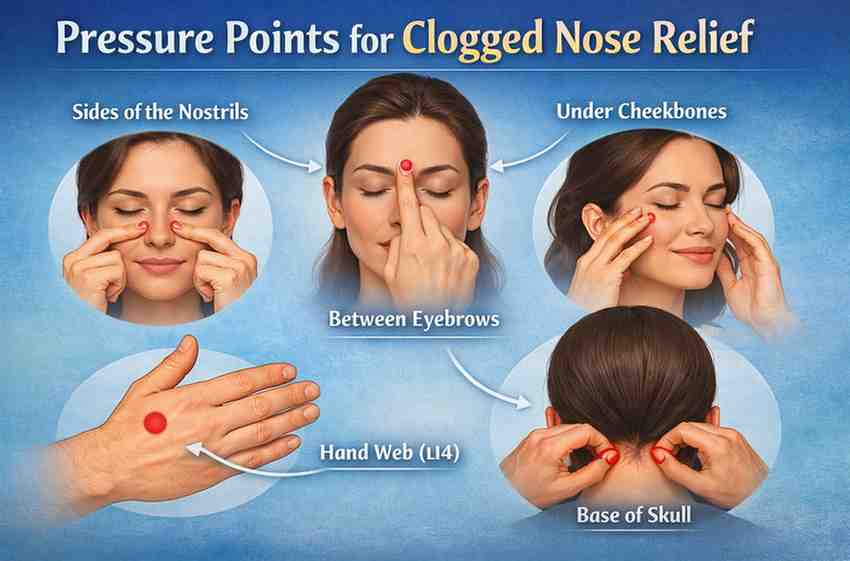
The 5 Pressure Points That Actually Get Used (Not Just Listed)
I’m not going to dump a long anatomy lecture on you. These are the ones I’ve consistently seen people use.
1. The Sides of the Nostrils (LI20 Area)
This is the first one almost everyone tries.
You press gently on the outer edges of your nostrils, right where the cheek meets the nose.
What I’ve seen:
-
Mild congestion responds well here.
-
Allergy-related stuff sometimes eases within 1–3 minutes.
-
People press way too hard.
Almost everyone I’ve seen struggle with this does this one thing wrong:
They jab instead of press.
This isn’t a bruise-it technique. It’s steady pressure, 60–90 seconds, slow breathing.
When it works, the shift feels gradual — like one nostril quietly opening.
Not dramatic.
But noticeable.
2. Between the Eyebrows (Yintang)
This one surprised me after watching so many people try it.
It doesn’t always “clear” the nose instantly.
But it reduces that heavy sinus pressure feeling.
And that changes everything.
When sinus congestion comes with:
-
Forehead tension
-
Eye strain
-
Headache
This point often reduces the pressure sensation even if airflow isn’t fully restored.
Most people expect instant airflow.
But what they get first is pressure relief.
That’s still a win.
3. Under the Cheekbones (Maxillary Sinus Area)
This is where I’ve seen the biggest difference in people with sinus infections or thick congestion.
Firm, circular pressure under the cheekbones.
What consistently works:
-
Slow circles
-
2–3 minutes
-
Leaning slightly forward
What repeatedly fails:
-
Doing it for 10 seconds
-
Not breathing deeply
-
Trying it once and quitting
This one often needs repetition — 2–3 times a day.
4. The Web Between Thumb and Index Finger (LI4)
This one confuses people.
“How is my hand connected to my nose?”
Fair question.
From what I’ve seen, this works best when congestion is tied to overall inflammation or headache.
It’s not magic.
But it seems to modulate pain and pressure perception.
Common mistake?
Pressing lightly and expecting dramatic results.
This one needs firm, tolerable pressure. 60 seconds per hand.
And no — it’s not for pregnant individuals. I always tell people that upfront.
5. Base of the Skull (Occipital Points)
I didn’t expect this to be such a common issue — but a lot of sinus pressure comes with neck tension.
Pressing at the base of the skull where the neck meets the head can:
-
Reduce tension
-
Improve drainage sensation
-
Relieve that “blocked head” feeling
Especially in people who sit at desks all day.
This one doesn’t clear mucus.
It reduces structural tension.
Big difference.
How Long Does It Take to Work?
Here’s the honest pattern I’ve seen:
-
Mild congestion: 1–5 minutes of noticeable shift
-
Moderate sinus pressure: 5–15 minutes
-
Severe infection-level blockage: minimal change
If someone is fully blocked due to infection, thick mucus, or structural issues?
Pressure points alone rarely solve it.
They help with discomfort.
Not necessarily full airflow restoration.
And that’s where expectations usually break.
What Most People Get Wrong
Almost everyone I’ve seen struggle with this does at least one of these:
-
Trying it once and declaring it useless
-
Not combining it with hydration
-
Pressing too hard
-
Holding their breath
-
Doing it while stressed and rushed
This works better when:
-
You’re seated
-
Shoulders relaxed
-
Slow nasal breathing (even if limited)
-
2–3 rounds
It’s a regulation technique. Not a brute-force one.
Is It Worth Trying?
Short answer?
Yes — if:
-
Your congestion is mild to moderate
-
You want a non-drug option
-
You’re okay with subtle improvement
No — if:
-
You expect instant spray-level decongestion
-
You have severe sinus infection
-
You’re unwilling to try it consistently
It’s low-risk.
Low-cost.
Low downside.
That alone makes it reasonable to test.
Who Will Probably Hate This Approach
Let me be blunt.
If you want fast, dramatic, guaranteed results — this will frustrate you.
If you’re already irritated and impatient, you’ll likely press for 30 seconds and give up.
And if your congestion is caused by:
-
Deviated septum
-
Nasal polyps
-
Advanced sinus infection
This won’t fix the root issue.
It’s supportive.
Not curative.
Common Objections I Hear
“There’s no science behind this.”
There is some physiological basis around nerve pathways and circulation — but it’s not as robust as pharmaceutical trials. That said, real-world observation shows consistent symptom modulation.
“It didn’t work the first time.”
Most people need repetition.
“It feels silly.”
So does mouth breathing at 3:00 AM. Pick your discomfort.
Quick FAQ (People Also Ask Style)
Do pressure points really relieve a clogged nose?
For mild to moderate congestion, they often reduce pressure and slightly improve airflow.
How many times a day should I do it?
2–3 sessions daily during congestion episodes seems common in people who see benefit.
Can this replace decongestants?
Not usually for severe cases.
Is it safe?
Generally yes — if you avoid excessive force and know contraindications (like LI4 during pregnancy).
Reality Check Section
This is not:
-
A cure for chronic sinusitis
-
A replacement for antibiotics when needed
-
A structural correction for nasal anatomy
It is:
-
A tension modulator
-
A circulation stimulator
-
A discomfort reducer
Different category.
That distinction matters.
Practical Takeaways
If you’re going to try pressure points for clogged nose relief, here’s what I’d tell you based on what I’ve seen work repeatedly:
-
Start with nostril sides + cheekbones
-
Add eyebrow point if forehead pressure exists
-
Use hand point for headache involvement
-
Stay consistent for 2–3 days
-
Pair with hydration
What to avoid:
-
Over-pressing
-
Expecting instant dramatic results
-
Using it once and quitting
Emotionally?
Expect mild hope.
Small shifts.
Gradual improvement.
Patience here looks like repetition, not intensity.
So no — this isn’t magic.
But I’ve watched enough people go from “nothing works” to “okay, that actually helped a little” to know it deserves a fair trial.
Sometimes relief isn’t dramatic.
Sometimes it’s just enough space to breathe a little easier.
And honestly, when you’ve been congested for days?
That small shift feels bigger than it sounds.