Honestly, most people I’ve watched try to lose weight start in the exact same place.
Frustrated.
Confused.
And quietly convinced that everyone else somehow has more discipline than they do.
I’ve seen friends try intermittent fasting, coworkers obsessively track calories, and people bounce between the two like they’re switching phone plans.
Two weeks fasting.
Three weeks counting calories.
Then back again.
And the weird part?
Both methods can work.
Both methods also fail constantly.
After watching dozens of people try this—friends, gym buddies, clients I’ve helped analyze habits for, even family members—the real story of intermittent fasting vs calorie restriction is way messier than the internet makes it look.
It’s not just about metabolism.
It’s not even really about food.
It’s about how humans behave around food over time.
And the patterns start to become very obvious once you’ve watched enough people try both.
Why People Even Start Comparing Intermittent Fasting vs Calorie Restriction
The moment someone decides to lose weight, they usually encounter these two ideas first.
-
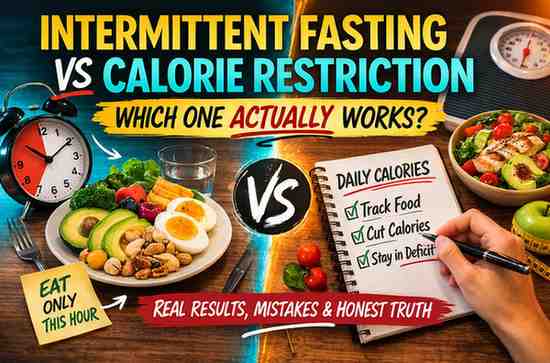
Intermittent fasting (IF) – eat only during certain hours.
-
Calorie restriction (CR) – eat fewer calories than you burn.
On paper they seem totally different.
But from what I’ve seen in real life…
They’re actually solving the same core problem:
How do you make eating less feel sustainable?
Because here’s the uncomfortable truth almost nobody likes to say out loud:
Weight loss almost always comes down to a calorie deficit.
Not magic foods.
Not special meal timing.
Just energy in vs energy out.
But the psychology of how people achieve that deficit is where everything falls apart… or works.
The First Thing That Surprises Most People
This honestly surprised me after watching so many people try both approaches.
Intermittent fasting is basically a stealth form of calorie restriction.
People think fasting works because of hormones or metabolic tricks.
Sometimes those play a small role.
But most of the time what actually happens is simpler:
When someone only eats between 12 PM and 8 PM, they accidentally eliminate:
-
Late night snacking
-
Random breakfast calories
-
Mindless grazing
-
Extra meals
Suddenly they’re eating 500–800 fewer calories without trying.
No spreadsheet.
No calorie counting.
Just less opportunity to eat.
That’s the hidden mechanism.
What Calorie Restriction Looks Like In Real Life
Calorie restriction sounds logical.
Eat less. Lose weight.
But the real-world version usually looks like this:
Week 1:
-
Download calorie tracking app
-
Buy a food scale
-
Log everything perfectly
Week 2:
-
Still motivated
-
Meals become repetitive
-
Social meals become annoying
Week 3:
-
Logging starts slipping
-
“Close enough” estimates appear
Week 4:
-
Tracking fatigue kicks in
-
People stop logging snacks
-
Weekend calories explode
I didn’t expect this to be such a common issue… but tracking fatigue is real.
Almost everyone I’ve seen struggle with calorie restriction does this one thing wrong:
They assume precision must last forever.
But humans are terrible at maintaining perfect tracking long term.
Even dietitians admit this.
What Intermittent Fasting Actually Feels Like
When people try intermittent fasting, the experience tends to follow a predictable emotional arc.
Week 1: The Shock Phase
Hunger at weird times.
Morning coffee becomes a survival strategy.
People say things like:
“I didn’t realize how much I snack until I stopped.”
Week 2–3: Adaptation
Hunger waves get easier.
Energy stabilizes.
Many people start liking the simplicity.
Week 4+: The Lifestyle Test
This is where reality hits.
Some people love it.
Others absolutely hate it.
And the divide becomes very clear.
The Biggest Pattern I’ve Seen
After watching people attempt both approaches repeatedly, a pattern shows up.
Success depends more on personality than diet science.
Not metabolism.
Not body type.
Personality.
Here’s what I mean.
People Who Usually Succeed With Intermittent Fasting
From what I’ve seen, fasting works best for people who:
-
Hate tracking numbers
-
Prefer clear rules
-
Don’t get hungry in the morning
-
Like big meals instead of small ones
-
Have predictable daily schedules
These people often say something like:
“It’s easier to just not eat than to eat a little.”
That mindset fits fasting perfectly.
People Who Usually Succeed With Calorie Restriction
Calorie counting works better for people who:
-
Like data
-
Enjoy tracking progress
-
Want flexibility in meal timing
-
Prefer multiple meals per day
-
Cook at home frequently
They tend to say:
“I like knowing exactly what I’m eating.”
Structure helps them feel in control.
What Most People Get Completely Wrong
This might be the most common mistake I’ve watched unfold.
People try to combine the hardest version of both methods.
Example:
Someone starts intermittent fasting…
But then also tries to eat extremely low calories.
So their day looks like:
-
18 hour fast
-
800 calorie eating window
-
intense workouts
That combination almost always ends badly.
Within weeks they’re exhausted.
Then binge eating happens.
Then guilt.
Then the diet collapses.
I’ve seen this cycle repeat so many times it’s almost predictable.
How Long Does It Usually Take To See Results?
People ask this constantly.
Based on patterns I’ve seen across many attempts:
Intermittent fasting
Most people notice:
-
1–2 weeks: hunger adjusts
-
3–4 weeks: visible weight changes
-
2–3 months: meaningful fat loss
But only if binge eating doesn’t creep in.
Calorie restriction
Tracking tends to show results faster because it’s precise.
Typical timeline:
-
Week 1–2: water weight drop
-
Week 3–4: steady fat loss
-
2+ months: noticeable body composition changes
Still… consistency matters more than speed.
Common Mistakes I See With Intermittent Fasting
Almost everyone I’ve seen struggle with fasting does at least one of these.
1. Overeating during the eating window
People treat the window like a food festival.
Calories explode.
Progress disappears.
2. Going too extreme too quickly
Jumping straight into:
-
20 hour fasts
-
OMAD (one meal a day)
The body fights back hard.
3. Ignoring protein
People eat carbs and snacks during their window.
Then hunger returns quickly.
Protein stabilizes everything.
4. Social friction
Dinner plans shift.
Morning coffee dates disappear.
Not everyone enjoys that trade-off.
Common Mistakes With Calorie Restriction
Calorie counting fails in predictable ways too.
1. Underestimating calories
Restaurant meals destroy accuracy.
Oils add up fast.
2. “Weekend amnesia”
Tracking Monday–Friday.
Ignoring Saturday–Sunday.
Progress stalls.
3. Choosing tiny meals
Low-volume foods leave people starving.
Hunger rebounds.
4. Perfectionism
Missing one entry.
Then abandoning the entire system.
I see this constantly.
The Reality Check Nobody Talks About
Neither method works if someone is emotionally exhausted.
Weight loss isn’t just physical.
It’s mental.
If someone is:
-
chronically stressed
-
sleep deprived
-
emotionally overwhelmed
Both approaches feel ten times harder.
I’ve watched people blame the diet… when life was the real issue.
Objections People Usually Have
“Is intermittent fasting bad for metabolism?”
From what I’ve seen and read through research patterns:
Short fasting windows like 16:8 generally don’t harm metabolism.
But extreme fasting routines can backfire if calories drop too low.
“Is calorie counting obsessive?”
It can be.
But many people only track for a few months.
Then they develop intuition.
Almost like learning portion awareness.
“Which one loses weight faster?”
Neither.
The one someone actually sticks to wins.
Every time.
Quick FAQ (Straight Answers)
Is intermittent fasting better than calorie restriction?
Not inherently. Both create a calorie deficit. The best one is the method someone can maintain without burnout.
Can you combine intermittent fasting with calorie counting?
Yes. Many people use fasting to limit eating hours and light calorie tracking for awareness.
Which method is easier?
That depends on personality. Some people hate tracking numbers, while others hate skipping meals.
Who should avoid intermittent fasting?
People who:
-
struggle with binge eating
-
need frequent meals for medical reasons
-
feel dizzy or weak when fasting
Who struggles most with calorie restriction?
People who dislike logging food or have highly unpredictable eating schedules.
Practical Takeaways From Watching People Try Both
If someone asked me for realistic advice after observing so many attempts, I’d probably say this.
Start simple.
Not extreme.
If trying intermittent fasting:
Start with 12–14 hour overnight fasting first.
Then slowly extend.
Focus on:
-
protein
-
whole foods
-
stable meals
Not just skipping breakfast.
If trying calorie restriction:
Track for 2–4 weeks only.
Use that time to learn:
-
portion sizes
-
hidden calories
-
hunger triggers
Then transition to awareness instead of obsessive tracking.
Regardless of method:
These patterns consistently help people succeed:
-
Sleep matters more than expected
-
Protein reduces hunger dramatically
-
Liquid calories sabotage progress
-
Stress increases cravings
-
Slow progress lasts longer
Small boring habits beat dramatic diets.
Every time.
And honestly… the biggest shift I’ve seen in people who finally make progress is mental.
They stop searching for the perfect diet.
Instead they find the one that fits their life without constant friction.
So no — intermittent fasting vs calorie restriction isn’t really a battle.
They’re just two tools trying to solve the same problem.
And from what I’ve watched over the years…
The people who win aren’t the ones with the best diet strategy.
They’re the ones who stop trying to force themselves into a system that clearly doesn’t fit them.
Once that click happens, things tend to get a lot easier.