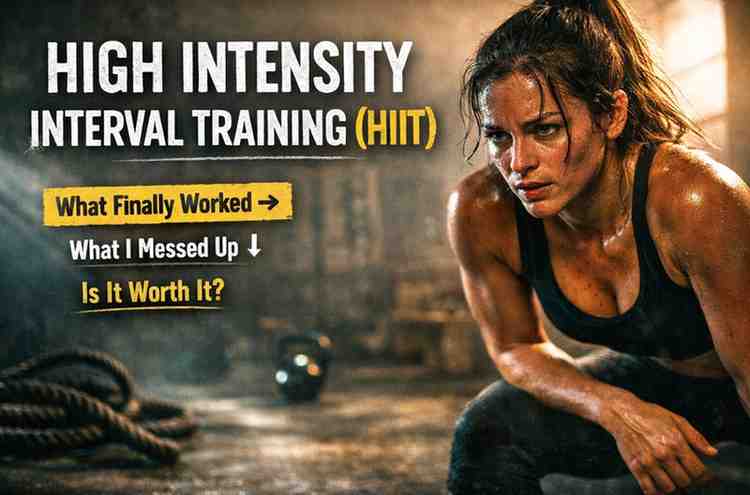
Honestly, I didn’t think this would work.
I’d already tried three other “get fit fast” things and ended up more tired than fit. Gym memberships I ghosted. Home workouts I quit after Day 4. So when I first heard about High Intensity Interval Training (HIIT), I rolled my eyes. Another intense thing for people who already have their life together.
But I was frustrated. My energy was trash. My weight wasn’t moving. And I hated long workouts with a passion. So I tried HIIT mostly out of annoyance. Like, fine, I’ll do your 20-minute misery and see what happens.
Not gonna lie… the first week humbled me. Hard.
I thought I was “in decent shape.” I was not. ????
This is me walking you through what actually happened, what I messed up at first, what finally clicked, and who should probably avoid this whole approach.
No hype. No miracle talk. Just what I learned the hard way.
Why I Tried HIIT (and What I Got Wrong)
I didn’t come to HIIT because I loved cardio. I came because:
-
I was tired of feeling out of breath going up stairs
-
I didn’t have 60–90 minutes to work out
-
I needed something that felt efficient
-
And yeah… I wanted fat loss, but mostly I wanted my body to stop feeling like a rusty machine
What I misunderstood at first:
-
I thought “high intensity” meant “go 110% every second”
-
I thought “short workouts” meant “no warm-up needed”
-
I thought soreness = progress
-
I thought if I wasn’t dying on the floor, it wasn’t working
All of that was wrong. Painfully wrong.
My first few HIIT sessions were basically:
Me going way too hard →
Getting dizzy
Taking long breaks
Then feeling like I failed HIIT as a concept
I almost quit right there.
What HIIT Actually Felt Like (The Real Version, Not the Instagram Version)
Let me paint the non-aesthetic picture:
-
Burning lungs
-
Legs shaking in a way that felt personal
-
Sweat in places I didn’t know sweat could exist
-
A weird mix of “this sucks” and “okay… I feel alive?”
But here’s the part no one warned me about:
The mental side is harder than the physical part.
The workout is short, sure.
But the discomfort is concentrated.
You don’t get to zone out like a long jog.
You’re present the whole time.
You’re negotiating with yourself every interval.
Some days I’d literally count down:
“Just 20 seconds. Don’t quit at 18. Don’t be dramatic.”
And then I’d quit at 19.
Learning curve. ????♂️
The First Month: What Changed (and What Didn’t)
Let’s be real about timelines.
What changed fast:
-
My stamina improved within 2 weeks
-
Stairs felt easier
-
I felt weirdly proud after workouts
-
My heart rate recovered faster between intervals
-
My mood was better on workout days
What did NOT change fast:
-
The scale barely moved
-
My body didn’t suddenly look different
-
My belly didn’t magically flatten
-
I still had low-energy days
-
Some workouts still felt awful
This honestly surprised me.
I expected visible results first.
What I got was internal progress first.
It took about 4–6 weeks before I saw noticeable body changes.
And even then, it was subtle. Clothes fitting slightly better. Less bloating. A bit more shape.
If you’re starting HIIT only for fast visual results… you might get discouraged. Just saying.
The HIIT Routine That Finally Worked for Me
I failed with complicated routines.
I failed with fancy apps.
I failed trying to copy athletes on YouTube.
What worked was stupidly simple:
3 days a week. 20–25 minutes.
My basic structure:
-
5-minute warm-up (don’t skip this, future-you will thank you)
-
20 seconds hard work
-
40 seconds slow recovery
-
Repeat 10–12 rounds
-
5-minute cooldown
Moves I stuck with:
-
Bodyweight squats
-
Fast marching or high knees (low impact version when tired)
-
Push-ups (on knees at first, no shame)
-
Step-backs instead of jump lunges
-
Shadow boxing when my joints were cranky
I didn’t expect this at all, but rotating low-impact HIIT saved me.
Jumping every session messed up my knees and made me skip workouts.
Modifying kept me consistent.
Consistency > intensity.
I learned that the annoying way.
“Don’t Repeat My Mistake” Moments
Here’s the stuff I wish someone had grabbed me by the shoulders and told me:
-
Don’t start with 5–6 HIIT days a week.
I burned out in 10 days and took a week off. Dumb. -
Don’t copy super-fit influencers.
Their “beginner” workouts wrecked me. -
Don’t skip rest days.
HIIT stresses your nervous system more than you think. -
Don’t train fasted at first.
I almost threw up. Twice. Not cute. -
Don’t ignore joint pain.
HIIT shouldn’t hurt your joints. Burn is fine. Sharp pain is not.
From what I’ve seen, at least… people quit HIIT because they go too hard → too fast, then blame HIIT for the burnout they caused.
How Long Does HIIT Take to Actually Work?
Short answer (for featured snippet folks): Most people notice fitness improvements in 2–3 weeks. Visible body changes usually take 4–8 weeks with consistency and supportive nutrition.
Longer, honest answer:
-
Cardio endurance: quick improvement
-
Strength: moderate improvement
-
Fat loss: slower than your ego wants
-
Habit-building: harder than the workout itself
I didn’t expect that at all.
The biggest “result” wasn’t my body.
It was that I stopped negotiating with myself about skipping workouts.
Common HIIT Mistakes That Slow Results
This is where I messed up the most:
-
Going max effort every interval
-
Not controlling form when tired
-
Treating HIIT like punishment
-
Not eating enough protein
-
Sleeping like trash and wondering why I felt weak
-
Comparing my progress to people online
Also… doing random HIIT workouts with no progression.
Your body adapts. You need small changes over time:
-
More rounds
-
Slightly shorter rest
-
Harder variations
-
Better form
-
Better recovery
No need to be extreme. Just don’t stay stuck forever.
Is High Intensity Interval Training (HIIT) Worth It?
Short answer:
For me? Yeah. With conditions.
Longer answer:
HIIT is worth it if:
-
You hate long workouts
-
You’re okay being uncomfortable for short bursts
-
You want cardio + strength in one
-
You can respect recovery
-
You’re patient with visible results
HIIT is NOT worth it if:
-
You already feel burned out
-
You have untreated joint issues
-
You hate intense sensations
-
You’re chasing “fast fat loss” at any cost
-
You’re using exercise to punish yourself
This approach rewards consistency and self-awareness.
It punishes ego.
Objections I Had (and What I Learned)
“HIIT is only for super fit people.”
Nope. But the internet markets it that way. You can scale everything.
“It’s too intense for beginners.”
Only if you define intensity as suffering.
You can do HIIT with walking intervals.
“I’ll get bulky.”
Didn’t happen. I got leaner and tighter, not bulky.
“It’ll wreck my knees.”
It did… when I jumped too much. Low-impact saved me.
“I don’t have energy for this.”
Ironically, HIIT gave me more energy over time. The first 2 weeks were rough though.
Quick FAQ (People Also Ask – Real Answers)
Does HIIT burn more fat than steady cardio?
Sometimes, for some people. What matters more is consistency and recovery. HIIT is efficient, not magical.
Can beginners do HIIT?
Yes. Start with walking intervals or gentle bodyweight moves. “High intensity” is relative to your fitness.
How many days a week should I do HIIT?
2–4 days max for most people. More isn’t better if you’re not recovering.
Is HIIT good for weight loss?
It can help. But food habits matter more than any workout style. That part annoyed me, but it’s true.
Can I do HIIT at home with no equipment?
Yep. I did most of mine in a tiny room. No fancy gear.
Reality Check (Stuff No One Likes to Admit)
-
HIIT doesn’t fix emotional eating
-
HIIT won’t save bad sleep
-
HIIT can spike stress if you’re already exhausted
-
HIIT can feel mentally heavy on bad days
-
HIIT doesn’t make you disciplined overnight
Some days I skipped.
Some weeks I half-assed it.
Progress still happened because I came back instead of quitting completely.
That was new for me.
Practical Takeaways (No Fluff)
If you’re thinking about trying HIIT, here’s the grounded version:
Do this:
-
Start with 2–3 sessions per week
-
Warm up and cool down
-
Choose low-impact options at first
-
Track how you feel, not just calories
-
Give it 4–6 weeks before judging results
Avoid this:
-
Going all-out every session
-
Copying elite routines
-
Ignoring joint pain
-
Skipping rest
-
Expecting fast visual changes
Expect emotionally:
-
Early doubt
-
Some frustration
-
Small wins before big ones
-
Random “I actually feel strong” moments
-
Occasional “why am I doing this” days
Patience in HIIT doesn’t look like waiting.
It looks like showing up even when you’re not excited.
So yeah… High Intensity Interval Training (HIIT) didn’t magically fix my life.
It didn’t make workouts fun every day.
It didn’t turn me into a fitness influencer with perfect lighting.
But it did something quieter.
It made the whole “getting in shape” thing stop feeling impossible.
And honestly? That shift mattered more than any number on a scale.
If you try it and hate it… cool. At least you’ll know.
If you try it and it clicks? Even better.
Either way, you’re not broken for struggling with this stuff.
You’re just human.