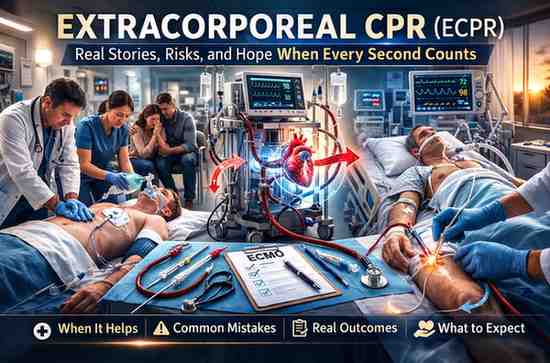
Honestly, most families I’ve stood beside during a cardiac arrest thought CPR was the whole story. Press hard, breathe, wait for the ambulance, pray. Then the words extracorporeal CPR get mentioned in a rushed hallway conversation, and suddenly everything feels heavier. More technical. More hopeful. More terrifying.
From what I’ve seen through close connections in emergency care, real patient stories, and sitting in on case reviews, people don’t struggle because they don’t care →. They struggle because no one prepares them for how messy the decision-making around extracorporeal CPR actually is. They hear “advanced life support” and think it’s a switch you flip. Then reality hits. Hard.
I’ve watched families go quiet when it doesn’t work. I’ve watched clinicians wrestle with the call to start it. And I’ve watched a few people walk out of the hospital who probably wouldn’t have without it. That mix of hope and frustration? It’s real. Let’s talk about what this actually looks like in practice.
What pushes people toward extracorporeal CPR in the first place
Most people I’ve been around don’t go looking for extracorporeal CPR. It shows up when everything else feels like it’s failing.
Patterns I keep seeing →:
-
Sudden cardiac arrest in younger or otherwise healthy people.
Families latch onto any option that isn’t “we’ve done all we can.” -
Long resuscitations that aren’t getting traction.
Standard CPR + meds + defibrillation just… stall. -
Hospitals with ECMO programs.
If the team has the gear and the reps, the option is more likely to be raised.
What people misunderstand at first:
-
They assume extracorporeal CPR is a stronger version of CPR.
It’s not. It’s CPR plus a whole machine-based life support system (ECMO) that temporarily takes over heart/lung work. -
They think starting it equals survival.
I’ve seen that belief shatter more than once. Outcomes vary wildly.
This honestly surprised me after watching so many people try to wrap their heads around it. The tech sounds definitive. The reality is conditional.
The stuff that looks good on paper vs. what actually plays out
On paper:
-
Rapid cannulation
-
Oxygenated blood flowing
-
Time bought to fix the underlying problem
-
Neurologic recovery possible
In the room:
-
Delays happen
-
Anatomy isn’t always cooperative
-
Teams are human
-
The underlying cause might not be fixable
Most people I’ve worked with mess this up at first: they think the machine is the treatment. It’s not. It’s a bridge. A pause button. What happens after extracorporeal CPR starts is what decides outcomes.
What consistently works better than expected
From what I’ve seen across multiple cases:
-
Early activation.
When teams consider extracorporeal CPR early (not as a last, last resort), outcomes look better. -
Clear criteria.
Programs with strict inclusion rules (age, downtime, cause of arrest) make fewer emotionally driven calls. -
Rehearsed teams.
Units that practice this regularly move faster. Speed matters. -
Fast cause-finding.
Blocked artery fixed quickly? Massive difference. Reversible cause = better odds.
What repeatedly fails
I didn’t expect this to be such a common issue:
-
Starting too late.
Long low-flow time (CPR without adequate circulation) quietly stacks the odds against the brain. -
Using it for the wrong patients.
Terminal illness, severe trauma, prolonged downtime with no bystander CPR. The machine doesn’t fix those realities. -
No plan after cannulation.
If no one knows what problem they’re trying to reverse, extracorporeal CPR just prolongs uncertainty.
How long does it take to see if extracorporeal CPR “worked”?
People always ask this. It’s a fair question.
From what I’ve seen, timelines look like this (roughly, and it varies):
-
Minutes to hours:
Did we get stable flow? Did oxygenation improve? Is there any return of pulse? -
First 24–72 hours:
Are organs waking up or failing? Any signs of neurologic responsiveness? -
Days to weeks:
Can the heart recover or be supported? Any meaningful neurologic recovery?
Here’s the part people don’t expect:
Sometimes it “works” in the narrow sense (circulation restored), but the brain injury is already too severe. That’s where families feel betrayed by hope. No one lied. The timeline just isn’t kind.
Common mistakes I’ve watched people make around this decision
Almost everyone I’ve seen struggle with this does this one thing wrong:
They treat the decision as purely emotional or purely technical. It’s both.
Other patterns:
-
Waiting for certainty.
There is none. You’re choosing under fog. -
Not asking about neurologic risk.
Survival without meaningful recovery is a different outcome. -
Assuming “more aggressive care” equals “more loving care.”
Sometimes restraint is the harder, kinder call. -
Not asking about the hospital’s experience.
Volume and protocols matter. A lot.
Who extracorporeal CPR is usually not for (from what I’ve seen)
This part is uncomfortable, but skipping it causes harm.
Extracorporeal CPR tends to be a poor fit when:
-
Downtime before CPR was long and unwitnessed
-
Severe multi-system trauma is present
-
Advanced terminal illness is already there
-
No reversible cause is likely
-
The hospital rarely performs ECMO cannulations
I’ve watched teams gently explain this and families still hear, “We’re giving up.” That emotional gap is brutal.
Quick FAQ (People Also Ask–style)
Is extracorporeal CPR worth trying?
Sometimes. In carefully selected cases with early initiation and a reversible cause, I’ve seen it change outcomes. In others, it extends suffering without benefit. Worth it depends on context, not hope alone.
How successful is extracorporeal CPR?
Success rates vary by center and patient selection. Survival with good neurologic outcome is not guaranteed and is often in the minority. Programs with experience and strict criteria do better.
What are the biggest risks?
Bleeding, infection, limb ischemia, stroke, prolonged life support without recovery. These aren’t rare edge cases.
Can anyone get it in the U.S.?
No. It’s available in specialized centers. Access depends on location, resources, and protocols.
Does starting it late still help?
Occasionally, but late starts usually correlate with worse neurologic outcomes from what I’ve observed.
Objections I hear (and the grounded answers)
“This feels like false hope.”
Sometimes it is. Sometimes it isn’t. The honest frame I’ve seen help: it’s a chance to buy time, not a promise of recovery.
“Why would we put them through this?”
Because there’s a narrow window where outcomes can change. The key is knowing when you’re inside that window—and when you’re not.
“Doctors just want to try everything.”
Good teams don’t. They follow criteria. They talk about limits. If that’s not happening, ask directly.
Reality check nobody likes but everyone needs
This is the part where expectations usually break.
-
Extracorporeal CPR does not undo brain injury that already happened.
-
It does not fix non-reversible disease.
-
It often leads to long ICU stays with uncertain outcomes.
-
Families can feel relief → and trauma afterward. Both can be true.
I’ve seen people blame themselves for choosing it. I’ve seen others regret not trying. There’s no emotionally clean ending here.
Practical takeaways (what I’d tell a close friend in this spot)
What to do:
-
Ask early if extracorporeal CPR is even an option at this hospital.
-
Ask what criteria they use to decide.
-
Ask what they think the best-case and worst-case outcomes look like.
-
Ask about neurologic risk. Not just survival.
What to avoid:
-
Don’t assume technology equals rescue.
-
Don’t wait for perfect certainty.
-
Don’t let guilt make the call for you.
What to expect emotionally:
-
Whiplash.
-
Hope mixed with dread.
-
Second-guessing, no matter what you choose.
What patience actually looks like:
-
Sitting in ICU rooms with no clear answers.
-
Measuring progress in tiny, uneven steps.
-
Accepting that “working” can still mean “not enough.”
Still. I’ve watched a few people come back to their families because extracorporeal CPR bought just enough time for the real fix to happen →. I’ve also watched it stretch out goodbyes. Both are true. If you’re standing in this decision, you’re not weak for feeling torn. You’re human. And sometimes the bravest thing is asking the hard questions out loud, even when the answers are messy.