Honestly, most people I’ve watched face cardiac emergencies don’t freeze because they don’t care. They freeze because they’re overwhelmed.
I’ve stood next to family members who thought cardiopulmonary arrest meant “heart attack.” I’ve watched coworkers argue over whether to move someone. I’ve seen trained staff hesitate because they were second-guessing protocol.
And here’s the hard truth →: effective cardiopulmonary arrest treatment isn’t complicated in theory.
But in real life? It’s loud. Emotional. Fast. And seconds disappear while people debate.
From what I’ve seen over and over again — the difference between chaos and survival usually comes down to whether someone understands what to do before it happens.
Let’s slow this down and talk about what actually works.
What Cardiopulmonary Arrest Really Means (And Why People Misread It)
Cardiopulmonary arrest is not the same as a heart attack.
It’s when:
-
The heart stops pumping effectively.
-
The person stops breathing normally.
-
Blood flow to the brain stops.
No pulse. No effective breathing. Unresponsive.
And here’s where most people I’ve worked with mess this up at first:
They look for dramatic signs.
But in real cases, it’s often:
-
Sudden collapse
-
Gasping or agonal breathing
-
No response when shaken
-
No normal breathing
That gasping? People mistake it for life.
It isn’t.
This honestly surprised me after watching so many people try to “wait and see.” Waiting is the mistake.
The 9 Steps I’ve Seen Save Lives (When Done Fast)
These are not theoretical steps. These are the patterns I’ve seen consistently work in real emergencies.
1. Recognize It Immediately
Don’t overthink it.
If someone:
-
Collapses
-
Isn’t responsive
-
Isn’t breathing normally
Treat it as cardiopulmonary arrest.
Almost everyone I’ve seen struggle with this does this one thing wrong: they try to diagnose instead of act.
Seconds matter more than certainty.
2. Call 911 Immediately (United States Protocol)
In the U.S., emergency response systems are built for speed — but only if activated early.
Call 911.
Put it on speaker.
Start CPR while dispatch guides you.
I’ve watched dispatchers coach panicked family members through compressions in real time. It works.
But only if you call early.
3. Start High-Quality CPR
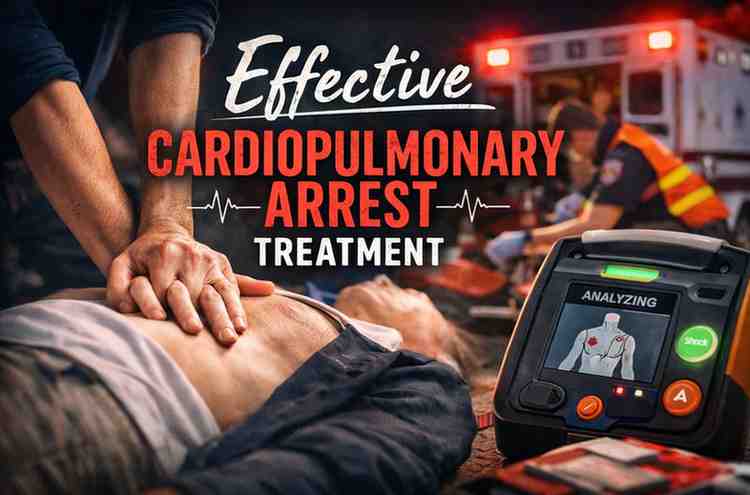
This is the core of effective cardiopulmonary arrest treatment.
Chest compressions:
-
Center of chest
-
100–120 compressions per minute
-
2–2.4 inches deep
-
Full recoil between pushes
If untrained, do hands-only CPR.
I didn’t expect this to be such a common issue, but people push too softly. Or they stop too often.
You will feel like you’re pushing too hard.
You’re probably not.
Broken ribs are survivable.
Brain damage from no oxygen is not.
4. Use an AED As Soon As Possible
Automated External Defibrillators (AEDs) are everywhere now:
-
Airports
-
Gyms
-
Schools
-
Office buildings
-
Shopping centers
And almost everyone I’ve seen is afraid to use one.
They’re designed for non-medical people.
Open it.
Turn it on.
Follow the voice prompts.
It will not shock unless needed.
This honestly surprised me after watching so many bystanders hesitate — the machine does most of the thinking for you.
5. Minimize Interruptions
Here’s something that looks small but changes outcomes.
Stopping compressions:
-
To reposition
-
To check pulse repeatedly
-
To argue
Every pause drops blood flow.
Experienced responders are almost obsessive about keeping compressions going.
That pattern shows up repeatedly in survival cases.
6. Rotate Compressors Every 2 Minutes
Fatigue happens fast.
I’ve seen strong athletes give high-quality compressions for about 90 seconds before depth drops without them realizing it.
Switch every 2 minutes if possible.
Quality over pride.
7. Advanced Care (EMS & Hospital)
Once EMS arrives, treatment may include:
-
Advanced airway management
-
Medications like epinephrine
-
Cardiac monitoring
-
Defibrillation
-
Rapid transport
In-hospital, they may initiate:
-
Targeted temperature management
-
Cardiac catheterization
-
Intensive monitoring
But here’s something people don’t expect:
Survival often depends more on the first 3–5 minutes than the advanced hospital care later.
That window is everything.
Why People Search for “Effective Cardiopulmonary Arrest Treatment”
From what I’ve seen, people look this up for three reasons:
-
They witnessed an arrest and feel shaken.
-
They have a high-risk family member.
-
They want to be prepared but feel unsure.
And underneath all of that?
Fear.
“What if I freeze?”
“What if I do it wrong?”
“What if I make it worse?”
Most people I’ve worked with carry quiet guilt even if they acted correctly.
That emotional weight is real →.
Common Mistakes I Keep Seeing
Let’s call these out clearly.
Waiting for certainty
If they’re not responsive and not breathing normally, act.
Shallow compressions
Too soft. Too hesitant.
Stopping too often
Checking pulse repeatedly kills momentum.
Not using AED
Fear of harming the patient.
Assuming younger people don’t arrest
Sudden cardiac arrest happens across ages.
Almost everyone I’ve seen struggle with this thought it “probably isn’t that serious.”
It usually is.
How Long Does It Take to See Results?
This question feels strange in this context, but I’ve heard it.
CPR buys time.
Brain injury can begin within 4–6 minutes without oxygen.
Early CPR can double or triple survival odds.
Defibrillation within minutes drastically improves outcomes.
But — and this matters — not every case results in survival.
That’s the part people don’t talk about enough.
Even perfect response doesn’t guarantee recovery.
And that’s not always a failure of treatment.
Who Should Avoid Taking This Lightly
This approach is not optional if you’re:
-
A caregiver
-
A coach
-
A teacher
-
A gym staff member
-
Living with someone with heart disease
Still, I’ve seen people assume:
“I’ll figure it out if it happens.”
That’s rarely how panic works.
Training changes reaction speed. Dramatically.
Objections I’ve Heard (And What I’ve Observed)
“I’m afraid I’ll break ribs.”
You might.
I’ve seen it happen.
But survival outweighs bruising or fractures.
“I’m not certified.”
Hands-only CPR saves lives.
Certification improves confidence. But action matters more.
“What if it’s not really cardiac arrest?”
If they’re responsive and breathing normally, CPR won’t be indicated.
If they’re not — delaying is the bigger risk.
Quick FAQ (People Also Ask)
What is the most effective treatment for cardiopulmonary arrest?
Immediate high-quality CPR and early defibrillation with an AED are the most effective early treatments.
Is CPR alone enough?
CPR maintains blood flow. Defibrillation is often needed to restore rhythm.
Can someone survive after 10 minutes without oxygen?
Rare, but possible with immediate CPR. Survival odds drop significantly after 4–6 minutes without circulation.
Should you always use an AED?
If available, yes. It analyzes and only shocks if necessary.
Reality Check: This Isn’t Comfortable
CPR is physical.
It’s intense.
It’s emotionally loud.
I’ve seen people shake afterward.
Even trained professionals.
You don’t walk away from these moments unchanged.
But I’ve also seen families grateful that someone tried.
That someone acted.
That someone didn’t stand there frozen.
Is It Worth Learning This?
If you’re wondering whether learning effective cardiopulmonary arrest treatment is worth it — yes.
Not because you’ll use it every day.
But because when it’s needed, nothing else matters.
I’ve seen untrained bystanders save lives.
I’ve seen trained professionals hesitate.
Preparation changes that.
And it doesn’t take years to learn. A short CPR certification class can completely change your reaction speed.
Practical Takeaways
If I had to distill this from everything I’ve observed:
-
Don’t wait for certainty.
-
Call 911 immediately.
-
Start compressions fast and push hard.
-
Use the AED without fear.
-
Minimize pauses.
-
Rotate compressors.
-
Accept that outcomes vary.
Emotionally?
Expect adrenaline.
Expect doubt.
Expect afterward replaying it in your head.
That’s normal.
Patience in this context means understanding that survival is influenced by timing, underlying health, and pure unpredictability.
No guarantees.
But action dramatically improves odds.
I won’t pretend this is easy.
It’s not.
Still — from what I’ve seen — the people who prepare ahead of time don’t eliminate fear.
They just act faster despite it.
And sometimes, that shift alone changes everything.
So no — this isn’t magic. But I’ve watched enough real situations unfold to know that effective cardiopulmonary arrest treatment isn’t about perfection.
It’s about seconds.
And someone deciding to move instead of freeze.