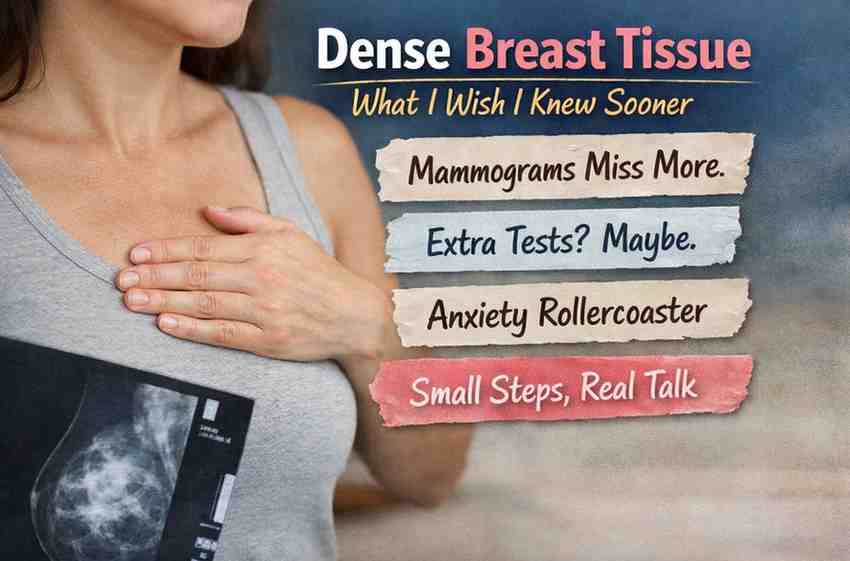
Not gonna lie—I didn’t even know what dense breast tissue meant the day the letter showed up in my mailbox. I opened it in the kitchen, coffee going cold, skimmed two sentences, and felt that weird tight feeling in my chest. The kind that makes your brain jump to worst-case scenarios before you’ve finished reading.
“All good. No cancer detected.”
But then: “You have dense breast tissue.”
Cool. Awesome. What does that even mean?
Is this bad?
Is this just another thing to worry about?
Do I need to do something about it or is it just… trivia about my body?
I remember Googling it at midnight and immediately regretting it. Everything felt either alarmist or weirdly dismissive. Half the pages sounded like legal disclaimers. The other half made it sound like I was walking around with a ticking time bomb in my chest. I closed my laptop and just sat there, annoyed and scared at the same time.
So yeah. If you’re here because you got that same letter or your doctor mentioned dense breast tissue in passing and now your brain won’t shut up—hi. I’ve been there. I’ve messed this up. I’ve learned a few things the slow way. And I wish someone had explained it to me like a real person instead of a pamphlet.
What “dense breast tissue” actually felt like to learn about (not the textbook definition)
Here’s the part no one tells you: finding out you have dense breast tissue doesn’t feel medical. It feels personal. It messes with your sense of safety.
At first, I thought:
-
“Okay, so my boobs are just… dense? Cool, whatever.”
-
Then five minutes later: “Wait, does this mean they can miss cancer on mammograms?”
-
Then ten minutes later: “Why did no one tell me this before?”
-
Then an hour later: doom-scrolling.
What surprised me most?
This is common. Like, very common. I’d spent years assuming “normal” breasts are mostly fatty and that anything else is weird. Turns out a lot of people have dense breast tissue and walk around totally unaware until that first mammogram report.
That disconnect messed with me.
If it’s common, why does it feel so lonely when you first hear about it?
The first thing I misunderstood (and it caused way too much stress)
I thought dense breast tissue meant:
-
Higher chance I have cancer right now
-
Or that something was already wrong
That’s not what it means.
Dense breast tissue doesn’t mean you’re sick.
It means the mix of tissue in your breasts is different—more glandular and fibrous, less fatty. The annoying part? Dense tissue and tumors both look white on a mammogram. So things can hide. That’s the real issue.
Once I wrapped my head around that, my fear shifted from “oh no, I’m doomed” to “okay, I need to be a little more intentional about screening.”
That shift alone lowered my anxiety by like 30%.
How long it took me to stop spiraling about this (honest timeline)
If you’re wondering, “How long does it take to feel okay about this?”
Here’s my messy timeline:
-
Week 1: Panic + confusion + late-night Googling
-
Week 2: Anger. Mostly at the medical system for not explaining this better
-
Week 3: Acceptance-ish. Started asking better questions
-
Month 2: I stopped thinking about it every day
-
Now: It’s just a thing I factor into my health routine
So no, the stress doesn’t disappear overnight.
But it does get quieter once you understand what you’re dealing with and what your options actually are.
What I tried that didn’t help (learn from my mistakes)
I went into “fix-it” mode immediately. Which, in hindsight, wasn’t useful.
Things I tried that were… not helpful:
-
Obsessively checking my breasts in the mirror every other day
-
Reading worst-case forum posts at 1 a.m.
-
Assuming every random ache meant something
-
Putting off talking to my doctor because I didn’t want to seem dramatic
That last one? Big mistake.
I wasted weeks stressing quietly instead of just asking: “What does this mean for me, specifically?”
When I finally asked, the answer was… calm. Boring, even.
And I mean that in a good way.
What actually helped me feel more in control
This is where things shifted from anxiety to something manageable.
1. I asked for clarity, not reassurance
There’s a difference.
Reassurance sounds like:
“Am I okay???”
Clarity sounds like:
-
What does dense breast tissue change about screening?
-
Do I need anything beyond mammograms?
-
How often should I check in about this?
Clarity gave me decisions. Reassurance just gave me temporary comfort.
2. I learned what extra screening actually means (and what it doesn’t)
I assumed “extra screening” meant panic-level medical escalation.
Sometimes it’s just:
-
Ultrasound
-
Or, in some cases, MRI
-
Or simply being consistent with yearly imaging
Not everyone with dense breast tissue needs everything.
This is where talking to your doctor actually matters.
3. I stopped treating my body like an enemy
This one was emotional.
For a while, I felt betrayed by my own anatomy. Like my body was “hiding things from me.” That mindset was exhausting.
Once I reframed it as:
“My body isn’t wrong. It just needs a different kind of attention.”
…everything softened.
People Also Ask–style questions (the stuff I wish someone answered plainly)
Is dense breast tissue dangerous?
Short answer: no, not by itself.
It’s a normal variation. The risk is about detection being harder, not your body being “bad.”
Does dense breast tissue mean higher cancer risk?
Slightly higher, yes.
But higher doesn’t mean “high.” It means your baseline risk is nudged up, not launched into orbit.
Can dense breast tissue change over time?
Yeah.
From what I’ve seen, at least, density can decrease with age, especially after menopause. Mine shifted slightly over a few years. I didn’t expect that at all.
Do I need extra tests every year?
Not automatically.
This depends on:
-
Your age
-
Family history
-
Other risk factors
-
Your comfort level with uncertainty
This is a conversation, not a rule.
Objections I had (and maybe you do too)
“This feels like overkill. Aren’t we over-medicalizing normal bodies?”
I felt this hard.
And honestly? Sometimes the system does overdo it. But dense breast tissue isn’t about pathologizing you. It’s about knowing when one tool (mammograms) has blind spots.
“Extra screening sounds expensive and stressful.”
Yeah. It can be.
This is one of those trade-offs no one sugarcoats: more information can mean more follow-ups, more bills, more waiting. That’s real.
“If they’re just going to call me back for more tests, what’s the point?”
I thought this too.
But the point is catching something early if it’s there. Not chasing ghosts forever. Still, false alarms happen. That part sucks.
Reality check (stuff no one markets to you)
Let’s be real for a second.
-
Extra screening can mean more anxiety
-
You might get called back for something that turns out to be nothing
-
Waiting for results is emotionally brutal
-
Insurance coverage can be confusing
-
Not every doctor explains this well
This isn’t a magical safety net.
It’s a slightly better flashlight in a dark room.
Helpful, but imperfect.
The small wins I didn’t expect
A few quiet wins came out of this whole dense breast tissue learning curve:
-
I got better at advocating for myself
-
I stopped ignoring weird medical language
-
I became way less afraid of asking “dumb” questions
-
I learned how to tolerate uncertainty without spiraling (still working on that, honestly)
Also?
The fear shrank. Not disappeared. Shrunk. That counts.
Common mistakes that slow everything down
If I could go back, I’d avoid these:
-
Ignoring the note on the mammogram report
(I almost did. Don’t do that.) -
Assuming dense breast tissue = emergency
-
Not asking what applies to me
-
Letting Google be my main doctor
The biggest mistake?
Waiting for someone else to explain it to me clearly. You sometimes have to ask for clarity yourself. Annoying, but true.
Who this whole “be proactive” approach is NOT for
I want to be honest about this part.
Extra screening and being hyper-aware is not for everyone.
This might not be your lane if:
-
Medical stuff sends you into full panic mode
-
You’re dealing with health anxiety that’s already overwhelming
-
You don’t have access to follow-up care and it would just add stress
-
You’re in a season of life where you’re barely holding it together emotionally
There’s no moral high ground here.
Some people do better with less information. That’s valid.
Would I recommend paying more attention if you have dense breast tissue?
Honestly? Yes.
But not in a doom-y way.
I’d recommend:
-
Knowing what dense breast tissue means
-
Understanding how it affects mammogram accuracy
-
Talking to a doctor who doesn’t brush you off
-
Deciding what level of monitoring feels right for you
I would not recommend:
-
Living in constant fear
-
Treating every twinge like a crisis
-
Letting this label take over your identity
It’s a data point. Not your destiny.
Short FAQ (the quick answers I wish were on that letter)
Is it worth doing extra screening for dense breast tissue?
For me, yes. The peace of mind was worth the hassle. For others, the stress outweighs the benefit. Both are reasonable.
How long does it take to adjust emotionally?
A few weeks to stop panicking. A few months to fully normalize it.
What if I do nothing different?
Plenty of people don’t change anything and are fine. Just make sure that choice is informed, not accidental.
Can lifestyle changes → affect dense breast tissue?
This one surprised me. Lifestyle affects overall breast health and cancer risk, but density itself isn’t something you can reliably “fix” with food or exercise. Anyone promising that is overselling.
Practical takeaways (the boring but useful stuff)
If you’re staring at a report that mentions dense breast tissue and feeling weird about it, here’s what I’d actually suggest:
What to do
-
Ask your doctor what dense breast tissue means for your screening plan
-
Clarify whether additional imaging makes sense for you
-
Keep records of your reports so you can notice changes over time
-
Give yourself a few days to emotionally settle before making big decisions
What to avoid
-
Panic-Googling at midnight
-
Assuming worst-case outcomes
-
Letting vague medical language scare you into inaction
-
Ignoring it completely out of fear
What to expect emotionally
-
Initial anxiety
-
Some frustration with unclear answers
-
Relief once you understand your options
-
Occasional “ugh, bodies are annoying” moments
What patience looks like
-
Letting this become background knowledge instead of a daily fear
-
Revisiting the conversation once a year, not every week
-
Allowing your understanding to evolve as your body changes
No guarantees.
No magic reassurance.
Just… more grounded.
Still, if I’m being real? I wish someone had told me all this in one messy, human conversation instead of a sterile paragraph on a report. Dense breast tissue isn’t a crisis. It’s a context. A detail about how your body shows up on a screen. It can be annoying. It can be scary at first. It can also just become… part of your health rhythm.
So no—this isn’t magic.
But for me? It stopped feeling like a mystery I had to be afraid of.
And that alone made it easier to breathe and keep going.