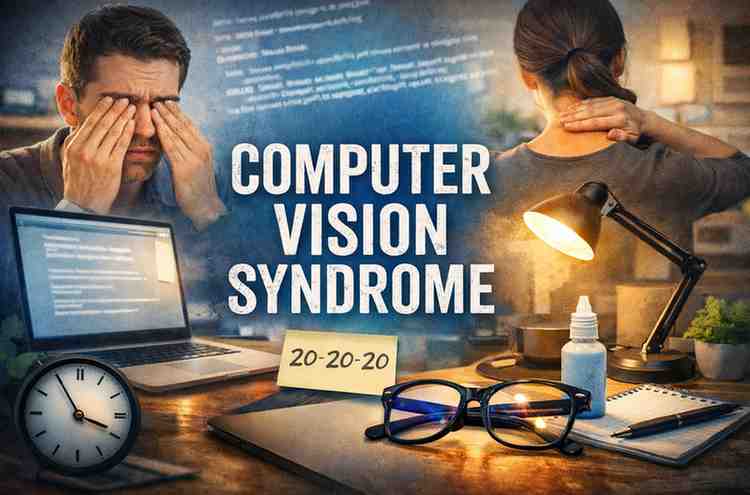
I didn’t set out to “fix” my eyes. I just wanted the headaches to stop. The kind that creep in around 3:17 PM, right when the workday isn’t done and your screen still feels like it’s staring back at you. My eyes felt sandy. My neck was tight. I was squinting at emails I’d read three times already. Someone finally said the words Computer Vision Syndrome, and I rolled my eyes—because of course there’s a name for this mess. Still. The name stuck. And once I started paying attention, I realized this wasn’t just eye strain. It was a whole-body thing. Annoying. Sneaky. Fixable-ish. Not in a magical way. More in a slow, annoying, human way.
Not gonna lie… I messed this up at first. I thought a pair of blue light glasses would solve it. They didn’t. I thought “just blink more” was solid advice. Turns out, it’s not that simple. What helped was a pile of small, boring changes I resisted because I wanted one clean fix. This is what that actually looked like.
The stuff nobody told me about Computer Vision Syndrome (but I learned the hard way)
It’s not just your eyes. It’s your habits.
I went in thinking Computer Vision Syndrome = dry eyes + screens. Cool, eye drops, done. Except my neck was in knots. My shoulders were up near my ears. I was leaning into the screen like it owed me money. Turns out:
-
The posture you hold while staring at a screen feeds the headaches.
-
The way you focus (staring without blinking) messes with tear film.
-
The lighting around you matters more than the screen brightness slider.
That honestly surprised me. I kept treating my eyes like they were the problem when the whole setup was the problem.
I misunderstood “screen breaks” completely
People say “take breaks” like it’s obvious. I thought it meant scrolling my phone for a minute. Yeah… that’s not a break. That’s just another tiny screen.
What finally helped was the boring version:
-
Look at something far away. Like actually far. Out a window. Down a hallway.
-
Stand up. Move blood around.
-
Don’t check notifications. That defeats the point.
From what I’ve seen, at least, the distance change matters more than the time. Even 30 seconds of looking far beats 5 minutes doomscrolling.
Blue light glasses: not a miracle, not useless either
I bought a cheap pair. They looked ridiculous. They did… something? Hard to measure. My eyes didn’t feel magically healed. My sleep didn’t transform overnight. But late-night screen time felt less harsh.
Here’s my honest take:
-
They’re not a cure for Computer Vision Syndrome.
-
They can help with comfort for some people.
-
If your setup is bad, glasses won’t save you.
I’d do it again, but I wouldn’t expect much from them alone.
What actually moved the needle (slowly, annoyingly)
The 20-20-20 rule (yeah, that one)
Every 20 minutes, look at something 20 feet away for 20 seconds.
I hated this advice. It sounded like a poster in a school nurse’s office. But when I actually did it? My eyes felt less cooked by the end of the day. Not perfect. Just… less angry.
How I made it stick:
-
I tied it to natural pauses (email sent = look away).
-
I didn’t set a timer. Timers stressed me out.
-
I forgave myself when I forgot. Which was often.
Fixing my screen height changed more than eye drops ever did
This was a “wow, why didn’t I do this earlier” moment.
When my screen was too low:
-
I leaned forward.
-
My neck cramped.
-
My eyes worked harder because I was squinting slightly upward.
Raising the screen to eye level reduced:
-
Neck tension
-
End-of-day headaches
-
The urge to hunch like a goblin
It felt dumb that a stack of books under my laptop helped more than fancy eye products. But here we are.
Lighting: the silent saboteur
I used to work in a dark room with a bright screen. Felt cozy. My eyes hated it.
What helped:
-
Soft light behind the screen (not directly in my eyes)
-
No harsh overhead glare
-
Reducing reflections on the screen
The contrast between bright screen + dark room was brutal on my eyes. This one change reduced that gritty, dry feeling by a lot.
Common mistakes I made (so you don’t have to)
-
Cranking brightness up thinking it would reduce strain
→ It made the contrast worse. -
Using eye drops randomly
→ Some drops made my eyes feel better for 5 minutes, then worse. Preservative-free worked better for me. -
Powering through discomfort
→ This backfired. The headaches got louder. -
Assuming pain meant weakness
→ Nope. It meant my setup sucked.
How long does it take to feel better?
Short answer: not overnight.
Longer answer: I noticed small relief within a week. Real change took a few weeks of being consistent-ish.
Timeline (rough, from my experience):
-
Days 3–5: Eyes feel less gritty by evening.
-
Week 2: Fewer headaches.
-
Week 3–4: Neck and shoulder tension eased.
-
After a month: I stopped thinking about my eyes all the time. Huge win.
If nothing changes after a few weeks, that’s a sign your tweaks aren’t hitting the real → problem. Or there’s something else going on (dry eye disease, vision issues, migraines). That’s when I’d loop in a professional.
People Also Ask–style quick answers (the stuff you probably Googled)
What is Computer Vision Syndrome, really?
It’s the cluster of eye strain, dryness, headaches, blur, and neck/shoulder pain that comes from long screen use. It’s less a disease and more a “your setup + habits are frying your comfort” situation.
Is Computer Vision Syndrome permanent?
No, not usually. Symptoms are reversible for most people if you change habits and setup. But if you ignore it long enough, it can feel permanent.
Does Computer Vision Syndrome damage your eyes?
From what I’ve seen and been told, it doesn’t permanently damage healthy eyes. It does make them miserable. Big difference.
Is it worth trying to fix this, or should I just push through?
Worth fixing. Pushing through made my days harder and my work worse. Relief didn’t make me less productive. It did the opposite.
Objections I had (and how they played out)
“I don’t have time for breaks.”
I said this. Then I realized I had time for headaches. Pick one.
“My job is screens. This is unavoidable.”
Screens are unavoidable. Misery isn’t. You can’t delete screens. You can make them less hostile.
“This feels like a lot of tiny changes for small payoff.”
Yeah. It is. The payoff adds up, though. Small relief stacked into noticeable relief.
Reality check (because I wish someone had said this to me)
-
This isn’t a one-time fix.
You don’t “solve” Computer Vision Syndrome and move on. You manage it. -
Some days will still suck.
Deadlines. Late nights. Bad posture days. It happens. -
If your eyes are still burning after honest effort, get checked.
Not everything is screen strain. Sometimes it’s dry eye disease, vision issues, or something else layered on top. -
This approach is not for people who want a single gadget to fix everything.
If you want one purchase to solve it, you’ll be disappointed.
Short FAQ (the quick hits)
Is this worth trying if I work 8–10 hours on a screen daily?
Yes. Especially then.
Will this work for everyone?
No. It helps most people some. It won’t cure underlying eye conditions.
Do I need special glasses?
Maybe. Helpful for some. Not required to see improvement.
Can I fix Computer Vision Syndrome without changing my routine?
Honestly? No. The routine is the problem.
Practical takeaways (the unglamorous, useful stuff)
What to do
-
Raise your screen to eye level.
-
Use softer lighting behind your screen.
-
Look far away a few times an hour.
-
Blink on purpose sometimes. Feels silly. Helps anyway.
-
Use preservative-free eye drops if dryness is real.
What to avoid
-
Working in a dark room with a bright screen.
-
Staring without breaks.
-
Assuming glasses alone will fix it.
-
Ignoring neck and shoulder tension.
What to expect emotionally
-
Mild annoyance at first.
-
“Why am I doing this” moments.
-
Quiet relief when your eyes stop screaming at 4 PM.
What patience looks like
-
A week of small changes before judging results.
-
Tweaking your setup more than once.
-
Accepting that progress is uneven.
No guarantees. No miracle claims. Just a bunch of small levers you can pull until the discomfort stops running the show.
I’m not cured. Some days my eyes still feel cooked. Deadlines happen. Late nights happen. But Computer Vision Syndrome stopped feeling like this mysterious punishment I had to accept. It became… manageable. Which isn’t sexy. It’s just enough.
So no — this isn’t magic. But for me? It took the edge off the daily grind. And honestly, that little bit of relief was enough to keep → me trying.