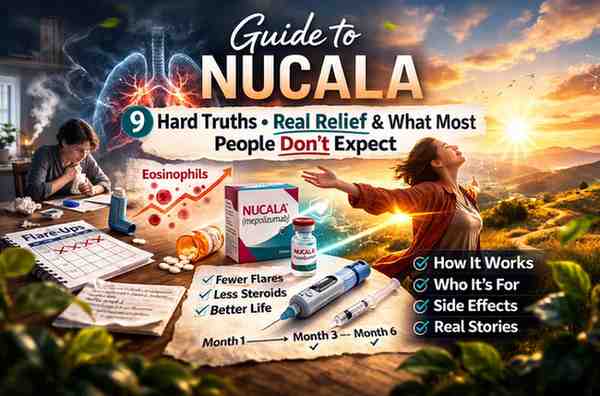

Honestly, most people I’ve watched start NUCALA don’t begin with excitement.
They start exhausted.
I’ve seen it in late-night messages. In clinic waiting rooms. In long voice notes from people who’ve tried every inhaler, every steroid taper, every “let’s just adjust this dose one more time.”
They don’t search for a Guide to NUCALA because they’re curious.
They search because they’re tired of flaring. Tired of prednisone. Tired of planning life around their lungs.
And from what I’ve seen, the frustration usually isn’t about the medication itself.
It’s about expectations.
So let’s talk about this properly. Not like a brochure. Not like a miracle story. Just what actually happens.
First: What NUCALA Actually Is (In Plain English)
NUCALA (mepolizumab) is a biologic medication used in the U.S. primarily for:
-
Severe eosinophilic asthma
-
Eosinophilic granulomatosis with polyangiitis (EGPA)
-
Hypereosinophilic syndrome (HES)
-
Chronic rhinosinusitis with nasal polyps
It works by targeting IL-5, a protein involved in producing eosinophils — the inflammatory cells that drive certain types of asthma and related conditions.
That’s the technical part.
Here’s the practical part:
It’s for people whose inflammation isn’t controlled by standard inhalers alone.
And that distinction matters.
Why People End Up Considering NUCALA
From what I’ve seen, there’s usually a pattern.
People try:
-
High-dose inhaled corticosteroids
-
LABA inhalers
-
Rescue inhalers more often than they admit
-
Multiple steroid bursts per year
-
ER visits they’re embarrassed about
Then someone finally runs bloodwork.
Eosinophils are elevated.
And suddenly the conversation shifts.
Not “adjust your inhaler.”
But “we may need something more targeted.”
That’s usually where NUCALA enters the picture.
The 9 Hard Truths About NUCALA Most People Don’t Hear Upfront
1. It’s Not Instant Relief
This honestly surprised me after watching so many people try it.
People expect a dramatic shift after the first injection.
That’s rarely how it plays out.
Most of the real improvement shows up between:
-
Month 2
-
Month 3
-
Sometimes Month 4
The first few weeks?
Often… quiet.
Subtle.
Sometimes discouraging.
And almost everyone I’ve seen struggle early thinks, “Maybe this isn’t working.”
Patience is harder than the injection.
2. It Works Best for the Right Type of Asthma
If someone doesn’t actually have eosinophilic-driven inflammation, NUCALA may not do much.
That’s not failure. That’s biology.
Most people I’ve worked with mess this up at first by assuming:
“Severe asthma = biologic will fix it.”
Not necessarily.
It works best when:
-
Blood eosinophils are consistently elevated
-
Steroid dependence is tied to eosinophilic flares
-
Exacerbations follow an inflammatory pattern
Without that? Expectations usually break.
3. The Real Win Is Fewer Flares — Not “Perfect Breathing”
People think success means:
“I’ll feel like I never had asthma.”
What I’ve seen?
Success looks more like:
-
Fewer ER visits
-
Fewer steroid bursts
-
Milder flare intensity
-
Better recovery time
It’s reduction, not elimination.
And that distinction changes everything emotionally.
4. The Injection Part Is Usually Easier Than Expected
Most patients fear the shot.
Almost all of them later say:
“That wasn’t the hard part.”
NUCALA is given:
-
Once every 4 weeks
-
Either in-office or via at-home injection (depending on approval and training)
The emotional weight before the first dose is often worse than the injection itself.
5. Insurance Is the Real Stressor (U.S. Reality)
Let’s be honest.
In the United States, access can be harder than biology.
I’ve seen more frustration around:
-
Prior authorizations
-
Step therapy requirements
-
Coverage denials
-
Delays in specialty pharmacy shipment
Than around side effects.
This is where most people burn out before they even begin.
6. Side Effects Exist — But They’re Usually Manageable
From what I’ve observed, common ones include:
-
Mild headache
-
Injection site reaction
-
Fatigue in the first 24–48 hours
Serious reactions are rare, but they are possible. Anaphylaxis is discussed for a reason.
This is not candy. It’s an immune-modifying medication.
But most people I’ve seen tolerate it better than long-term prednisone.
And that comparison matters.
7. Prednisone Tapering Is Emotional
I didn’t expect this to be such a common issue.
When people reduce steroids after starting NUCALA, their body sometimes feels… weird.
Mood shifts. Energy changes. Joint aches.
They assume:
“NUCALA is causing this.”
Often it’s steroid withdrawal.
That distinction gets missed a lot.
8. It Doesn’t Replace Good Asthma Hygiene
Almost everyone I’ve seen struggle long-term does this one thing wrong:
They stop respecting triggers.
NUCALA reduces eosinophilic inflammation.
It does not:
-
Cancel allergens
-
Erase viral infections
-
Override smoke exposure
-
Replace controller inhalers (unless advised)
It’s an addition. Not a lifestyle replacement.
9. The Biggest Shift Is Psychological
This part doesn’t get talked about enough.
When flares decrease, people slowly start planning life again.
Trips.
Exercise.
Sleeping without fear.
That shift? Quiet. But powerful.
Not dramatic.
Just… relief.
How Long Does NUCALA Take to Work?
Short answer (for most people I’ve seen):
-
Some subtle changes: 4–8 weeks
-
Clearer reduction in flares: 3–6 months
-
Full pattern stabilization: Around 6 months
If someone sees zero improvement by Month 4–6, that’s usually when providers reassess.
Not at Week 2.
That early panic causes unnecessary quitting.
Common Mistakes That Slow Results
Here’s what I’ve repeatedly seen go wrong:
-
Skipping doses due to scheduling chaos
-
Stopping inhaled controllers too early
-
Expecting instant breathing improvement
-
Ignoring lifestyle triggers
-
Not tracking flare frequency objectively
Tracking matters.
Memory lies. Data doesn’t.
Even simple notes like:
-
Rescue inhaler use per week
-
Night awakenings
-
ER visits
That helps determine if it’s working.
Who NUCALA Is NOT For
Let’s say this clearly.
It’s not ideal for:
-
Mild, well-controlled asthma
-
Non-eosinophilic asthma
-
People unwilling to commit to monthly injections
-
Those expecting immediate, dramatic change
-
Anyone hoping to replace all other management overnight
If someone hates consistency… this can feel like a burden.
Objections I Hear All the Time
“Is it worth it?”
If someone is:
-
Hospitalized multiple times per year
-
On frequent steroids
-
Living in flare anxiety
From what I’ve seen — yes, often worth exploring.
If asthma is already stable? Probably not necessary.
“What if it doesn’t work?”
Then it’s information.
Not failure.
There are other biologics (like dupilumab, benralizumab, omalizumab) used in the U.S. depending on phenotype.
This is about matching the right drug to the right inflammation pattern.
“Is it safe long-term?”
Long-term data in the U.S. has generally shown stable safety profiles.
That said:
All immune-modifying drugs require monitoring.
Blanket safety statements make me nervous.
It’s safe when appropriate and supervised.
Quick FAQ (For Real Search Intent)
Does NUCALA cure asthma?
No. It manages eosinophilic inflammation. It reduces exacerbations. It does not cure asthma.
Can I stop my inhaler after starting NUCALA?
Not automatically. That decision should be made with your provider after stable improvement.
How often is NUCALA taken?
Once every 4 weeks.
What happens if I miss a dose?
It may reduce effectiveness. Consistency matters. Talk to your provider for timing adjustments.
Can it worsen symptoms at first?
Not typically. But early changes may feel unclear, especially during steroid tapering.
Reality Check Section
This is where expectations usually break:
-
It’s not instant.
-
It’s not a cure.
-
Insurance can be exhausting.
-
Improvement is gradual.
-
You still need good asthma habits.
But.
For the right person?
It reduces chaos.
And that’s bigger than it sounds.
Practical Takeaways
If you’re considering NUCALA:
-
Confirm eosinophilic involvement with labs.
-
Prepare for a 3–6 month evaluation window.
-
Track symptoms objectively.
-
Don’t taper other meds too fast.
-
Stay consistent with injections.
-
Expect emotional adjustment during steroid reduction.
-
Give it enough time before judging.
What patience actually looks like?
It looks like:
-
Fewer flares before you notice easier breathing.
-
Gradual stability.
-
Quiet months instead of dramatic rescue moments.
Not fireworks.
Stability.
And I’ll say this gently.
Most people who regret trying NUCALA didn’t actually regret the medication.
They regretted expecting magic.
From what I’ve seen, the people who do best are the ones who treat it like a long game. They track patterns. They stay realistic. They work with their provider instead of against the process.
So no — this isn’t a miracle.
But I’ve watched enough people go from living in flare cycles to having steady months again.
And sometimes that shift — from chaos to predictability — is the real relief.