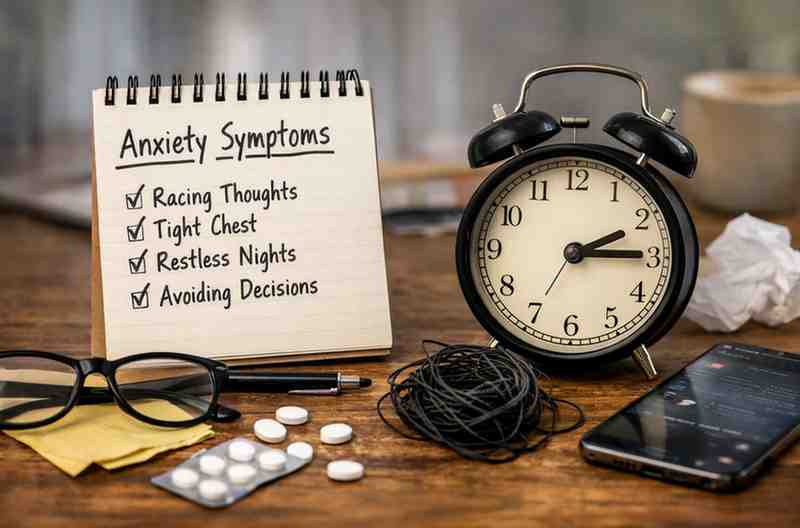
Honestly, most people I’ve watched try to “fix” anxiety hit a wall early. They read a checklist, nod along to the obvious stuff, and then quietly assume they’re the problem when things don’t change. The pattern I keep seeing →? Anxiety symptoms don’t always look like panic attacks and shaking hands. They show up sideways. In habits. In sleep. In how someone checks their phone ten times before sending a text.
I’ve sat next to friends on late-night drives who swore they were “fine” while white-knuckling the steering wheel. I’ve watched coworkers spiral over tiny mistakes. I’ve helped people track what actually changed when they stopped dismissing what their body was trying to say. From what I’ve seen, naming anxiety symptoms accurately is the first small win that opens the door to relief. Not cure. Relief. There’s a difference.
What people usually think anxiety symptoms look like (and where that falls apart)
Most folks start with a narrow picture:
-
racing heart
-
sweaty palms
-
feeling scared for “no reason”
-
panic attacks
Those happen. Sure. But almost everyone I’ve seen struggle with this does this one thing wrong: they wait for anxiety to look dramatic before taking it seriously.
What actually shows up, over and over:
-
Constant scanning for what might go wrong
-
Avoiding decisions because choosing feels risky
-
Body stuff: jaw pain, tight shoulders, stomach flips
-
Over-preparing to the point of exhaustion
-
Sleep that looks fine on paper but feels shallow and unrestorative
This honestly surprised me after watching so many people try to self-diagnose. They miss their own anxiety symptoms because they don’t match the dramatic version they expect.
The anxiety symptoms that fly under the radar (but cause the most damage)
These are the ones people don’t label as anxiety at first. They just call it “my personality” or “stress.”
1) Decision paralysis
From what I’ve seen, this is huge. People freeze on small choices—what to eat, when to reply, whether to say yes. It looks like being indecisive. It feels like safety-seeking.
2) Replaying conversations
Almost everyone I’ve worked with mess this up at first. They think rumination is problem-solving. It’s not. It’s anxiety looping in a trench coat.
3) Hyper-responsibility
“I’ll just handle it.”
“I don’t want to burden anyone.”
This one burns people out quietly.
4) Body alarms without a clear threat
Chest tightness. Nausea. Headaches.
People chase physical explanations for months before realizing anxiety symptoms → can live in the body.
5) Avoidance dressed up as ‘being practical’
Not applying. Not going. Not trying.
It feels rational in the moment. The long-term effect is a smaller life.
Why people try to ignore anxiety symptoms at first
-
They don’t want a label.
-
They’ve normalized discomfort.
-
They’re scared of what it means.
-
They think it’ll pass if they’re “strong enough.”
Most people I’ve worked → with had a phase of toughing it out. It usually made things louder, not quieter.
What consistently works (vs. what looks good on paper)
This is where expectations usually break.
What looks good on paper but fails in real life
-
Forcing positivity
-
Cutting caffeine and expecting that to fix everything
-
One-size-fits-all breathing techniques
-
Waiting to “feel ready”
I didn’t expect this to be such a common issue: people stack tactics without understanding why their anxiety symptoms show up.
What actually works more often than not
From what I’ve seen:
-
Pattern tracking
Not journaling everything. Just noticing triggers and responses. -
Naming the symptom out loud
“This tight chest is anxiety.”
The nervous system calms a little when it’s not confused. -
Reducing avoidance, gently
Tiny exposures. Not dramatic leaps. -
Externalizing the problem
Talking about it with one safe person. -
Building one boring routine
Sleep, food, movement. Not glamorous. Weirdly effective.
Cause → effect → outcome shows up clearly here:
When people name anxiety symptoms accurately → they stop fighting ghosts → their responses get calmer → symptoms lose some power.
How long does it take to see any relief?
Short answer: faster than people expect for small relief →, slower than people want for big change.
From what I’ve seen:
-
1–2 weeks: people feel less confused
-
3–6 weeks: symptoms feel more predictable
-
2–3 months: some patterns lose intensity
-
Longer: deeper habits shift
If someone expects anxiety symptoms to vanish in days, they usually quit early. That’s where expectations break.
The mistakes that slow everything down
Almost everyone I’ve seen struggle with this does one of these:
-
Chasing perfection
-
Trying ten tools at once
-
Hiding symptoms to look “normal”
-
Judging themselves for having anxiety symptoms
-
Waiting for motivation instead of starting messy
This honestly surprised me after watching so many people try to “do it right.” There is no clean version of learning your patterns.
Mini-stories I keep seeing repeat
-
The friend who thought it was “just burnout” until panic hit in grocery store lines.
-
The colleague who managed fine at work but unraveled at home.
-
The student who aced exams but avoided applying for opportunities because the body said “danger.”
Different lives. Same anxiety symptoms. Different masks.
Is it worth paying attention to anxiety symptoms early?
Short answer: yes. Not because it fixes everything. Because it shrinks the problem to something workable.
What experienced folks would do differently:
-
They wouldn’t wait for a breakdown.
-
They’d name symptoms earlier.
-
They’d ask for help sooner.
That early naming is often the first relief people → feel.
Objections I hear all the time (and what tends to happen)
“This is just how I am.”
Sometimes. But from what I’ve seen, personality doesn’t cause stomach flips before every email.
“Other people have it worse.”
True. Still doesn’t mean your anxiety symptoms aren’t real.
“I don’t want to depend on tools forever.”
Most tools are training wheels. Not lifelong crutches.
“What if I try and it doesn’t work?”
Then you learned something. That’s not nothing.
Reality check (what this is NOT for)
This approach is probably not for you if:
-
You want instant calm
-
You hate tracking patterns
-
You refuse any outside support
-
You expect one technique to fix everything
Also, sometimes anxiety symptoms overlap with medical issues or deeper mental health conditions. When things don’t shift, getting professional help is a real option. Not a failure.
Short FAQ (for the questions people actually ask)
Are anxiety symptoms always mental?
No. The body is often the loudest messenger.
Can anxiety symptoms come and go?
Yes. They flare with stress, change, uncertainty.
Do symptoms mean something is wrong with me?
From what I’ve seen, they usually mean your nervous system is trying to protect you—badly timed, but protective.
Is it worth trying small changes first?
Almost always. Small wins build momentum.
Practical takeaways (the boring, useful stuff)
What to do
-
Notice patterns, not just episodes
-
Name anxiety symptoms out loud
-
Try one small exposure
-
Keep one steady routine
What to avoid
-
Waiting for motivation
-
Comparing your timeline to others
-
Treating symptoms like enemies
What to expect emotionally
-
A weird sense of grief for lost time
-
Small wins that don’t feel dramatic
What patience actually looks like
-
Repeating simple things
-
Getting bored with basics
-
Watching intensity drop slowly
No guarantees. No hype. Just patterns I’ve seen hold.
Still, I won’t pretend this is neat. People backslide. They ghost their own plans. They get tired of paying attention to anxiety symptoms. Then something clicks again. That back-and-forth is part of it.
So no — this isn’t magic. But I’ve watched enough people finally stop feeling stuck once they stopped fighting their symptoms and started listening to them. Sometimes that shift alone is the real win.