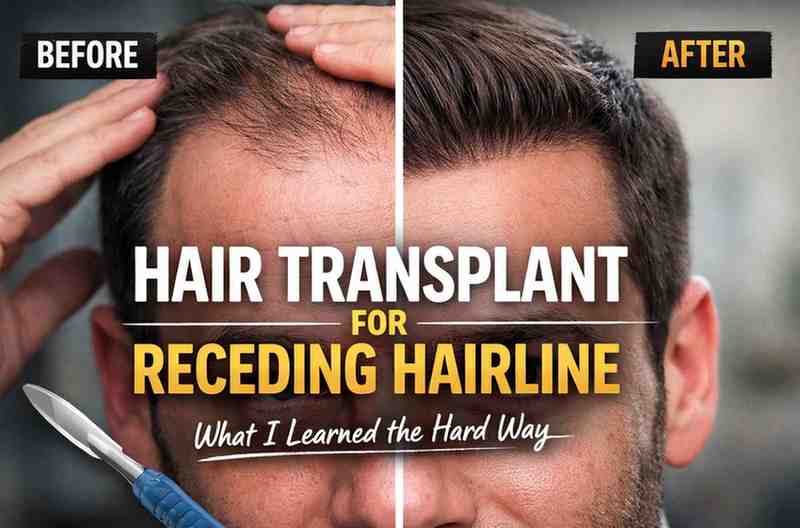
I’m just gonna say it: watching your hairline creep back is one of those tiny everyday heartbreaks that no one prepares you for.
It’s slow at first. Annoying. Funny, even.
Then one random morning, you’re brushing your teeth and the bathroom light hits your forehead at that evil angle… and you suddenly look like some “before” photo on a clinic website.
That was me.
And honestly, getting a hair transplant for a receding hairline wasn’t part of my life plan at all. I never even thought I’d google the words “Norwood scale” or know what graft density meant. But life is weird like that.
Not gonna lie… I spiraled a bit.
Tried covering it with different hairstyles.
Tried pretending it didn’t bother me.
Tried convincing myself that “maybe no one notices.”
People notice.
Or maybe it’s just you noticing.
Either way, it messes with your mood in a way you don’t talk about out loud.
So yeah. This is my very long, slightly chaotic, very honest story of what it was actually like to go through a hair transplant, why I almost backed out twice, the dumb mistakes I made (and you should avoid), and what I’d tell anyone in the U.S. thinking about fixing their receding hairline the same way.
I’m not a doctor. I’m just someone who did it, survived it, kinda fumbled through it, and learned what actually matters.
Grab a snack. This might get long.
Why I Even Considered a Hair Transplant (A.K.A. The “Oh Crap, This Is Real” Phase)
The first time my barber said, “Your hairline’s thinning a bit,” I laughed it off.
The third time he said it, he did that awkward cough-barber shuffle where they pretend they didn’t say it.
By the fifth time, I was googling pictures of celebrities who magically “aged backward.”
I tried everything before considering surgery:
-
biotin gummies (tasted good, did nothing)
-
rosemary oil (smelled nice, made my pillow oily)
-
minoxidil (patchy results, messy routine)
-
stress-lowering habits (lol)
-
changing shampoos, conditioners, moon-water rituals… whatever
Nothing stopped the slow retreat happening at my temples.
There’s a point where “receding hairline” stops being a phrase and starts being a tiny identity crisis.
That’s where I was.
And honestly, the thing that pushed me over the edge?
A random selfie.
I took it in a parking lot. The sun was right overhead.
I looked at it later and legit thought, “Whose forehead is that?”
That’s when the idea of a hair transplant for a receding hairline stopped feeling extreme and started feeling… maybe necessary.
What I Totally Misunderstood at First (Please Don’t Repeat My Stupidity)
I’m kinda embarrassed to admit this, but here are the things I believed at first:
❌ 1. I thought hair transplants were instant.
Nope.
They’re slow. Painfully slow. “Why did I do this” slow.
You’ll doubt yourself many times.
❌ 2. I thought more grafts = better results.
Too many grafts at the front can look fake.
Density matters.
Direction matters more.
❌ 3. I thought I’d look good in a month.
Try 8–12 months.
The first 3 months are pure chaos.
Your transplanted hair falls out.
Your emotions fall out too.
❌ 4. I assumed every doctor would give me an honest plan.
Some clinics straight-up sell hope like it’s on clearance.
Find someone who tells you “no” at least once.
❌ 5. I thought it was one-and-done.
Future hair loss continues unless you manage it.
This honestly surprised me.
The Consultation (Where I Learned More in 20 Minutes Than 2 Years of Googling)
The doctor looked at my hairline for five seconds and said,
“You’ve been losing hair for longer than you admit.”
Hurtful.
But accurate.
He explained a bunch of things that finally clicked:
Your receding hairline isn’t random.
It’s genetics + hormones + time + stress + random life chaos.
A hair transplant won’t fix all hair loss.
It only fixes the front.
You still need to protect the rest.
The donor area matters more than the balding area.
This was new to me.
Your “donor” hair (usually the back of your head) is like the gold reserve of your scalp.
If you run out of it, that’s it.
Game over.
Receding hairline restoration is an art.
He showed me how the angles matter — even a few degrees can make hair look weird or “wig-like.”
I felt both terrified and calmer afterward.
Like I finally understood what I was signing up for.
The Day of the Procedure (AKA the Longest, Weirdest Day Ever)
It’s not painful-painful.
It’s more like “my scalp is getting unplugged and replanted like a garden” energy.
The numbing shots sting.
I won’t lie.
They suck for 20 seconds, then you feel nothing.
The sound of extraction is bizarre.
It’s like tiny crunches.
The first time I heard it, I wanted to laugh and gag at the same time.
The hours drag on.
I watched two movies.
Listened to music.
Scrolled.
Took micro-naps.
The team joked around.
It felt more like a long tattoo session than “surgery.”
Then you see your new hairline drawn on your head.
This is the moment that gets emotional.
It’s the first spark of hope after months of shame.
Still, by the time I got home, I felt like my forehead lost a boxing match.
Swollen. Puffy.
Not cute.
The First Week (Where I Questioned Every Life Decision)
If there’s one part of this whole journey I truly hated, it was the first week.
Let me paint the picture:
-
You sleep sitting up like a vampire.
-
Your forehead swells downward so you look like a cartoon character.
-
You mist water on your new grafts every hour.
-
You’re scared to sneeze in case a graft pops out (unlikely but the fear is real).
-
Your scalp looks like a pixelated video game map.
Showering is a mission.
You pat, you dab, you whisper to your scalp like it’s a fragile newborn.
This part sucks.
No point sugarcoating it.
But it passes.
The Shedding Phase (Where Your Heart Breaks Again)
Around week 3–6, the transplanted hair falls out.
Yes. Falls. Out.
And you know it’s normal.
You know it’s expected.
Doctors warn you about it.
But when you see little hairs in your sink, your soul leaves your body for a second.
This was the “not gonna lie, did I just waste a ton of money?” phase.
I googled “failed hair transplant” way too often.
I had phantom graft loss dreams.
I checked my hairline 20 times a day.
Still, this is all part of the process.
It grows back.
Eventually.
Months 3–5 (The Ugly Duckling Era)
Patchy growth.
Random sprouts.
Uneven texture.
Stray hairs doing their own thing.
This part is humbling.
People don’t warn you about how awkward it looks.
You tell yourself it’s fine.
But inside you’re low-key panicking.
These months tested my patience.
I messed this up at first by obsessively comparing my photos to Reddit and YouTube.
Worst idea ever.
Everyone grows at different rates.
Month 6 (First Moment of Real Hope)
One random morning, I looked in the mirror and thought:
“Wait… something’s different.”
The hairline looked softer.
More natural.
Less see-through.
My barber noticed first.
That’s when I knew it was actually happening.
Month 6 felt like finding $20 in your old jeans.
Small joy.
Big relief.
Month 9–12 (The “Damn, I Look Like Myself Again” Phase)
This is where it hits.
The density picks up.
The texture matches your real hair.
The shape fills in.
Your face looks balanced again.
I didn’t expect how emotional this part would be.
I felt younger.
More confident.
Less tense in photos.
Less self-conscious in daylight (huge win).
It wasn’t perfect, but it felt right.
What Actually Worked for Me (Only Sharing What I Tried Personally)
Take this with a grain of salt — just my own experience.
1. Keeping expectations realistic
This is a cosmetic improvement, not a rewind on life.
2. Choosing a clinic that wasn’t cheap
The cheap places tried to oversell.
The right doctor talked me out of unnecessary grafts.
3. Using finasteride to protect future hair
You don’t have to.
But I did because I didn’t want more loss behind the transplant.
4. Not touching, scratching, or messing with grafts early
This matters.
So much.
5. Sleeping elevated
Annoying but worth it.
6. Microfiber pillowcase
Helps reduce friction.
7. Stopping doom scrolling
Reddit comparisons made everything 10× harder.
8. Accepting that results take a year
This saved my sanity.
What I Wish Someone Told Me Before I Started
I’m putting these here because maybe one of them will save someone from losing their mind like I almost did.
You’re gonna feel insecure during the recovery.
Everyone does.
It’s temporary.
People don’t notice as much as you think.
Most are wrapped up in their own life.
Your new hairline will look weird before it looks good.
Normal.
Your confidence will come back slowly.
And it feels so damn good when it does.
The transplant fixes the front, not the whole story.
Maintenance matters.
It’s emotional.
Way more emotional than I expected.
Honest Pros & Cons (From Someone Who Actually Went Through It)
Pros
-
younger look
-
better symmetry
-
natural appearance
-
permanent result
-
boosts confidence
-
makes styling fun again
-
photos become less stressful
-
feels like getting part of yourself back
Cons
-
expensive
-
long recovery
-
emotional rollercoaster
-
shedding phase sucks
-
not instant
-
risk of future thinning
-
requires aftercare
Would I do it again?
Yeah.
But smarter.
If You’re in the U.S. and Thinking About It… These Are My Real Takeaways
1. Pick skill, not price.
Cheap clinics gamble with your donor hair.
It’s not unlimited.
2. Talk to 3–4 doctors.
You’ll know who feels right.
3. Don’t rush.
A receding hairline can be fixed.
A bad transplant takes years to fix.
4. Expect a year-long journey.
Anything less is false advertising.
5. Don’t chase “teenager hair.”
Go for natural.
Trust me.
6. You don’t owe anyone an explanation.
It’s your face.
Your choice.
So yeah… that’s my whole messy saga.
A hair transplant for a receding hairline wasn’t a magic fix.
It didn’t make life perfect.
It didn’t erase stress or change my personality.
But it gave me back something small and important — a version of my face that felt like me.
That alone made the whole thing worth it.
If you go through with it, I hope you get that same moment — that quiet little “oh wow, I’m back” feeling.
It hits different.
And if you’re still deciding?
Take your time.
Ask questions.
Do it when you’re ready.
You’ll know when that moment is.