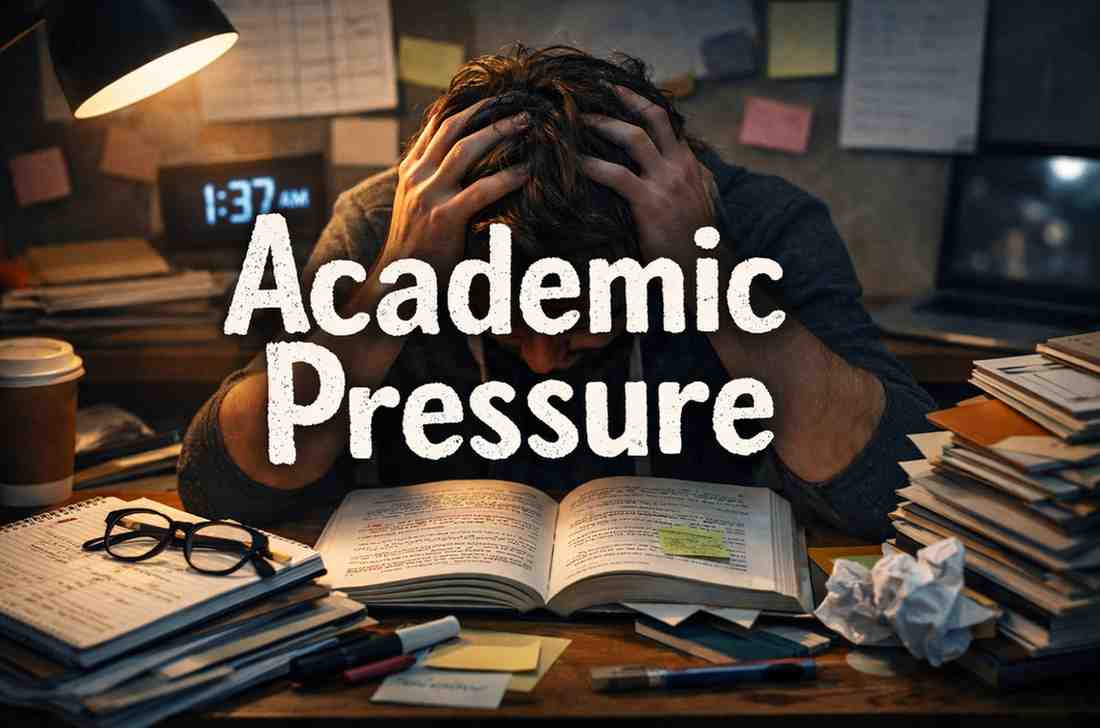
I Didn’t Even Realize It Was Academic Pressure at First
Not gonna lie… for the longest time, I thought I was just “bad at handling stress.”
That’s what everyone said, anyway.
I was doing fine on paper. Grades weren’t terrible. Teachers weren’t yelling at me. My parents weren’t exactly forcing me to study 24/7. So when I started feeling tired all the time, snappy over small things, and weirdly empty after exams, I blamed myself.
Lazy. Weak. Dramatic.
It wasn’t until one random night — around 1 a.m., scrolling through forums instead of sleeping — that I saw someone describe academic pressure in a way that hit a nerve. They weren’t talking about grades. They were talking about constant mental weight. The feeling that you’re always behind. Always being evaluated. Always one mistake away from “falling off.”
That was it.
I kinda just sat there like… oh. So it’s not just me.
The Pressure Didn’t Come From One Place (That Was the First Mistake)
Here’s what I misunderstood early on: I thought academic pressure came from school.
Like, teachers. Exams. Deadlines.
Turns out, that was only a piece of it.
From what I’ve seen — and lived through — it usually stacks up from a bunch of directions:
-
Expectations from family (even unspoken ones)
-
Comparison with classmates or friends
-
Social media highlight reels
-
Fear of disappointing someone
-
Fear of wasting money (especially in the US & Canada, where tuition is… yeah)
-
The idea that one bad semester can “ruin everything”
I kept trying to fix → one thing at a time. Study harder. Wake up earlier. Cut distractions.
But the pressure didn’t go away. It just… changed shape.
That was frustrating. And honestly, confusing.
What Academic Pressure Actually Felt Like (For Me, At Least)
People describe it like stress. Or anxiety. Or burnout.
For me, it was quieter than that. Sneakier.
It looked like:
-
Sitting down to study and staring at the page for 20 minutes
-
Feeling guilty when I rested
-
Feeling guilty when I didn’t rest
-
Doing “productive” things all day and still feeling behind
-
Panicking over small assignments more than big exams
-
Feeling relieved when something got canceled… then ashamed for feeling relieved
I didn’t cry every day. I wasn’t having breakdowns in class.
Which made it easier to ignore.
That’s the dangerous part. Academic pressure doesn’t always scream. Sometimes it just hums in the background until you’re exhausted.
“Just Work Harder” Made Everything Worse
This might sound obvious now, but I messed this up badly.
Every time things felt heavy, I responded the same way: push harder.
More hours. Less sleep. Fewer breaks. More caffeine. Less talking about it.
That worked… briefly.
Then it didn’t.
My focus dropped. I forgot things I knew. I reread the same paragraph five times. Tests felt harder even when the material wasn’t.
And the worst part? I started tying my self-worth to output.
Good grade = I’m okay
Bad grade = something’s wrong with me
That mindset alone can crush you.
If I could go back, I’d tell myself this earlier: effort doesn’t cancel pressure. Sometimes it multiplies it.
The One Shift That Actually Helped (Kinda Surprised Me)
This part surprised me, honestly.
What helped wasn’t a fancy planner or study hack. It was separating learning from proving.
I realized most of my stress came from always feeling evaluated — even when I was just studying alone. Like every session was a test.
So I started doing something small:
-
Some study time was “no outcome allowed”
-
No grades. No timers. No expectations
-
Just reading, watching, or practicing for understanding
At first, it felt wrong. Like I was slacking.
But slowly… the pressure eased. Not gone. Just quieter.
I still worked hard. I just stopped treating every minute like a performance.
That change alone made academic pressure more manageable than any productivity trick I tried.
What Didn’t Work (So You Don’t Waste Time Like I Did)
Let me save you some frustration.
Here’s what didn’t help me, even though everyone recommends it:
-
Perfect schedules — life never followed them
-
Motivational quotes — felt fake when I was exhausted
-
Comparing study routines — instant stress
-
Ignoring emotions — they come back louder
-
Waiting for a break to recover — pressure doesn’t magically stop
I kept thinking relief would come later. After exams. After the semester. After graduation.
But pressure just moves the finish line.
Learning to manage it during the process mattered way more.
Academic Pressure Hits Different in the US & Canada
This part doesn’t get talked about enough.
In the US and Canada, education is expensive. That alone changes the emotional weight of school.
There’s this constant thought in the back of your head:
“This costs money. I can’t mess this up.”
Add student loans, competitive job markets, and the whole “your degree defines your future” narrative… yeah. That’s a lot.
I noticed friends from different systems experienced stress differently. For us, failure didn’t just feel personal — it felt financial.
That doesn’t mean you’re weak for feeling overwhelmed. It means the system is heavy.
Recognizing that helped me stop blaming myself so much.
Don’t Make My Mistake: Ignoring the Early Signs
I wish I paid attention sooner.
The signs were there:
-
Trouble sleeping before minor deadlines
-
Losing interest in subjects I liked
-
Feeling numb instead of stressed
-
Dreading school even on “easy” weeks
I brushed it off. Told myself it was normal.
Some stress is normal. Constant pressure isn’t.
If I had acknowledged it earlier, I could’ve adjusted sooner instead of waiting until I was burnt out.
So yeah — if something feels off, trust that feeling.
Practical Things That Actually Helped (No Fluff)
Here’s what worked for me, in real life, not theory:
-
Defined “enough” for each task
-
Separated rest from reward (rest because you’re human)
-
Talked about it casually instead of making it dramatic
-
Stopped glorifying exhaustion
-
Focused on progress, not position
None of these fixed everything. But together? They made things lighter.
And lighter was enough.
This Isn’t Magic (And I’m Not Pretending It Is)
Quick reality check.
This isn’t a cure. Academic pressure didn’t disappear. It still shows up during exams or big decisions.
But now, it doesn’t run the show.
I know when to push. When to pause. When to ask for help. When to lower the bar without guilt.
That balance took time. And mistakes. And a lot of unlearning.
If you’re still in the thick of it, that’s okay. You’re not behind.
You’re human.
FAQs — What I’ve Learned Messing With This Myself
Is academic pressure the same as stress?
Not exactly. Stress comes and goes. Academic pressure feels constant, like a background weight that never fully lifts.
How long does it take to feel better?
For me, weeks — not days. Small changes added up slowly. There wasn’t a single “aha” moment.
Can academic pressure affect mental health?
From my experience, yes. Especially if ignored. It can mess with sleep, confidence, and motivation.
Does taking breaks actually help, or just delay work?
Breaks helped me work better. Without them, I just stared at my screen longer.
Would I do anything differently now?
I’d talk about it sooner. And I’d stop treating struggle like a personal failure.
I used to think academic pressure was just part of the deal. Something you endure, survive, and forget.
Now? I see it differently.
It’s not a badge of honor. It’s a signal. One worth listening to.
So no — this isn’t some overnight fix. But learning to work with the pressure instead of fighting it?
Yeah. That changed everything for me.